Experience our new Lafayette showroom — Now Open! Come Visit Us -->

12 Person Cabin Tent: The Complete 2026 Buyer’s Guide

A big camping trip often starts with a simple thought. One tent would be easier. Keep the family together, keep the gear in one place, and avoid the headache of managing several smaller shelters across a campsite.
That idea is exactly why so many people start looking for a 12 person cabin tent. The name sounds reassuring. It suggests plenty of room, easy sleeping arrangements, and a comfortable group setup for a long weekend outdoors. In practice, though, this category works very differently from the label on the box.
A giant cabin tent isn't just a bigger version of a regular family tent. It's closer to a portable basecamp. It asks for more planning, more campsite awareness, and more honesty about how people sleep, store gear, and move around. Before a trip, many families also sort through practical planning lists like these family camping essentials, because comfort problems usually start long before the tent goes up. For groups thinking beyond the campsite itself, even home setup ideas like backyard fun ideas for family gatherings can help clarify what kind of space people really need to relax together.
Table of Contents
- Your Guide to Group Camping Comfort
- What 12-Person Really Means for You
- Key Features Beyond Floor Space
- A Practical Guide to Calculating Tent Capacity
- Campsite Strategy for Your Tent Palace
- Keeping Your Investment Safe and Dry
- FAQs and Essential Accessories
Your Guide to Group Camping Comfort
A common scene plays out the same way. A family books a campsite, counts heads, and realizes that separate tents sound messy. Parents want younger kids close. Grandparents want a chair, not a crawling-height shelter. Teenagers want some privacy, but not enough to sleep across the campground. A giant cabin tent looks like the tidy answer.
Then reality arrives at camp.
A large duffel comes out of the vehicle. The footprint on the ground looks much bigger than expected. Sleeping spots that seemed generous on a product page suddenly have to share space with bags, shoes, blankets, cool-weather layers, and the daily clutter that shows up whenever several people live in one shelter for a few days. The trip can still go well, but only if expectations match the kind of shelter this really is.
A 12 person cabin tent works best when the group treats it like a shared living space with sleeping zones, not like a box that magically fits twelve full-size campers in comfort.
That distinction matters because this tent category is built for standing room, separation, and convenience, not for squeezing in the maximum possible headcount. People shopping for a first oversized tent often focus on the biggest number first. Experienced campers usually look at comfort, layout, weather limits, setup style, and campsite fit before anything else.
Why trips go wrong with giant tents
Most frustrations come from a few predictable problems:
- Overestimating capacity. Families count people, not bedding size and gear bulk.
- Underestimating setup space. A large tent needs a clear, flat area.
- Treating comfort features as extras. Room dividers, door placement, and airflow often matter more than the headline capacity.
- Assuming “instant” means effortless. Fast frame systems help, but a huge shelter still takes coordination.
A good buying decision starts by ignoring the most flattering marketing assumption and thinking like a campsite planner instead.
What 12-Person Really Means for You
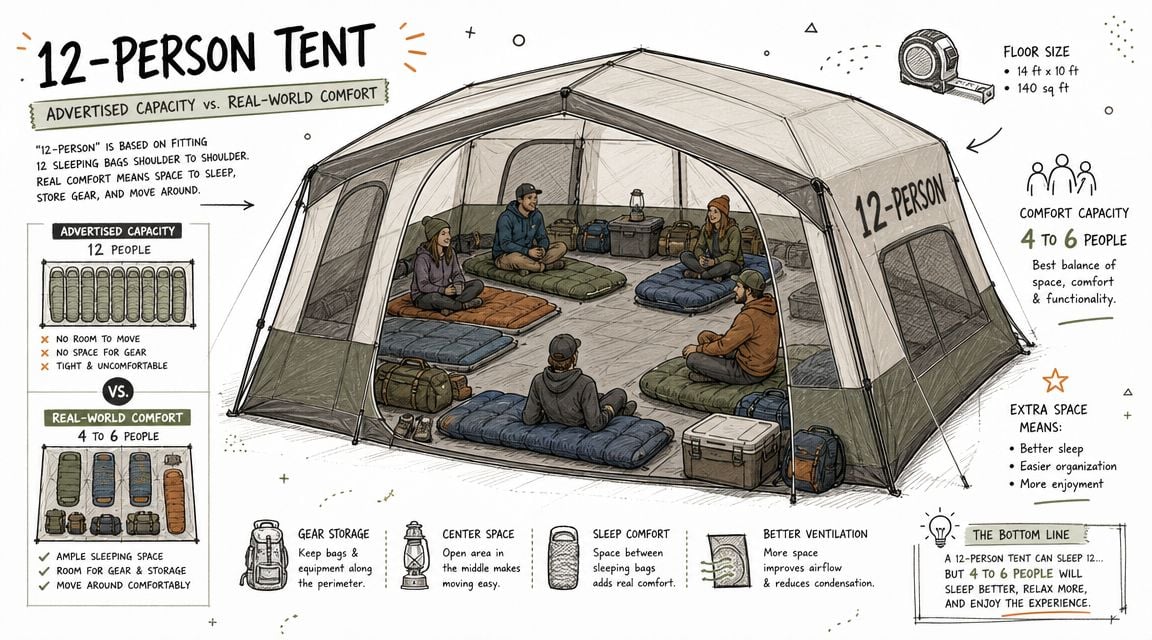
The phrase 12 person cabin tent sounds precise, but it usually isn't a comfort promise. It is closer to a maximum occupancy label based on tight sleeping arrangements. That difference is where many first-time buyers get tripped up.
Why the label misleads buyers
A practical view is much more useful than the box claim. Many 12-person cabin tents are sold for large groups, but a more realistic way to think about them is as a 6- to 8-person family basecamp, especially when campers use queen air mattresses, cots, or room dividers for privacy, as noted in this real-world capacity discussion of a 12-person family cabin tent.
That doesn't mean the tent is misleading in a dishonest way. It means the rating assumes a stripped-down sleeping layout that most families typically don't use. A sleeping bag grid is one thing. A family with raised bedding, duffels, shoes by the door, and room to change clothes is something else entirely.
People who want a comfortable setup should think in zones:
- Sleeping zone for bodies and bedding
- Walkway zone so nobody climbs over each other at night
- Gear zone for bags, jackets, lanterns, and loose items
- Privacy zone if the group includes mixed ages or multiple households
That approach turns a “12-person” label into a realistic trip plan.
For families using air beds, a size visual like these air mattress dimensions and fit examples can help clarify why floor plans disappear faster than expected.
What makes a cabin tent different
The word cabin matters as much as the number. Cabin tents use a shape built around straighter walls and more vertical interior space. That gives campers one of the biggest advantages in this category. People can stand up, move around more naturally, and divide the interior into room-like areas.
Practical rule: Buyers should judge a giant cabin tent by how livable it feels for a smaller group, not by how many bodies could theoretically be lined up on the floor.
This is why many families end up happy with a large tent once they stop expecting dorm-style occupancy. A roomy shelter for six, seven, or eight people can feel luxurious. The same shelter packed wall-to-wall can feel stressful before the first night is over.
Key Features Beyond Floor Space
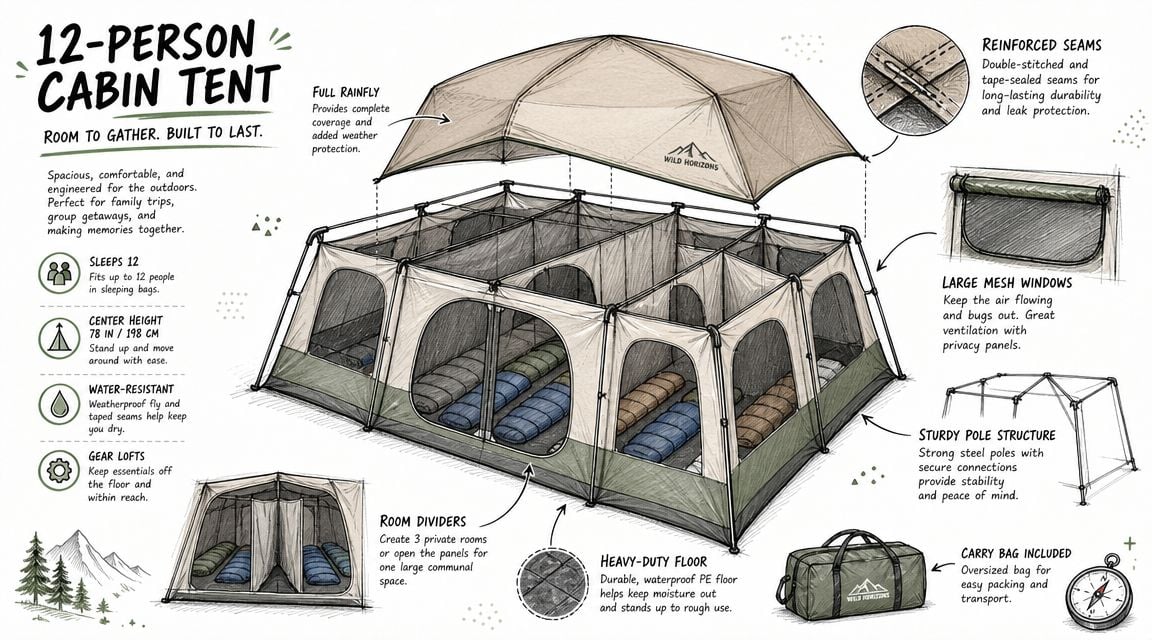
The first figure that stands out is sleeping capacity. The smarter place to start is the spec sheet behind it. A typical model in this class has about 180 square feet of floor space with dimensions near 18 x 10 feet, a peak height of 80 inches, and room for 3 queen-size beds, according to this 12-person instant cabin tent specification page.
That sounds spacious, and it is. But floor space alone doesn't tell a buyer whether the tent will feel comfortable during a damp weekend, a hot afternoon, or a rushed arrival at camp.
Reading the layout first
An oversized tent works best when the layout matches the group.
A long rectangle can be excellent for families who want sleeping areas on each end and a central walkway. Divided rooms help when kids go to bed earlier than adults. Multiple doors matter more than many buyers expect because they reduce the nightly traffic jam that starts when one person needs to get out.
The best layout questions are simple:
- Where will bags go if the weather turns wet?
- Can sleepers reach the door without climbing over bedding?
- Do dividers create privacy, or do they just chop up airflow?
- Will tall campers stand comfortably in the center?
People shopping for campsite comfort often compare these tradeoffs with other outdoor-living decisions, and guides on choosing outdoor furniture for comfort and space can sharpen the same habit of measuring livability, not just overall size.
Weather specs that matter
Weather performance in this category usually depends less on sheer size and more on the details of fabric and construction. The same specification page lists 1200 mm water resistance and taped seams, which points to a tent built for common rain rather than severe, prolonged storm use.
That matters because many buyers read “weather resistant” as if it means all-conditions confidence. It doesn't.
A few features deserve close attention:
- Water resistance rating. This gives a rough sense of rain handling.
- Taped seams. These help prevent water from entering where panels meet.
- Rainfly coverage. More coverage usually means better protection, especially around doors and windows.
- Vent placement. Good airflow reduces interior dampness and helps manage condensation.
A giant family tent can stay comfortable in ordinary wet weather, but buyers should read rain specs as limits, not as a license to ignore site drainage and storm exposure.
Setup details that change the experience
Setup style often determines whether the tent feels family-friendly or exhausting. In a widely documented example, a 12-person instant cabin design uses pre-attached poles and is described as ready in as little as 2 minutes, with review material also describing setup in under 2 minutes, according to this overview of the modern 12-person tent segment.
That speed is helpful, but it doesn't remove the challenges of handling a very large structure. A fast frame still needs clear ground, correct orientation, and careful staking. Instant systems reduce complexity. They don't reduce size.
Features that usually improve the camping experience include:
- Pre-attached poles for simpler setup.
- Room dividers for mixed-age groups.
- Large doors and multiple windows to ease traffic and airflow.
- A sensible storage bag that doesn't turn repacking into a wrestling match.
A Practical Guide to Calculating Tent Capacity
Shoppers often ask one question in the wrong way. Instead of asking, “How many people does this tent sleep?” the better question is, “How many people can this tent support comfortably with the bedding and gear this group uses?”
A simple comfort check
Capacity labels are usually based on sleeping-bag-only occupancy. In one documented example, a tent designed for 12 people in sleeping bags fits only six people comfortably using air mattresses, showing how usable capacity can drop by about half once bedding volume enters the picture, according to this manufacturer documentation on sleeping bag versus air mattress capacity.
That single detail explains a lot of frustration.
A practical comfort check uses four decisions:
- Count actual sleepers, not occasional visitors.
- List bedding type. Sleeping pads take less space than queen air mattresses or cots.
- Decide where gear lives. If bags stay inside, they need floor area.
- Add breathing room. A tent should allow changing clothes, night movement, and bad-weather downtime.
If a family plans to bring raised bedding, a gear pile for each person, and separate sleep zones, the comfortable group size drops quickly. That isn't a flaw in the tent. It's the normal effect of turning raw floor area into a livable space.
Real-World Tent Capacity Guide
| Advertised Capacity | Sleeping Bags Only (Minimal Gear) | Air Mattresses/Cots (Comfortable) | Luxury Basecamp (Ample Gear & Living Space) |
|---|---|---|---|
| 12 people | Fits the stated label in a tight layout | Often closer to 6 people | Often best for 6 to 8 people with room dividers and gear |
| 12-person cabin style | Best for simple overnight sleeping | Better for families using real bedding | Best treated as a shared basecamp |
If a group wants comfort, a walkway, and indoor gear storage, the advertised number should be treated as the ceiling, not the goal.
This table won't replace a floor-plan sketch, but it gives buyers a better starting point than the package claim. For a family of six, a 12 person cabin tent may be exactly right. For twelve full-size campers with luggage, it usually won't be.
Campsite Strategy for Your Tent Palace
A large cabin tent can feel wonderfully comfortable once it's standing. Getting there takes planning. The biggest setup mistake isn't poor pole technique. It's choosing a site that doesn't suit the shelter.
Choosing a site that actually fits
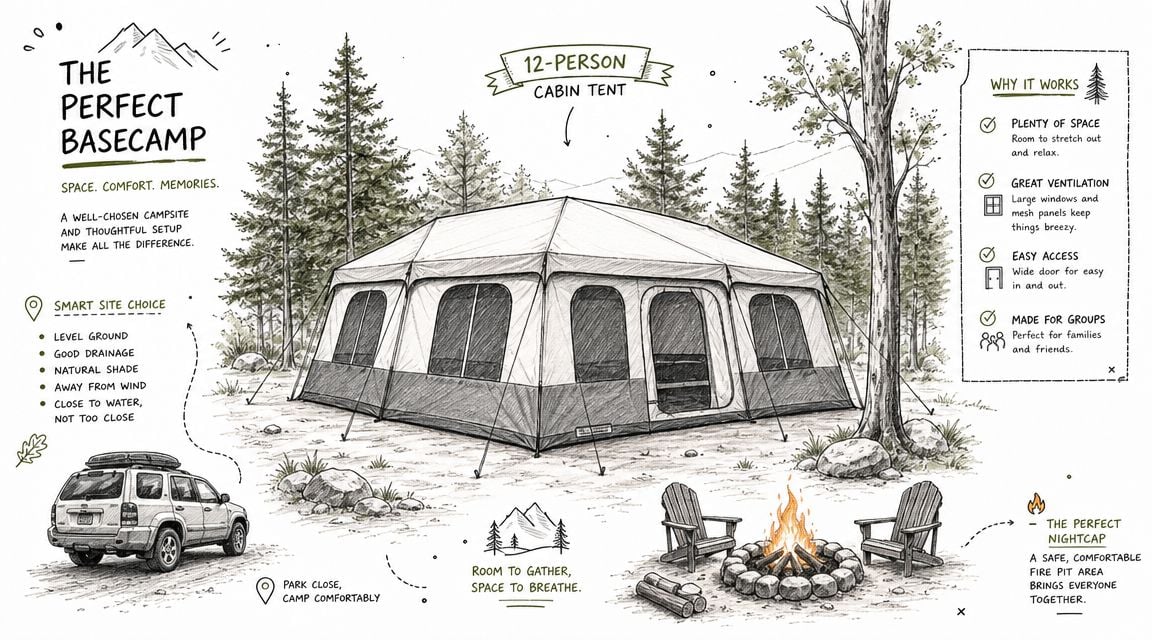
A tent with a large rectangular footprint needs more than an open-looking campsite. It needs a patch of ground that is flat enough, long enough, and clear enough for both the tent body and the surrounding stake-out area. Trees, roots, slopes, and oddly placed picnic tables can turn a promising site into a poor match.
The easiest way to avoid trouble is to think beyond the tent floor.
Look for:
- Clear perimeter space so stakes and guylines aren't forced into awkward angles
- Good drainage so runoff doesn't move toward the sleeping area
- Natural wind breaks such as terrain or well-placed vegetation
- Door orientation that supports traffic flow between tent, vehicle, and cooking area
Families who enjoy making outdoor spaces more functional often already think this way at home, and planning ideas for outdoor living space design follow the same logic of flow, access, and usable zones.
Wind discipline matters
The biggest weather weakness of this tent style isn't always rain. It's profile. The spacious straight-wall shape increases livability, but it also creates a larger wind load, making site selection and proper guylines critical, as highlighted in this discussion of oversized cabin tent weather tradeoffs.
That means two things should never be treated as optional:
- Use the guylines even if the weather looks calm at setup.
- Stake the tent carefully before the wind decides to test it.
A high-wall cabin tent can behave like a sail if it isn't tensioned well. Campers who skip guylines because the frame looks sturdy often learn that the frame is only part of the structure. The stabilized shape comes from the whole system working together.
Campers should set a giant tent as if wind will arrive later, because it often does.
Keeping the campsite usable
A giant shelter can create a clutter problem if the interior isn't organized from the start. Shoes by every doorway, loose bags in walkways, and damp items spread across sleeping zones can make a roomy tent feel chaotic.
A better routine is to assign spaces early. One side for sleep. One spot for bags. One corner for wet items. One clear path to the door. That system also makes cleanup easier and reduces the chance that small trash gets left behind. For families teaching outdoor responsibility, a simple explanation of the impact of litter on wildlife can reinforce why campsite organization matters beyond convenience.
Keeping Your Investment Safe and Dry
A big family tent takes effort to buy, transport, set up, and repack. It deserves a careful post-trip routine. Most long-term tent problems start after the trip, not during it.
The post-trip routine that prevents problems
The non-negotiable step is drying. Even if the tent looks mostly dry at camp, moisture can hide in seams, corners, flooring, and folded fabric. Packing it away damp invites mildew, odor, and fabric damage.
A simple care routine works best:
- Dry every panel fully before storage, including the floor and rainfly.
- Brush off dirt gently before it gets ground into the fabric.
- Spot-clean sap or mud carefully instead of scrubbing aggressively.
- Check zippers and seams while the tent is open and visible.
- Practice repacking slowly so the carry bag isn't strained.
Large-tent owners often find that good storage habits overlap with broader care habits for seasonal gear, and guidance on protecting outdoor furniture from weather and wear reflects the same principle. Dry, clean, and covered items last longer.
One more habit helps. Pack the tent for the next trip, not just for the drive home. That means stakes together, guylines untangled, and repair items easy to find. The next campsite setup gets much easier when the previous trip ended with discipline instead of a rushed stuffing session.
FAQs and Essential Accessories
A 12 person cabin tent usually raises the same handful of questions after the shopping decision is almost made. Those questions are worth answering before the first trip.
Common questions
Is a 12-person cabin tent portable enough for frequent moving?
Usually not in the lightweight sense. One documented example weighs 52.55 lb and packs to about 51 x 12 inches, showing the bulky, car-camping nature of this category in this review of a 12-person instant cabin tent.
Can one or two people set it up?
Often yes, especially with instant-style frames, but the process is easier when the site is already cleared and the tent is fully oriented before raising it.
Are room dividers worth it?
For many families, yes. Dividers help with privacy, changing clothes, and different bedtimes. They matter less for groups that only need a single open sleeping space.
Is this a good choice for long walks from parking to the campsite?
Usually no. This category is better treated as a shelter for drive-up camping where weight and packed length aren't major obstacles.
Accessories worth packing
A few extras make a giant tent much easier to use well.
- A properly sized ground cover helps protect the floor from abrasion and dirt.
- Stronger replacement stakes can improve hold in varied soil.
- A mallet and stake puller reduce setup and takedown frustration.
- Interior organizers or bins keep a large space from turning messy.
- A small repair kit helps handle minor issues before they become trip-ending problems.
For broader trip prep, many families also benefit from practical packing lists like these essential family camping items, especially when several people are sharing one shelter.
The biggest takeaway is simple. A 12 person cabin tent works best when buyers stop thinking about maximum occupancy and start thinking about comfort, weather limits, setup reality, and basecamp organization.
For Lafayette-area households getting ready for family guests, backyard gatherings, or better sleep at home after the trip, Lucas Furniture & Mattress is a trusted local resource. The Kokomo showroom serves Lafayette and Central Indiana with mattresses, sectionals, outdoor furniture, custom order options, simple financing, clearance savings, and reliable in-home delivery to the Lafayette area. Visit the showroom near Lafayette today, or browse the full inventory online with guaranteed in-home delivery to the Lafayette area!