Experience our new Lafayette showroom — Now Open! Come Visit Us -->

Lafayette’s Expandable Dining Tables: Your 2026 Guide

A growing family in Lafayette often needs a dining room to do two different jobs. On Tuesday, it has to feel open and easy for a quiet dinner. On a holiday weekend, it has to welcome extra relatives without making the room feel cramped. That's why many shoppers start looking for an expandable table instead of a fixed one.
When looking for a Lafayette furniture store or a furniture store near Lafayette IN, the local shopping path usually includes both the dedicated Lafayette location and the larger Kokomo showroom that serves Central Indiana. Lucas Furniture & Mattress serves the Lafayette area with in-home delivery, and its main showroom and clearance outlet in Kokomo give local shoppers access to a broader selection of dining furniture, mattress options, sectionals, custom order possibilities, simple financing, and clearance finds.
Table of Contents
- Your Guide to Expandable Dining Tables from Lucas Furniture
- The Case for Flexibility in Modern Dining
- Understanding Expansion Mechanisms and Features
- Perfect Placement A Sizing and Layout Guide
- Choosing Your Style Materials Finishes and Durability
- Why Lucas is Your Go-To Furniture Store Near Lafayette IN
Your Guide to Expandable Dining Tables from Lucas Furniture
Find the Best Expandable Dining Tables at Lucas Furniture & Mattress: Your Lafayette Furniture Store
A lot of Lafayette households run into the same problem. The dining room fits daily life just fine, until birthdays, holiday meals, or a last-minute invitation list turns a comfortable setup into a squeeze. Expandable dining tables solve that problem by keeping the room compact most of the time and giving it more seating when the house fills up.
That's a practical fit for local shoppers who want one table to handle everyday routines and special occasions with less compromise. A nearby furniture store near Lafayette IN can make that decision easier when shoppers can compare shapes, mechanisms, materials, and room fit in person.
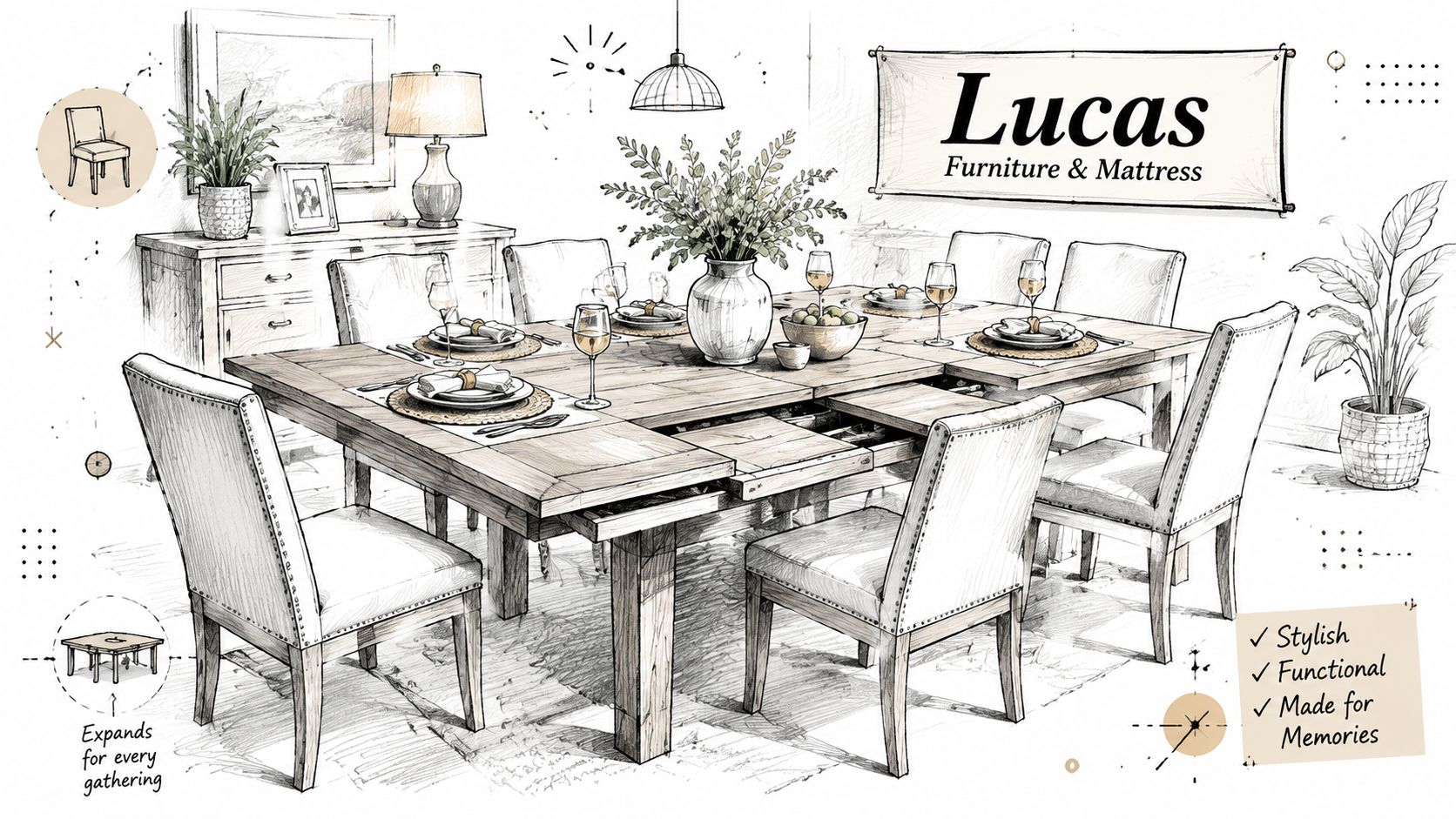
Lucas Furniture serving Lafayette gives shoppers access to a dedicated Lafayette showroom and the main Kokomo showroom and outlet, with reliable in-home delivery available to the area. Shoppers who want a strong starting point can use this dining table buying guide to narrow down shape, room fit, and everyday use before visiting.
Practical rule: The best expandable table isn't the one that gets biggest. It's the one that feels right when closed and still works smoothly when guests arrive.
The Case for Flexibility in Modern Dining
Expandable tables have moved well beyond being an occasional niche purchase. The global extendable dining table market reached USD 10.7 billion in 2024, driven by demand for space-efficient solutions, and that growth is tied directly to furniture that can shift from seating 6 people daily to hosting 12 for special events. That's a clear sign that shoppers are solving a real household problem, not chasing a short-lived trend.
In Central Indiana, that flexibility matters because homes don't all follow one layout. Some have a formal dining room. Others rely on an eat-in kitchen, an open-plan living area, or a dining space that also needs to connect visually with a sectional, home office corner, or traffic path to the patio. A table that stays large all the time can make a room feel crowded. A table that never expands can leave guests hunting for seats.
One table can do two jobs
An expandable table makes sense when daily life is smaller than entertaining life. Most households don't need maximum seating every single day. They need enough room for dinner, homework, a puzzle, or a laptop, then extra room only when people come over.
That's why one versatile table often feels smarter than trying to work around the problem with folding tables or mismatched seating.
- Daily comfort: The room stays more open for normal use.
- Guest readiness: Extra seats become possible without a second table.
- Long-term value: The piece adapts as routines change over time.
For shoppers in apartments, townhomes, or smaller dining rooms, that flexibility can make the whole room easier to live with.
Space efficiency feels better, not just smarter
The benefit isn't only practical. It also changes how a room feels. A compact table gives people more room to pull out chairs, walk around the space, and move between the kitchen and dining area without obstacles.
A dining room works best when furniture supports movement instead of controlling it.
Buyers who are still deciding between fixed and expandable options often benefit from reviewing small-space dining table ideas before narrowing the final size. That kind of planning helps shoppers avoid buying for the biggest event of the year and living with an oversized table the rest of the time.
Understanding Expansion Mechanisms and Features
The mechanism matters as much as the style. Two tables can look nearly identical when closed and feel completely different to use once it's time to expand them. Some open quickly with built-in leaves. Others require separate storage. Some feel especially convenient for frequent use, while others make sense for occasional hosting.
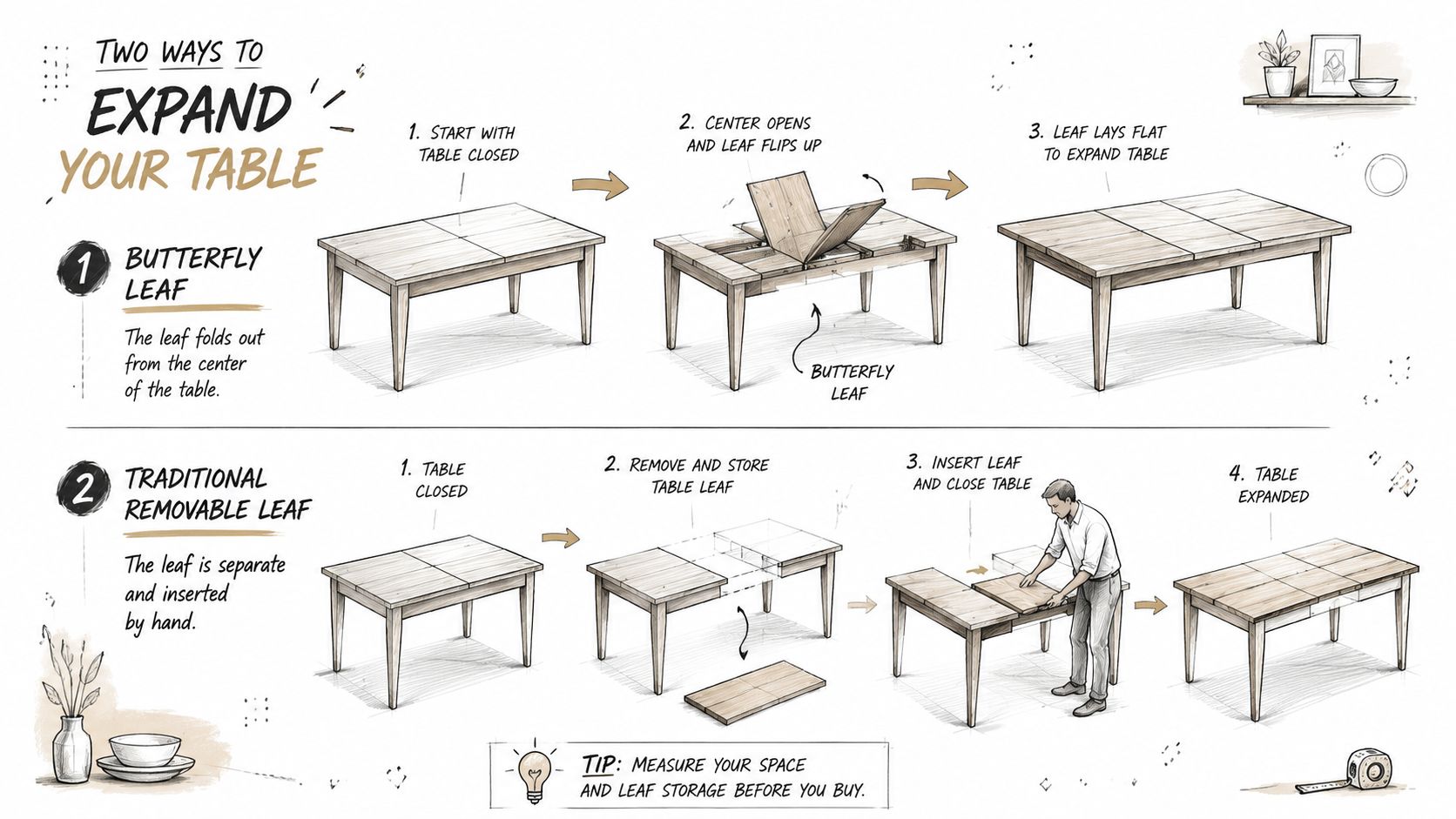
Technical sizing also helps explain what these tables can do. Expandable dining tables typically increase in length by 30 to 100 percent when extended, allowing a compact 4-seater to grow into a 6- or 8-seater, with larger versions reaching up to 12 seats. That's a wide range, which is why shoppers should look beyond the words “extendable” or “expandable” and study the exact mechanism.
Butterfly leaf tables
A butterfly leaf stores inside the table. The top separates, the folded center piece opens, and the tabletop closes around it. This style is popular because it keeps everything together in one unit.
It's often a good fit for households that expect to expand the table regularly. There's no separate leaf to carry to a closet or spare room. The trade-off is that built-in storage and moving parts can affect the tabletop seam pattern and overall weight.
Removable leaf tables
Traditional removable leaves create a classic extension system. The table pulls apart, one or more leaves are inserted, and the top locks back together. Some models include self-storage. Others require the leaf to be stored elsewhere.
This design can feel sturdy and straightforward, especially for buyers who don't mind handling a separate panel. It can also be practical for people who host only from time to time.
Drop-leaf and pedestal designs
Drop-leaf tables use hinged sections that raise or lower, which can be especially appealing in tighter spaces. Pedestal-base expandable tables are a different category to watch because the base can improve legroom compared with some four-leg designs.
Some advanced table systems go even further. Research on multi-functional dining tables describes intelligent adjustment systems with height ranges from 680 to 880 mm and added storage, disinfection, and cleaning features. Most shoppers won't need that level of specialization, but it shows how much dining furniture has evolved beyond a fixed flat surface.
Comparing Expandable Table Mechanisms
| Mechanism Type | How It Works | Best For | Considerations |
|---|---|---|---|
| Butterfly leaf | Leaf folds and stores inside the table | Frequent use, limited storage space | More seams, more moving parts |
| Traditional removable leaf | Table opens and separate leaf is inserted | Occasional hosting, classic design | Leaf storage needs planning |
| Self-storing removable leaf | Separate leaf stores within the table base or frame | Buyers who want flexibility without closet storage | Added construction complexity |
| Drop-leaf | Hinged sides lift up or down | Small rooms, casual use | Usually offers a different seating feel than center-extension designs |
| Pedestal extension | Center or end extension paired with pedestal support | Better legroom and softer traffic flow | Base shape still needs a careful chair-fit check |
People who expect to move homes soon may also want to read a guide on disassembling furniture for your Boston move. Even though it's written for moving, it gives useful insight into how furniture components, leaves, and hardware should be handled to avoid damage.
For buyers comparing models in person, these key dining table selection steps help turn showroom browsing into a clearer decision.
Perfect Placement A Sizing and Layout Guide
A beautiful table can still be the wrong table if it doesn't fit the room in both positions. That's the part many shoppers underestimate. They measure for the closed size, fall in love with the look, and only later realize the extended version changes the whole traffic pattern.
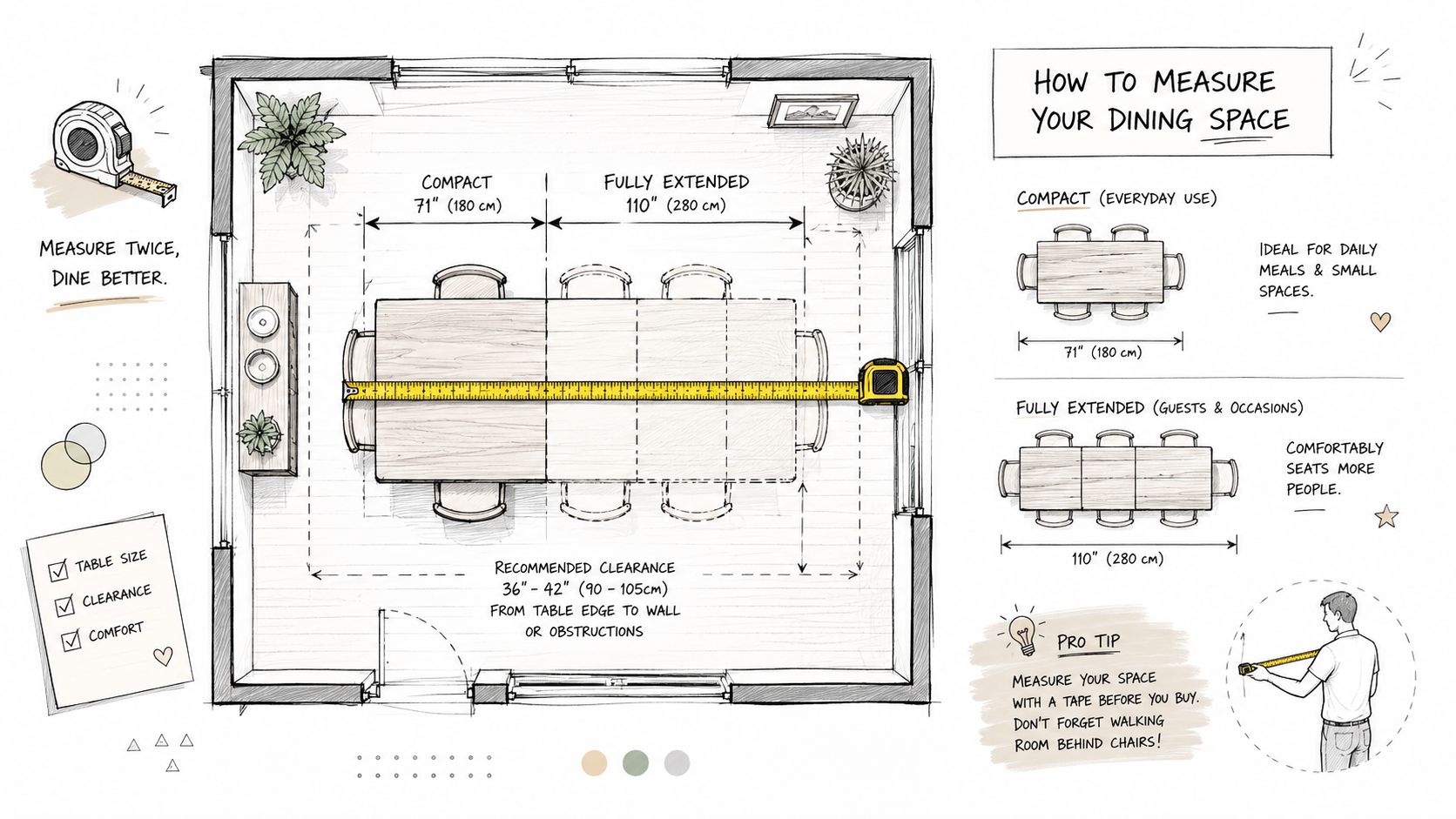
Measure for both sizes
The room has to work twice. Once for the everyday footprint, and again for the fully opened one. A good starting rule is the seating standard noted by design guidance that allows 22 to 24 inches of linear space per person and often plans for 36 inches of clearance for movement around the table, as referenced in this expandable dining table overview.
A simple measuring routine helps:
- Mark the closed size first: Use painter's tape on the floor to see the normal footprint.
- Mark the extended size next: Add the full length or width the table reaches when opened.
- Test the paths: Walk around the taped shape and notice doors, vents, nearby cabinets, and traffic flow.
- Add real chairs into the plan: Chair backs and pull-out space matter as much as tabletop size.
For kitchens and dining zones that share floor space, a practical kitchen layout guide can help visualize circulation before committing to a table shape.
The leg placement problem most guides miss
Many buying guides often stop too early. The hidden issue isn't just top size. It's where the legs end up after extension. A common but overlooked issue is how extension mechanisms alter leg geometry. Buyers frequently find that after extending a table, the new leg positions prevent two chairs from fitting between them, which directly affects real seating capacity.
That means a table advertised for a certain guest count may feel less generous in actual use if chair placement becomes awkward.
Check the space between supports, not just the full length of the top.
A few things help avoid that mistake:
- Look underneath the table: Support structure matters as much as the top.
- Test chair spacing when extended: Don't assume two chairs fit just because the surface looks long enough.
- Pay attention to end seating: Some bases make end seats comfortable, others don't.
- Ask how the legs move: Fixed legs and moving tops create a different seating pattern than shifting-leg systems.
If the table doubles as a workspace
Many households now use the dining table for more than meals. It may hold a laptop during the day, schoolwork in the evening, and dinner plates later on. In those cases, stability matters. Buyers should pay attention to joints, seams, and whether the expanded top feels solid when weight is applied near the extension area.
A sturdy expandable table can support hybrid use well. A weaker one may feel fine for dinner but less comfortable for typing, writing, or supporting electronics. That's why it's worth pressing gently on the extended area in the showroom, checking for movement, and asking how the mechanism locks into place.
Shoppers who want a more exact fit can use this dining table size guide before visiting the floor.
Choosing Your Style Materials Finishes and Durability
Function gets a table into the shortlist. Style decides whether it still feels right years later. The best choice usually comes from matching the material to the household's real habits, not just the photo that looks best online.
Material choices that change the feel of the room
Solid wood brings warmth, visual depth, and a classic feel that works in many Indiana homes. It often suits buyers who want a dining table to feel substantial and timeless.
Wood veneers can deliver a similar look with a different price profile and more design flexibility. For many households, a well-made veneer table is a sensible balance of style and budget.
Glass tops make a room feel lighter and more open. They can be useful in smaller dining areas where a heavier-looking table might visually crowd the space. The trade-off is upkeep, because fingerprints and smudges tend to show more quickly.
Metal details or bases often push the style more modern or industrial. They can pair well with upholstered chairs, a sleek sectional nearby, or a home office setup in an open-concept room.
For shoppers drawn to cleaner silhouettes and lower visual weight, this article on choosing a Japanese dining table offers useful design inspiration around proportion, simplicity, and room balance.
Finish and durability should match real life
A family with younger kids usually shops differently than an empty-nest couple. One may prioritize forgiving finishes and easy cleanup. The other may care more about grain detail, edge shape, or a statement base.
A few practical pairings tend to work well:
- Busy family home: A durable finish and a surface that doesn't make every mark feel dramatic.
- Formal dining space: A richer finish with more visual character can make sense.
- Mixed-use room: Materials that coordinate with nearby living room and home office pieces often create a calmer look.
The right finish should support how the room is used on an ordinary day, not only how it looks on a holiday.
Chair style matters too. Upholstered seats soften a harder table silhouette. Cleaner chair lines can balance a heavier wood top. If the dining room opens into the living area, matching undertones across the table, sectional, and storage pieces often makes the whole home feel more intentional.
Why Lucas is Your Go-To Furniture Store Near Lafayette IN
Local shoppers often want more than product listings. They want a place that helps them compare room solutions, stay on budget, and get the furniture home without added stress. For those seeking a Lafayette furniture store or furniture store near Lafayette IN, Lucas Furniture & Mattress is a relevant option because it serves Lafayette directly while also offering the added selection of the Kokomo showroom and outlet.
Lucas Furniture & Mattress serves Lafayette from two key locations, including the dedicated Lafayette showroom at 3210 Builder Dr and the main showroom and clearance outlet in nearby Kokomo, serving Central Indiana with broad selection and value. That gives shoppers access to both a local stop and a larger destination for browsing dining, living room, bedroom, home office, outdoor furniture, and more.
Why Choose Lucas Furniture? Our Value Proposition
Lucas Furniture serving Lafayette stands out as a locally owned retailer with strong customer reviews, a community-minded approach, and a focus on comfort and value. That matters when shoppers want guidance that feels practical rather than pushy.
The store's Low Price Promise supports value-focused shopping, especially for households furnishing multiple rooms at once. That can include a dining table, mattress, sectional, and bedroom pieces all in the same project.
Furnish Every Room Save Big
One of the biggest advantages of shopping a larger local retailer is range. Dining shoppers often discover they also need barstools, an accent cabinet, a sectional, a bed, or a desk for the home office.
Lucas Furniture & Mattress offers furniture for living, dining, bedroom, home office, and outdoor furniture as well. The clearance and outlet side is especially important for budget-conscious shoppers because it includes savings up to 70% off clearance/outlet merchandise, which can help stretch a furnishing budget further.
A good starting point for value shoppers is this guide to affordable furniture shopping.
Achieve Better Sleep Your Mattress Options
A dining purchase often happens during a larger home refresh. That's where the mattress category becomes relevant. Shoppers who are already making a room-by-room update can compare sleep options in the same trip.
Lucas Furniture & Mattress features a dedicated mattress center with options for different comfort preferences and budgets, plus a helpful Mattress Guide for narrowing down feel and support.
Customize Your Comfort Simple Financing Custom Orders
Not every room works with a stock setup. Some households need a particular finish, a different fabric, or a sectional configuration that better fits the floor plan. That's where custom order flexibility helps.
Financing matters too. A shopper replacing a dining set, mattress, and living room seating may prefer to spread costs over time instead of making one large payment at once. Lucas offers flexible financing options along with custom-order opportunities across many collections.
Shop Your Way Online In-Store and Delivered to Lafayette
Some buyers want to test chair comfort, inspect wood tones, and operate table mechanisms in person. Others prefer to browse online first and narrow their list before visiting. Lucas supports both approaches.
For logistics, the store's delivery policy states that delivery covers a 50-mile radius from its locations with a $149 fee, and an adult 18 or older must be present to accept delivery. For pickups, the policy requires a 24-hour advance call to the Kokomo customer service line. That kind of clarity helps shoppers in Lafayette plan the purchase from showroom to setup with fewer surprises.
For many Central Indiana households, that combination matters. A local showroom presence in Lafayette, the expanded selection in Kokomo, reliable in-home delivery, clearance opportunities, simple financing, mattress choices, custom order options, and help across dining, bedroom, living room, home office, and outdoor categories creates a smoother shopping experience from start to finish.
Visit the showroom near Lafayette today, or browse the full inventory online with guaranteed in-home delivery to the Lafayette area from Lucas Furniture & Mattress.