Experience our new Lafayette showroom — Now Open! Come Visit Us -->

Bombay End Table Guide 2026: Choose, Style, and Save

A homeowner in Lafayette may know exactly what the living room needs, a lamp beside the sofa, a landing place for a coffee mug, and a little storage for the remote, yet still struggle to identify the right piece online. A Bombay end table can solve that everyday gap, but the name describes a broad decorative style family rather than one single design. For shoppers comparing a Lafayette furniture store with a Kokomo showroom or outlet, the best purchase starts with shape, dimensions, materials, and intended use.
Lucas Furniture & Mattress serves Lafayette, Kokomo, and Central Indiana with in-home delivery options, while its main showroom and outlet are located in Kokomo. The guidance below helps a homeowner recognize a Bombay-style table, measure for it, compare vintage and modern interpretations, and decide when a local showroom visit, custom order, clearance search, or online purchase makes sense.
What a Bombay End Table Really Is
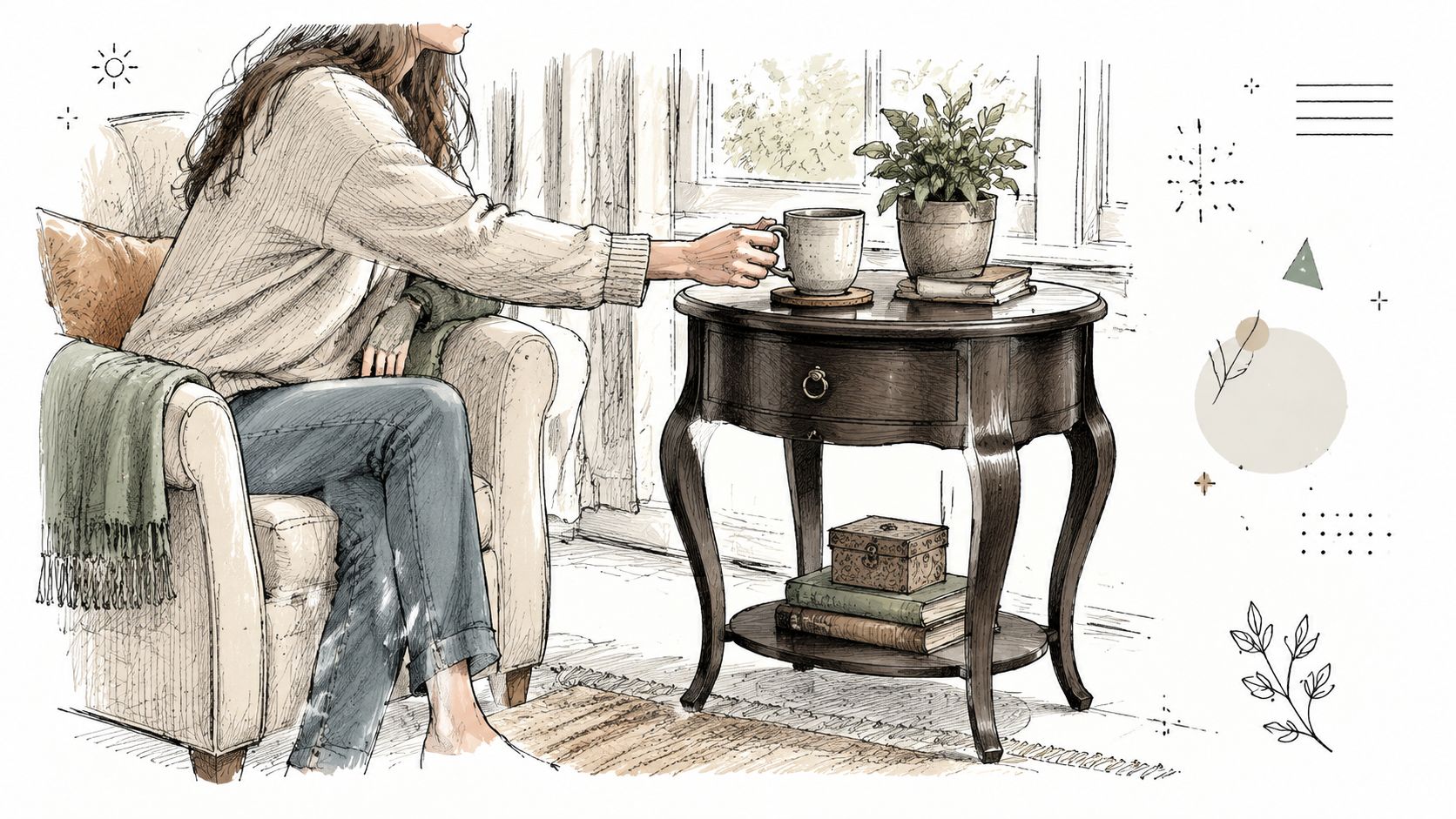
A sofa-side table earns its place by making daily routines easier. The ideal piece keeps a drink, reading lamp, glasses, or book close enough to reach without leaning awkwardly, while adding character to the room. A Bombay end table usually combines that compact function with a warm, ornate appearance.
The term is commonly associated with vintage occasional tables connected with The Bombay Company. Marketplace listings show examples from at least the 1970s through the 1990s, including a 1998 manufactured end table and a 1990s Victorian-style side table. A documented mid-century example is described as a mahogany accent table with brass hardware, showing how the category developed a recognizable blend of wood, metal, and decorative detailing. Those retail-era references are available in this documented Bombay-style accent table listing.
A style family, not a rigid recipe
One listing may emphasize British colonial influence, another may lean toward Regency formality, and a third may use French Provincial details. Shared cues often include:
- Decorative silhouette: Curved legs, pedestal supports, shaped aprons, or an ornate edge can separate the table from a plain square accent piece.
- Warm materials: Wood finishes, brass hardware, faux bamboo details, and mixed-metal accents appear repeatedly in the category.
- Compact purpose: The table remains an occasional piece, intended for a sofa, lounge chair, bedroom corner, or reading area.
- Furniture as ornament: The surface supports useful objects, but the base and finish also contribute strongly to the room's design.
That variety matters in a Lafayette home with existing furniture. A dark mahogany table with brass accents may complement traditional seating, while a lighter faux bamboo interpretation can sit more comfortably beside relaxed transitional décor. The label alone doesn't tell a shopper whether the table will match. The profile, finish, and hardware do.
Practical rule: Treat “Bombay” as a design direction, then inspect the actual table as carefully as the name.
Before choosing a finish, the buyer should identify the table's job. A lamp table beside a deep sectional needs stable proportions and easy reach. A decorative piece in a hallway can prioritize shape. A bedroom table may need enough surface for a lamp and personal items. That simple distinction prevents a beautiful but impractical purchase.
Standard Sizes and Signature Materials
Dimensions determine whether an end table feels naturally placed or slightly awkward. A commonly repeated Bombay end table footprint is 18 x 18 x 25 inches, a compact square profile that suits the end-of-sofa position. Multiple listings show this dimension band, supporting it as a recurring market specification rather than an isolated custom measurement. The Bombay end table product dimensions provide a useful reference point.
A vintage example shows why shoppers shouldn't assume every table will match that footprint. One documented mahogany and brass Bombay-style table measures 19.5 inches wide, 11 inches deep, and 29.5 inches high. Its narrow depth and greater height could work beside a chair or in a tight corner, but it might sit too tall next to a low sofa. The dimensions come from the vintage Bombay-style table record.
Read the material vocabulary
The material list on a tag gives clues about appearance, maintenance, and visual weight.
Mahogany or other finished wood creates a substantial, traditional presence. A darker wood table can anchor a room with neutral upholstery, especially when the surrounding furniture includes warm tones.
Brass hardware adds contrast and a polished decorative note. Look at handles, corner details, feet, and trim rather than judging the entire table from the top alone.
Faux bamboo introduces a carved or shaped pattern associated with vintage and colonial-inspired furniture. It can make a compact table look more detailed without requiring a large footprint.
Metal and mixed-metal elements may shift the table toward a more eclectic or contemporary direction. The finish matters as much as the material, since brushed, aged, and polished surfaces create different moods.
A quick showroom inspection should include the top, legs, joints, hardware, and underside. A square top offers predictable placement for a lamp and drink, while a pedestal base can provide visual interest and reduce the number of corners competing with nearby seating.
| Feature | Why it matters |
|---|---|
| Square top | Gives a lamp, coaster, and book defined places |
| Pedestal base | Adds decorative presence and can reduce visual clutter |
| Wood finish | Sets the table's warmth and relationship to existing furniture |
| Brass or metal hardware | Supplies contrast and reinforces the chosen design era |
| Compact footprint | Helps the table fit beside sofas, chairs, and beds |
The right material isn't automatically the most elaborate one. It's the material that supports the room's existing finish story and the amount of maintenance the owner is willing to provide.
How to Measure Your Room and Choose the Right Fit
A Bombay end table should fit the room the way a good dance partner fits a turn. Height, reach, and personal space must work together. A tape measure and a small sketch are enough to make the decision more reliable.
Start with the armrest
Measure from the floor to the top of the sofa or chair arm. The end table's surface should sit close to that line, with the exact relationship guided by the table's intended use and the furniture's proportions. A surface that is dramatically lower can make drinks and lamps harder to reach, while one that is noticeably higher may feel intrusive beside low seating.
Use the recurring 18 x 18 x 25 inch profile as a starting point, not a guarantee. If the armrest is tall, a taller vintage-style table may feel more natural. If the seating is low and relaxed, a shorter modern table may create better visual balance.
The best table isn't the one that looks largest on the showroom floor. It's the one that meets the hand without interrupting the seat.
Check the walking path
Mark the table's proposed footprint with painter's tape, folded paper, or a quick measurement on the floor. The required planning guidance calls for leaving at least 24 inches of walking lane between the table and the nearest chair or doorway. That clearance helps preserve a comfortable route through the room.
Check more than the straight path. Open a nearby cabinet, recline a chair if applicable, and consider how people carry laundry, toys, or serving dishes through the space. A table can fit on paper yet create a nuisance when a family uses the room.
Test a bedroom corner
A Bombay piece can also function as a nightstand when its height and storage needs cooperate. Measure from the floor to the top of the mattress, then compare that line with the table surface. A bedside table that is too low can force a reach downward, while a table that is too tall can make a lamp and personal items difficult to access from bed.
A homeowner shopping for both a Bombay end table and a new mattress should measure the existing setup before changing either piece. Mattress height can alter the final relationship between the bed and table. This is also where a dedicated mattress center and a clear comfort guide can help the buyer evaluate the bedroom as a complete arrangement instead of treating each item separately.
Vintage Versus Modern Bombay Tables
Vintage and modern Bombay tables can share a silhouette while offering different ownership experiences. A vintage table may carry visible age, unusual proportions, and materials such as mahogany and brass. A modern reproduction may deliver the decorative idea with a cleaner finish, more predictable dimensions, or an easier path to a coordinated room.
The secondary market shows how broad the category has become. One major resale marketplace reports 9 vintage or antique variations plus 1 modern edition, with earlier versions dating back to the 18th century. Its listed prices range from $470 to $24,000, with an average of $2,348. These figures appear in the secondary-market Bombay side table listings, and they should be read as market signals rather than a universal price guide for every table.
What vintage offers
Vintage furniture suits a buyer who values character and wants a piece with signs of age or a less predictable profile. Small differences in carving, hardware, finish, and wear can make the table feel collected rather than newly matched.
The tradeoff is inspection. The buyer should examine stability, surface condition, repaired joints, hardware movement, and any odor or finish damage. A narrow, tall vintage table may be perfect beside a chair but less useful beside a broad sectional.
What modern furniture offers
A modern Bombay-style table may be the practical choice for a homeowner who wants decorative detail without committing to a rare or highly priced collectible. Newer construction can make it easier to coordinate a pair, request a particular finish, or replace a piece later.
A local showroom gives the buyer an advantage here. Sitting beside the table, checking reach, and comparing it with a sectional, mattress setup, or existing wood finish reveals information that a listing photograph can't provide.
A simple decision test
Choose vintage when the table's history and individual character matter more than exact uniformity. Choose modern when predictable dimensions, a coordinated finish, or a custom order pathway matter more. For either option, the buyer should judge the actual construction, not the age label alone.
Styling Tips and Care That Actually Work
A Bombay end table has enough personality to become a small focal point. The styling challenge is to support that character without covering the surface or hiding the hardware.
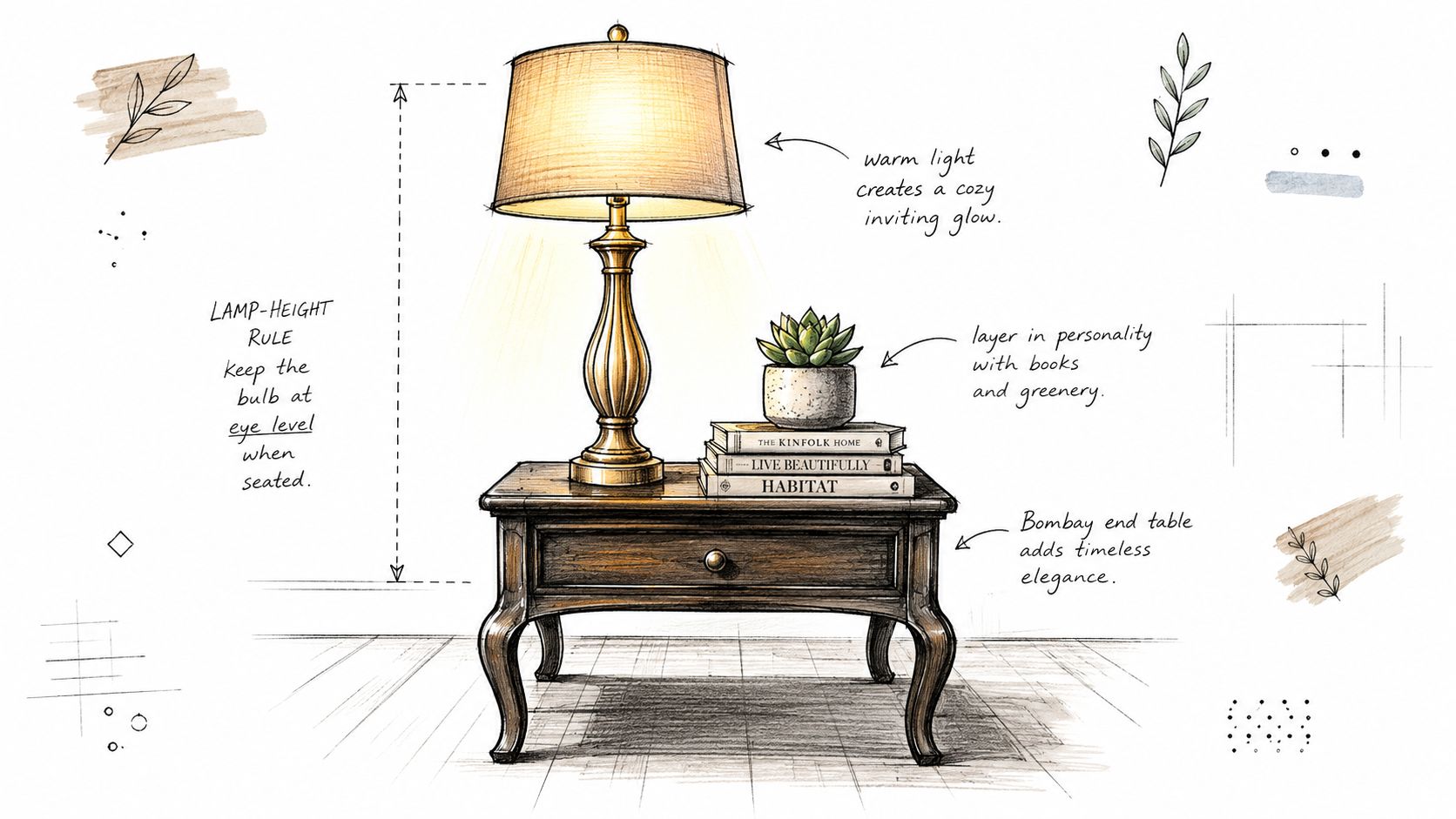
Start with the lamp. The useful lamp-height rule places the bulb light approximately 58 to 64 inches from the floor, creating a comfortable relationship between the seated eye line and the light source. The final result depends on the chair, sofa, lamp, and shade, so the homeowner should test the arrangement from the actual seat rather than judging it while standing.
Build the surface in layers
The two-vase test keeps decorative objects from becoming crowded. Place two vessels with different heights or shapes on the surface, then remove one if the lamp, table details, or nearby upholstery already provide enough visual activity.
A tray-and-book anchor works especially well on a detailed wood finish. The tray groups small items, while the book supplies a low horizontal layer beneath the lamp or vase. The arrangement feels intentional without turning the table into a storage pile.
- Begin with function: Leave room for a drink, glasses, or a remote.
- Add one vertical element: A lamp or tall vase establishes height.
- Use a low anchor: Books or a shallow tray balance the taller piece.
- Repeat a finish carefully: A small brass object can echo the hardware without creating a matching set.
Protect the finish
Place felt pads under every foot, especially on wood or hard flooring. Coasters should sit beneath drinks, and decorative objects should be lifted rather than dragged across the top.
Brass hardware benefits from gentle, consistent care rather than aggressive polishing. A six-month brass polishing routine can help maintain the metal's appearance, provided the finish is suitable for the product and the care instructions are followed.
Seasonal styling can extend beyond the living room. Outdoor furniture on a patio or sunroom can echo the Bombay table's warm wood and metal story through cushions, planters, and small accent pieces. Outdoor elements need materials designed for their environment, so an indoor table shouldn't be placed outside just because its finish matches the patio.
Why Lafayette Shoppers Choose Lucas Furniture and Mattress
A Bombay end table can look different under showroom lighting than it does on a phone screen. Wood tone, brass detail, edge shape, and overall height are easier to judge beside a sofa or chair. Lucas Furniture & Mattress gives Lafayette-area homeowners a local way to make that comparison in person, rather than choosing a style family from photographs alone.
The retailer is locally owned and has served Kokomo, Lafayette, and Central Indiana since 2002. Its Lafayette Showroom is at 3210 Builder Dr, while the Kokomo Outlet is at 1500 N Reed Rd. These locations are listed on the Lucas Furniture locations and financing page.
A showroom changes the decision
Bring your room measurements and, if possible, a photo of the sofa, chair, or bed beside the planned table. An associate can help you judge whether the piece reads as a quiet surface or becomes the room's main accent. That distinction matters because a Bombay end table may be ornate, restrained, dark, light, wood-focused, or metal-detailed. The name describes a flexible style family, not one fixed design.
Seeing several pieces together also clarifies scale. A table that appears compact online may feel tall beside a low sofa. Another may provide the right height for a reading lamp but crowd the walkway. In the showroom, you can test those relationships before arranging delivery.
Lucas Furniture's broader selection can support that comparison. Living room seating, dining furniture, bedroom pieces, home office items, mattresses, and seasonal outdoor furniture make it possible to consider the nearby room rather than evaluating the table in isolation. The goal is a coordinated relationship among finish, height, and function.
A practical Lafayette buying path
Start with the room where the table will live. For a sofa, check the arm height and traffic lane. For a bedroom, compare the surface with the mattress and test the lamp from the bed. If the floor model does not suit the space, ask whether another finish or configuration can be ordered.
Delivery planning belongs in the same conversation. Lucas Furniture provides delivery information for Lafayette-area shoppers, so buyers can confirm whether the service fits their location and furniture plan. Clear measurements, a chosen placement, and a showroom comparison make the purchase easier to evaluate from the first visit through setup.
Your Next Step and the Lafayette Furniture Store CTA
The most reliable buying path is straightforward. Measure the sofa armrest, mark the proposed footprint, check the traffic lane, and decide whether the table will serve a living room, bedroom, or occasional decorative role. A tape measure brought to the showroom can make a conversation about a Bombay end table far more productive.
Shoppers should ask about custom order options when the finish or configuration isn't available on the floor. If the piece will function as a nightstand, compare its surface with the mattress height and evaluate the lamp from the bed. The same reach-and-balance principle applies in both rooms.
Bombay End Table at a Glance
| Feature | What to Expect |
|---|---|
| Style | A broad decorative family with vintage, Regency, colonial, and French Provincial influences |
| Common reference size | Approximately 18 x 18 x 25 inches, with individual pieces varying |
| Materials | Wood, mahogany, brass, faux bamboo, metal, and mixed finishes |
| Best uses | Sofa end table, chair-side table, bedroom nightstand, or accent piece |
| Buying choices | Vintage, modern, custom order, clearance, outlet, online, or showroom purchase |
| Lafayette service | In-home delivery is available within the stated service radius |
A Lafayette homeowner can visit the area showroom, compare pieces in person, or browse online around the clock while keeping delivery and room measurements in view.
Lucas Furniture & Mattress offers end tables, living room furniture, sectional seating, bedroom pieces, mattresses, outdoor furniture, custom orders, financing, and clearance options for homeowners in Lafayette and Central Indiana. Visit Lucas Furniture & Mattress to explore the selection, then bring room measurements to the showroom or arrange in-home delivery to the Lafayette area.