Experience our new Lafayette showroom — Now Open! Come Visit Us -->

Memory Foam vs Latex Mattress: A Lafayette Shopper’s Guide


A Saturday mattress search can turn into a debate about softness, price, and who gets the final say. For a Lafayette shopper comparing memory foam and latex, the better question isn't which one feels nicer in the showroom. It's which material will still suit the household years from now, and whether the purchase makes sense as a long-term cost rather than a short-lived comfort win.
Lucas Furniture & Mattress serves Lafayette, IN, Central Indiana, and nearby communities through its main showroom and outlet in Kokomo, with reliable in-home delivery to the Lafayette area. Shoppers can compare mattresses in person, browse online, ask about simple financing, and coordinate delivery without treating a mattress purchase as an isolated transaction. The same store also carries sectionals, bedroom furniture, dining sets, home office pieces, outdoor furniture, clearance items, and custom-order options.
A Lafayette Shopper Walks Into the Mattress Aisle
A Lafayette-area couple walks into a mattress aisle on a Saturday afternoon. One partner leans toward a lower-priced memory foam model because it offers the familiar sinking hug. The other prefers a more expensive latex bed because it feels buoyant and easier to move across. Their disagreement sounds like a firmness argument, but it usually hides a larger concern: which mattress will still feel right in year eight, not just during week one?
That question comes up often on a showroom floor. Hot sleepers worry that traditional memory foam will hold too much warmth. Couples ask for motion isolation because one person wakes whenever the other turns. Buyers replacing a sagging innerspring want proof that a new foam bed won't develop the same problem. A shopper who has spent years sleeping on a firm surface may also dislike the slow, enclosed feel of memory foam, even when its pressure relief looks appealing at first.
The historical timeline helps explain why the two materials feel so different. Latex foam came first, with the Dunlop process emerging in 1929 and commercial latex mattresses appearing by the early 1930s. Talalay followed in the 1940s. Memory foam originated at NASA's Ames Research Center in 1966, became available for commercial use in the 1970s and 1980s, and reached consumers through mattress products in the 1990s, including the first consumer memory foam mattress in 1991 and U.S. availability in 1992. The mattress industry timeline shows why latex has a longer premium-foam history, while memory foam later achieved broader household recognition.
Floor-level rule: A mattress only earns its price when its feel, support, and construction match the sleeper using it.
A useful starting point is Lucas Furniture's mattress shopping guide. It helps Lafayette shoppers arrive with the right questions, instead of choosing based only on a sale sign or the first soft bed that feels comfortable for a few minutes.
| Decision factor | Memory foam | Latex |
|---|---|---|
| Body feel | Slow contour and deeper hug | Resilient, buoyant support |
| Motion isolation | Usually stronger | More responsive, with more movement transfer |
| Temperature | Traditional versions can retain heat | Generally more breathable |
| Pressure distribution | Strong cradling around shoulders and hips | Measured low-pressure performance can be excellent |
| Durability outlook | Depends heavily on density and construction | Commonly longer-lasting |
| Best value case | Lower entry cost and strong couple-friendly isolation | Higher upfront cost with longer service potential |
How Memory Foam and Latex Are Actually Built
Memory foam is viscoelastic polyurethane foam. Heat and pressure soften the material, allowing it to conform around the body before slowly recovering its shape. That delayed response creates the familiar sinking sensation. It can cushion the shoulders and hips effectively, but it can also make repositioning feel slower.
Density is the first specification worth asking about. Memory foam density is measured in pounds per cubic foot, or PCF. Consumer memory foam commonly ranges from about 3 PCF to 5 PCF, while foam below 3 PCF is generally considered low quality for a primary support layer because it can soften and develop impressions sooner. This memory foam materials guide explains why a shopper shouldn't judge a mattress by thickness alone.
A practical density reading looks like this:
- Around 3 lb/ft³: Softer and quicker to wear.
- Around 4 to 5 lb/ft³: A useful balance of support and longevity.
- Above 5 lb/ft³: Typically slower to respond and potentially warmer, though construction still matters.
Latex is rubber foam, produced from natural rubber, synthetic rubber, or a blend. Its elastic structure pushes back more quickly than viscoelastic memory foam, so sleepers tend to feel supported on top of the bed rather than enclosed within it. Dunlop and Talalay describe manufacturing processes, not automatic quality grades. The construction, firmness, layer placement, cover, and support base still determine the final experience.
Density comparisons also need care. RTINGS uses 48 kg/m³ as a good-quality reference for both materials, but its high-quality reference is 80 kg/m³ for memory foam and 64 kg/m³ for latex. RTINGS' mattress testing changelog makes the important point that equal density figures don't mean equal performance. Latex's elastic rubber structure can meet a high-quality benchmark at a lower density than memory foam.
Shoppers should ask about more than marketing labels:
- Density indicates how much material occupies a given volume and helps explain durability.
- Firmness describes the surface response and support feel. Retailers may use different scales, so lying on the bed matters more than the label.
- Layer position determines whether the material cushions the body or reinforces the core.
- Cell structure influences airflow, rebound, and how quickly the mattress responds.
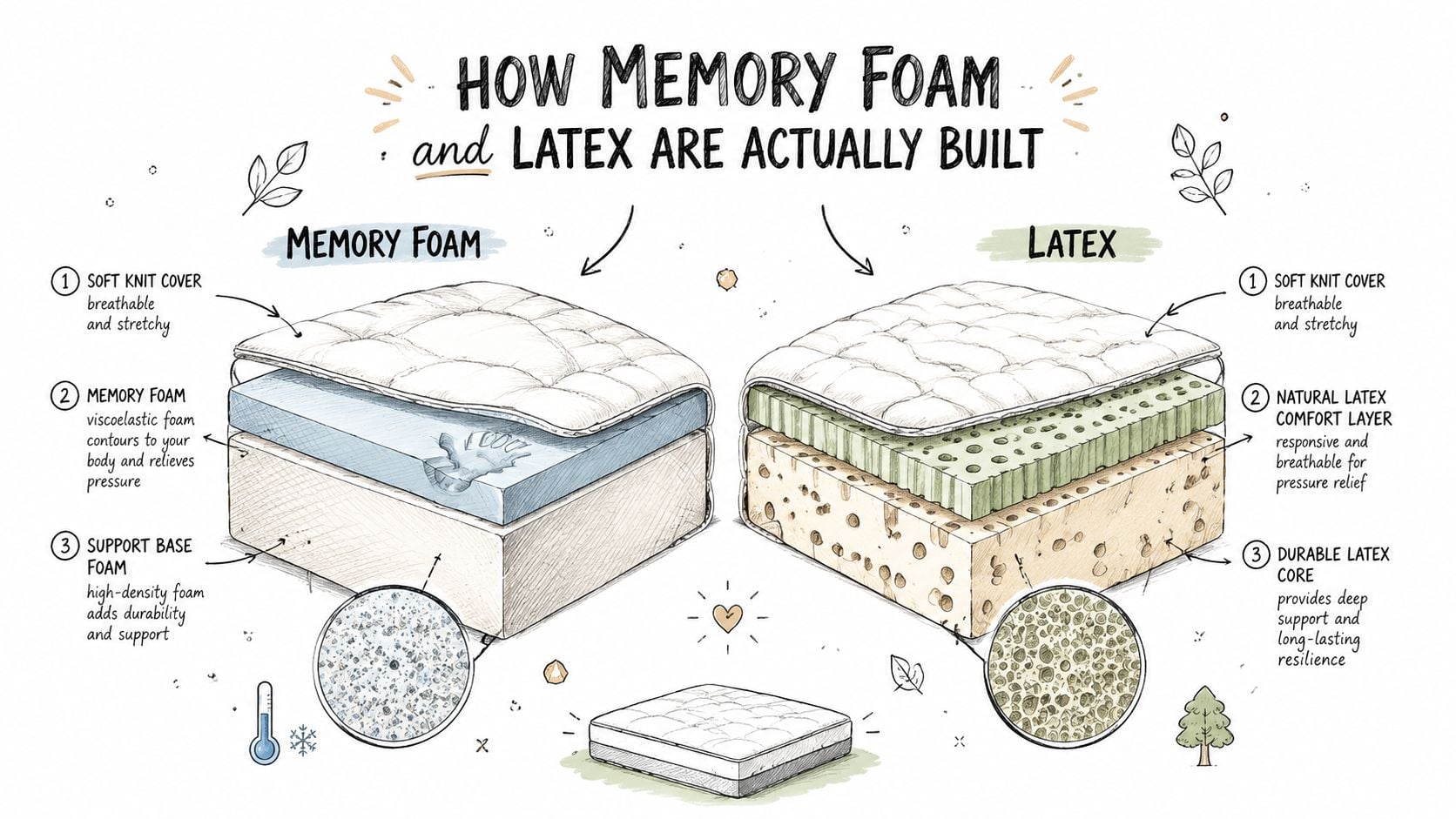
A shopper comparing natural and synthetic latex should also inspect the full bill of materials. Even a latex mattress may contain a fabric cover, fire barrier, and transition layers made from materials other than latex. For a clearer list of advantages and limitations, see Lucas Furniture's guide to latex mattress pros and cons.
Head-to-Head on Feel, Support, and Temperature
Memory foam wins the motion-isolation contest. Its slow-moving structure absorbs more of a partner's movement, which makes it a strong choice for couples with different schedules or restless sleeping habits. Latex has more bounce and transfers more of that movement, although a latex hybrid with pocketed coils can narrow the practical gap.
Support depends on body position and construction, not material name alone. Memory foam can let the hips sink, which may suit a side sleeper seeking shoulder and hip cushioning. A heavier back sleeper may instead feel that the hips settle too far into a softer configuration. Latex pushes back faster and can provide a more lifted lumbar feel across positions, but a firm latex mattress may feel too unyielding for someone who wants a cradle.
Temperature is another clear dividing line. Traditional memory foam can retain body heat, while latex is commonly described as cooler and more breathable because air can move through its structure. Gel, copper, graphite, and open-cell designs may alter the experience of memory foam, but those additions don't guarantee that every hot sleeper will feel cool.
The measurable pressure-relief evidence favors latex in a notable test. Across measured body regions, latex kept 90.9% to 96.1% of body surface area in the low-pressure band of 0 to 0.6 psi, compared with 82.1% to 91.8% for polyurethane foam. The same research reported lower peak contact pressure on the torso and buttocks for latex, while a broader review cited a reduction in peak pressure of up to 35.1% compared with polyurethane mattresses. The clinical pressure-mapping research supports the view that latex's pressure relief isn't just showroom language.
| Performance criterion | Memory foam | Latex |
|---|---|---|
| Pressure relief | Deep, immobilizing cradle | Even load distribution with resilient support |
| Motion isolation | Strongest choice for most couples | More movement and bounce |
| Temperature | Traditional versions may sleep warmer | Usually more breathable |
| Repositioning | Slower recovery can make turning harder | Quick rebound assists movement |
| Edge behavior | Depends heavily on support foam | Often more stable and resilient |
| Feel | Enveloping and contouring | Buoyant and responsive |
The floor recommendation is direct. Choose memory foam when motion isolation and deep contouring matter most. Choose latex when temperature, easy movement, resilient support, and pressure distribution rank higher. Lafayette shoppers who run warm can review cooling mattress options for hot sleepers before visiting the Kokomo showroom.
Price, Lifespan, and the Real Cost Per Year
The cheapest mattress isn't automatically the least expensive mattress to own. Memory foam usually has the lower starting price, while latex generally costs more upfront and can offer a longer service life.
Sleep Foundation estimates that a latex mattress costs roughly twice as much as a memory foam mattress on average, with useful life around 7.5 to 8.5 years for latex compared with 6 to 7 years for memory foam. The consumer comparison data frames the decision more clearly than a simple soft-versus-firm argument.
| Material or tier | Typical queen price range | Expected lifespan | Average cost per year |
|---|---|---|---|
| Memory foam | Not stated in verified data | 6 to 7 years in the cited estimate | Price divided by 6 to 7 |
| Latex | Roughly twice the average memory foam price | 7.5 to 8.5 years in the cited estimate | Price divided by 7.5 to 8.5 |
The table avoids fake precision because the verified research doesn't establish one universal queen price range or one fixed annual cost. The correct calculation is simple:
Purchase price ÷ expected years of use = approximate cost per year.
A buyer paying more for latex may receive better annual value if the mattress remains supportive longer. A buyer choosing mid-tier memory foam may still make the sensible decision if deep contouring and motion isolation matter more, especially when the purchase price is substantially lower and the construction uses appropriate density.
The variables that change the calculation include:
- Foam density: Lower-density memory foam can soften sooner.
- Layer configuration: A thin comfort layer over a durable support core behaves differently from an all-foam design built around softer material.
- Foundation: An unsuitable base can undermine support and warranty coverage.
- Care: Rotation, a proper protector, and careful handling may help preserve the sleep surface.
- Household use: A guest-room mattress experiences different demands from a primary bed used nightly by two adults.
A recent Sleep summary of a tracked-night study reported that people on a latex foam mattress fell asleep about 3 minutes faster on average, with reported improvements in coolness, comfort, support, and satisfaction across more than 1,500 nights. That finding doesn't make latex universal, but it strengthens the case for evaluating comfort over sustained use rather than judging a bed solely during a brief showroom visit.
For practical maintenance guidance, shoppers can review how long mattresses last. A Lafayette buyer should compare the actual price, expected years, household needs, and return terms before deciding which material delivers the better yearly value.
Matching the Mattress to Your Sleep Style and Body
Sleep position should determine the first test, not the color of the cover or the material's reputation. The right mattress keeps the body supported without forcing the shoulders, hips, or midsection into an awkward angle.
Side sleepers
Memory foam often suits side sleepers who want deeper cushioning around the shoulders and hips. Its contour can reduce concentrated pressure, but the softer the setup, the more carefully the sleeper should check whether the hips sink too far.
Latex can also work for side sleeping, especially when the comfort layer has enough give. It offers pressure distribution without the same enclosed feeling, so side sleepers who dislike being swallowed by foam should test it before dismissing it.
Back and stomach sleepers
Back sleepers generally need the lumbar area supported without excessive hip sink. Latex's faster push-back often appeals to sleepers who want to feel held up rather than surrounded.
Stomach sleepers usually need a flatter, more stable plane so the midsection doesn't drop too far. A firmer latex configuration may suit that need, but the shopper still has to test shoulder and rib comfort rather than assuming firm is automatically correct.
Combination and heavier sleepers
Combination sleepers change positions frequently. Latex's quick recovery makes turning easier because the surface doesn't remain compressed as long after movement. Memory foam can still work, but a slow response may feel restrictive for an active sleeper.
Heavier sleepers should ask for construction details instead of relying on a material label. A high-density memory foam design or a reinforced latex core may provide a more dependable foundation, but showroom testing remains essential because firmness and support vary by model.
A fast pairing guide:
- Deep contour and partner motion control: Memory foam.
- Quick repositioning and buoyant support: Latex.
- Warm bedroom or heat-sensitive sleeper: Latex is the stronger starting point.
- Shoulder and hip pressure concerns: Test both, with special attention to alignment.
- Preference for a stable, lifted surface: Latex.
- Preference for a slow, enveloping feel: Memory foam.
Shoppers who want to compare additional mattress constructions can find the right mattress here as a supplementary resource before visiting a local showroom.
The useful local next step is Lucas Furniture's guide to choosing a mattress for a sleeping style. It gives Lafayette shoppers a framework, but lying on the actual mattress remains the final test.
Allergies, Hygiene, and the Question Most Comparisons Skip
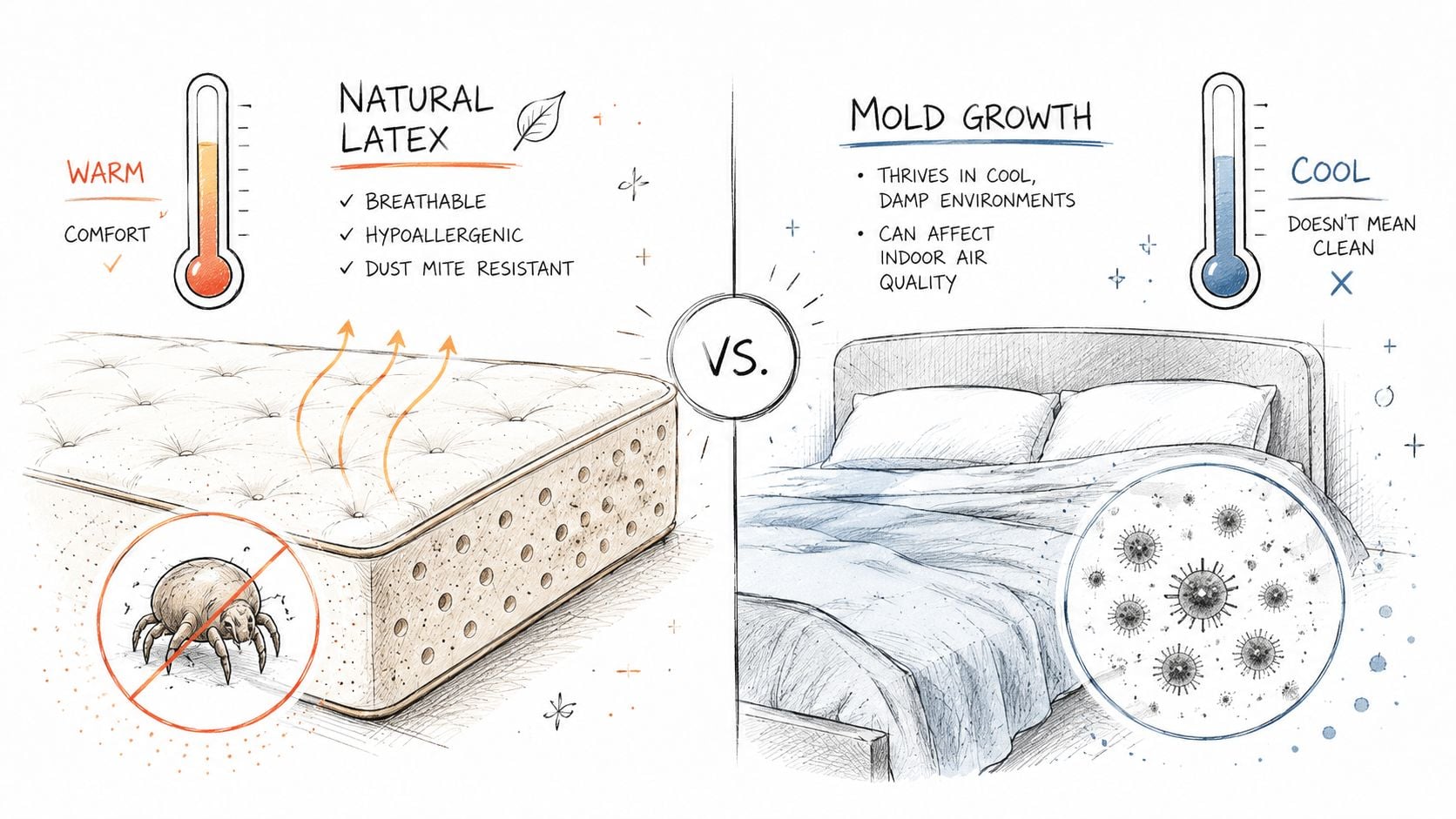
A cooler mattress isn't automatically a cleaner mattress. Temperature affects comfort, while microbial behavior, moisture, covers, ventilation, and cleaning routines affect hygiene.
The Korean Journal of Public Health research listed in the verified data found strong antimicrobial activity for latex across test conditions. Reported microbial reduction rates for latex exceeded 99.9%, while memory foam often remained below the threshold associated with meaningful antimicrobial activity. The Korean public-health paper provides a rare quantified comparison in a category where most guides focus only on cooling and softness.
That doesn't mean latex makes a mattress maintenance-free. Sweat, spills, pets, poor ventilation, and an unwashed cover can create problems on any bed. A washable, removable cover and a properly fitted protector matter more than a natural-material label alone.
Shoppers concerned about household allergens should ask for documentation rather than accept broad claims. CertiPUR-US concerns emissions and certain chemical content in certified polyurethane foams. GOLS relates to organic latex standards and supply-chain requirements. Those certifications answer different questions, so a retailer should identify which component carries which certification.
- Asthma or eczema concerns: Ask about cover materials, ventilation, and certification paperwork.
- Pet dander: Use a washable protector and maintain regular cleaning.
- Humid rooms: Prioritize airflow and moisture control, not just a “cooling” label.
- Odor sensitivity: Ask whether the mattress is likely to have noticeable off-gassing.
Readers who need a plain-language explanation of household pests can review bed bugs and dust mites explained. The practical verdict is straightforward: latex may offer a hygiene advantage, but cleanliness still depends on the entire sleep system and the room around it.
What to Test In-Store and How to Care for Your Pick
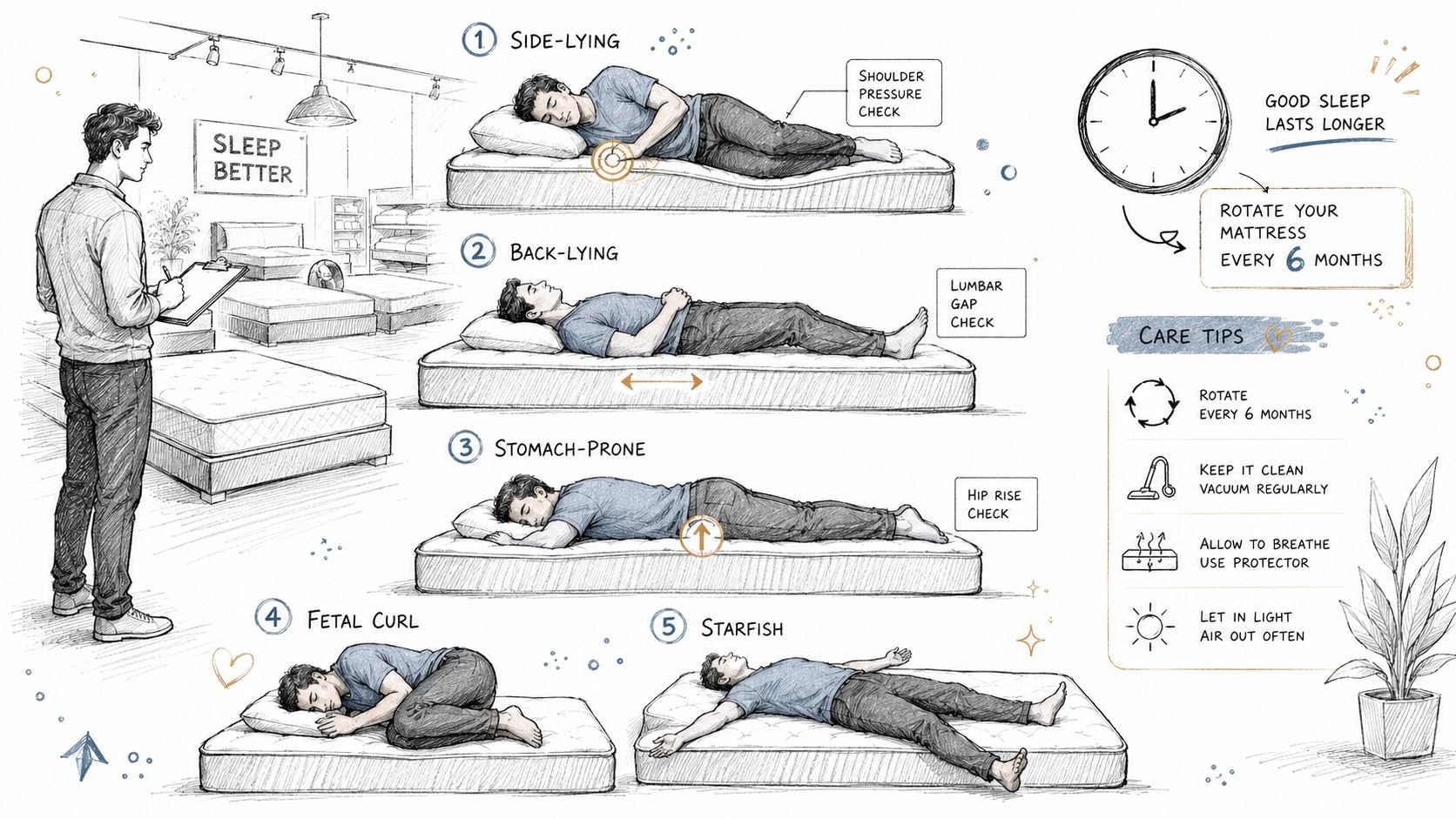
A showroom test should resemble actual sleep, not a quick sit followed by a purchase. Lafayette shoppers should test each serious contender in the positions used at home and pay attention to pressure, alignment, movement, and edge stability.
The showroom checklist
- Side position: Lie on one side and check whether the shoulder and hip feel compressed. The body shouldn't feel twisted or forced upward.
- Back position: Notice whether the lumbar area feels supported or whether the hips sink below the torso.
- Stomach position: Check whether the midsection drops too far or whether the surface feels uncomfortably hard beneath the chest.
- Edge sitting: Sit near the edge to evaluate compression when getting dressed or standing up.
- Partner movement: Have a partner roll and change position while the other person watches whether movement travels across the surface.
The 15-minute rest rule is useful because memory foam can change as it responds to body heat and pressure. A fast first impression may not represent the feel after sustained contact. Shoppers should bring the pillow used at home, note the usual sleep position, and discuss body weight with the floor team because those details affect support.
Protecting the purchase
During the first 24 months, households should follow the manufacturer's care instructions closely. That includes using the correct foundation, rotating the mattress when permitted, placing a breathable protector over the surface, and registering the warranty.
Warranty language deserves close attention. Stains, unsupported foundations, altered covers, and improper handling can complicate a claim. The delivery team should confirm the intended room, access route, old-mattress removal terms if available, and setup requirements before the truck arrives.
Lucas Furniture & Mattress serves Lafayette through in-home delivery from its Kokomo showroom and outlet. The store can also discuss simple financing, product availability, warranty registration, and whether a mattress is available for pickup or delivery. Policies and timing should be confirmed directly before purchase, especially for queen and king sets.

Bring these items: the household pillow, sleep-position notes, partner feedback, room measurements, foundation details, and a realistic delivery-access plan. That preparation turns a mattress visit into a useful test instead of a rushed guess.
Quick Answers for Lafayette Mattress Shoppers
Which material suits hot sleepers? Latex is the stronger starting point because it's generally more breathable, while traditional memory foam can retain body heat. The floor team at Lucas Furniture can help compare cooling construction and available stock before a Lafayette shopper drives to Kokomo.
Which material suits heavier bodies? A properly constructed latex mattress or high-density memory foam model can work, but the right firmness, core support, and alignment matter more than the label. Shoppers should ask the team to demonstrate pressure mapping and explain the available comfort-trial terms.
Can a latex topper refresh an existing memory foam bed? It can change the surface feel and add resilience, but it won't repair a worn-out support core or correct major sagging. If the existing mattress has lost structural support, replacement is the more dependable solution.
Lafayette shoppers can confirm current availability, showroom hours, financing details, and online chat support directly with Lucas Furniture before making the trip. A quick conversation can also clarify whether the preferred mattress is available for in-home delivery to the Lafayette area.
Lucas Furniture & Mattress offers memory foam and latex mattress choices, a dedicated mattress center, simple financing, clearance and outlet savings up to 70% off, and in-home delivery serving Lafayette from its Kokomo showroom. Compare the materials in person, then visit Lucas Furniture & Mattress to check inventory, explore a custom order for other rooms, and choose the sleep setup that fits the household for years to come.