Experience our new Lafayette showroom — Now Open! Come Visit Us -->

Customizable Computer Desk: Design Your Dream Setup

If you're working from the kitchen table, a spare bedroom, or one corner of the living room, you already know what goes wrong with a bad desk. Your shoulders creep up. Cords spill everywhere. The surface is either too cramped for real work or too bulky for the room.
A customizable computer desk solves that problem by fitting the way you live and work. For many local shoppers looking for a furniture store near Lafayette IN or a trusted Lafayette furniture store, their goal isn't just buying a desk. It's building a workspace that feels comfortable on Monday morning and still looks good on Saturday afternoon.
People around Lafayette often want that mix of function and flexibility. They need a desk that works for remote meetings, homework, gaming, paperwork, and everyday family life. They also want a simple buying process, whether they're shopping online or making the short trip to Kokomo. If you'd like ideas before you choose a setup, these home office furniture ideas are a helpful place to start.
Your Guide to the Perfect Customizable Computer Desk in Lafayette
A desk used to be a simple rectangle with four legs. Modern usage differs.
Today's workspace has to do more. It may need room for a laptop and a second monitor. It may need hidden storage for bills and school supplies. It may need to tuck into a bedroom without making the whole room feel like an office. That's why more Lafayette households are looking at a customizable computer desk instead of settling for a one-size-fits-all piece.
A good custom setup starts with a few plain questions.
- How do you work most days: Laptop only, dual monitors, writing by hand, video calls, or a mix?
- Where will the desk live: Dedicated office, loft corner, bedroom wall, or open living area?
- What bothers you about your current setup: Back strain, clutter, not enough surface space, or poor style match?
- What needs to stay flexible: Storage, height, shape, finish, or future add-ons?
Those answers matter more than trends. A compact desk can be perfect for one person and frustrating for another. An L-shaped setup can feel like a dream in one room and like an obstacle in the wrong layout.
That local context matters too. Homes and apartments around Lafayette vary a lot, and many shoppers want to see options in person before ordering. A nearby showroom in Kokomo gives people a chance to compare finishes, storage styles, and room scale without guessing from a tiny screen. Add in in-home delivery for the Lafayette area, and the process feels a lot less complicated.
A custom desk doesn't have to mean complicated. It just means choosing the parts that make daily work easier.
Why a Custom Desk is the New Home Office Essential
The desk has become one of the hardest-working pieces in the house. It isn't only office furniture anymore. It often doubles as a planning station, study spot, charging hub, and creative workspace.

Better fit means better comfort
Most desk frustration comes from mismatch. The surface is too shallow, the height feels off, or the storage doesn't match the tools you use every day.
Customization helps you correct those basics. You can choose a shape that fits the room, a top that supports your monitor setup, and storage that keeps the surface open. That sounds simple, but it changes how a room works. When everything has a place, work feels less chaotic.
Health is driving demand
People aren't just shopping for looks. They're paying more attention to posture, movement, and daily comfort. That's one reason the category keeps growing.
The global market for contemporary height-adjustable desks is projected to grow by USD 2.75 billion from 2025 to 2029, and the office application segment was valued at over USD 6.94 billion in 2023, according to Technavio's contemporary height-adjustable desk market analysis. That projection reflects growing interest in hybrid work and health-focused office setups.
You can see why. A desk that supports better posture isn't a luxury if you spend hours there each week. It's part of your daily environment, like your mattress or your sofa.
Style matters in shared spaces
A lot of home offices aren't true offices. They're guest rooms, loft edges, finished basements, and living room corners. In those spaces, the desk has to work hard without looking out of place.
That's where customization helps again. You can lean warm and traditional, clean and modern, or something in between. You can pair your desk with nearby furniture so the room feels intentional instead of temporary. If your workspace sits near a sectional, media console, or bookshelf, those visual details matter.
It supports the whole home
A good desk doesn't only improve work hours. It also reduces clutter after hours.
When paperwork, chargers, headphones, and notebooks all have a home, the room settles down faster. That's valuable in family spaces where one area may shift from office to homework zone to evening lounge in the same day.
Designing Your Dream Desk A Breakdown of Custom Options
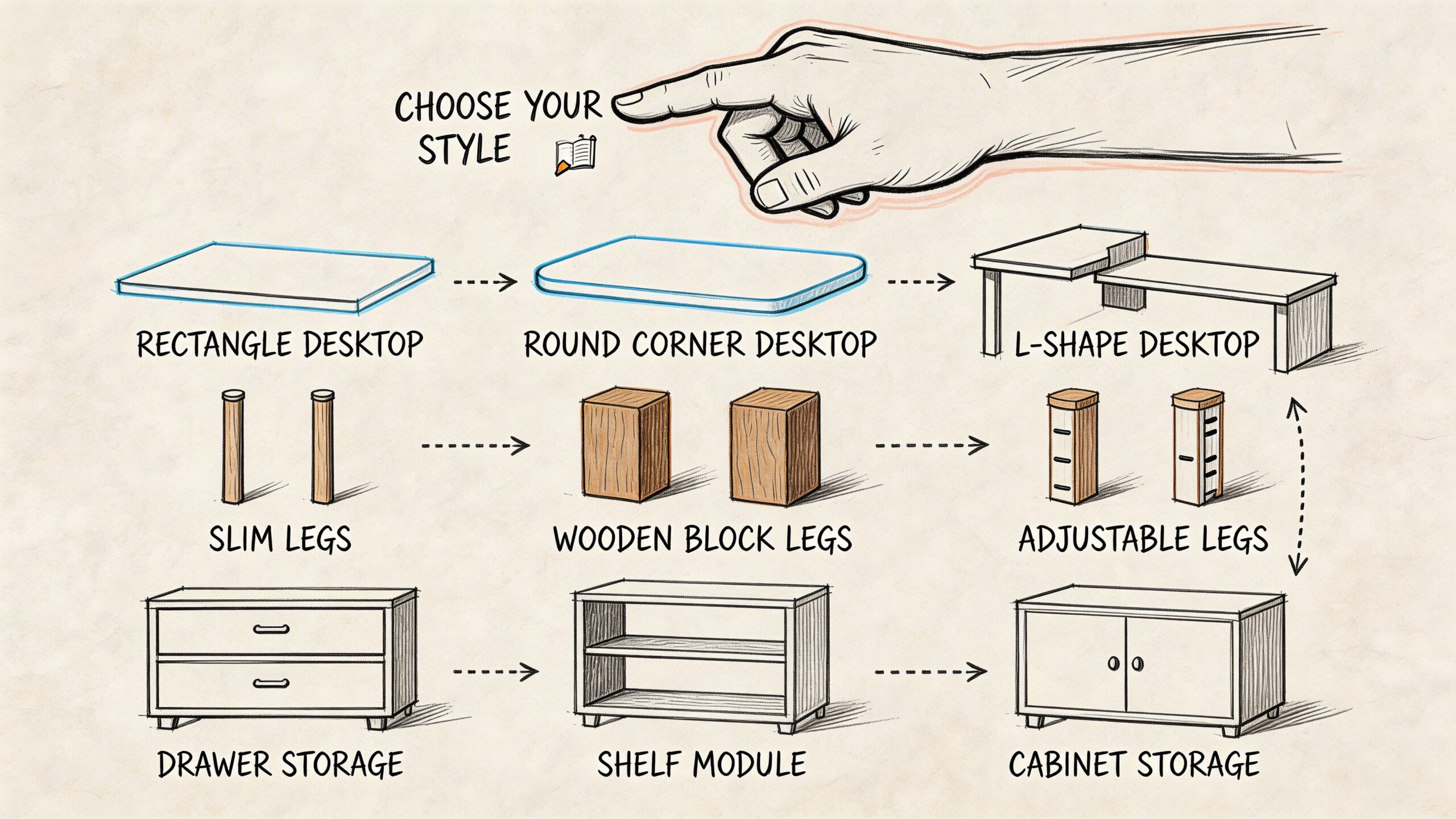
The easiest way to shop for a customizable computer desk is to build it in layers. Start with the shape. Then move to the surface. Then storage. Then the details that make the desk easier to live with every day.
Choosing your size and shape
Shape comes first because it controls how you move in the room.
A straight desk works well when the room is narrow or when you want the setup to read more like furniture than office equipment. It fits against a wall, behind a sofa, or under artwork without dominating the room.
An L-shaped desk gives you zones. One side can hold the computer. The other can handle writing, printing, sketching, or paperwork. That's useful if your workday includes switching tasks instead of staying on one screen for hours.
You might prefer:
- Compact straight desk: Good for bedrooms, apartments, and multipurpose corners.
- Executive straight desk: Better when you want a broader work surface but not a wraparound footprint.
- L-shaped configuration: Helpful for dual-task work, family use, or larger rooms.
- Convertible desk setup: Useful when flexibility matters more than a fixed, permanent office look.
If your setup includes a high-powered tower, multiple monitors, and accessories, furniture planning should happen alongside tech planning. For readers building a full workstation, this guide to a customized gaming PC can help you think through how the computer itself affects desk space, airflow, and cable routing.
Selecting materials and finishes
Many people get stuck at this stage. They know what they need the desk to do, but they don't know what finish will look right in the room.
Wood-look surfaces feel warmer and often blend better with bedroom and living room furniture. Dark finishes can look grounded and formal. Lighter tones usually make a small room feel more open. Metal details add a cleaner, more modern feel.
Instead of asking, "What's the best finish?" ask, "What else is already in the room?"
- If the room has warm wood tones, echo them.
- If nearby pieces are black, charcoal, or glass, a sharper contemporary finish may fit better.
- If the desk is in a shared family space, choose a finish that hides day-to-day wear and fingerprints more easily.
Practical rule: Match the desk to the room first, then to the trend. Trends move faster than furniture.
Integrating smart storage
Storage shouldn't be added as an afterthought. It should support how you work.
Some people need drawers for files, pens, and chargers. Others need one open shelf and a clean top. Parents often need a way to hide the workday quickly when the room shifts back to family use.
A few useful storage choices:
- Drawer units for documents and small items you don't want visible.
- Open shelving for books, baskets, and tools you use daily.
- Keyboard trays when surface depth is tight.
- Hutches or risers when you need vertical storage more than wider storage.
- Mobile storage pieces if you may move the desk later.
This is also where a custom order can help. Some shoppers don't need a fully bespoke desk. They just need the right top, leg style, and storage combination. In practical terms, that middle ground is often the smartest purchase.
For layout inspiration that shows how desks can work in living rooms, corners, and multifunction spaces, this guide to the ultimate guide to multifunctional home office furniture is worth saving.
The power of sit-stand ergonomics
Height adjustment is one of the most useful upgrades because it changes how your body uses the desk over the course of the day.
High-performance customizable desks use dual 18-volt DC motors and can lift at 1.7 inches per second, according to Xdesk's custom desk engineering overview. That faster movement helps users reach a comfortable position quickly and encourages more frequent posture changes, which the same source notes can reduce musculoskeletal strain.
You don't need the most advanced motorized system to benefit from ergonomics. What matters is that your desk supports a position you can maintain comfortably, and that it makes movement realistic instead of annoying.
That point is easy to miss. If changing height feels slow or inconvenient, people stop doing it.
Taming cords with cable management
Cable mess makes even a nice desk feel unfinished.
Good cable management keeps the workspace easier to clean and easier to use. It also matters more than people expect during video calls. Tangled cords, dangling chargers, and overstuffed power strips can turn a polished room into a stressful one.
Look for:
- Grommet holes for routing monitor and charging cords
- Modesty panels or backs that hide cable drop lines
- Under-desk trays to hold power strips and extra slack
- Monitor arm compatibility so cords move with the screen instead of across the top
A desk with smart cable planning often feels larger than it is because the usable surface stays open.
Among retailers that handle broader home furnishings, Lucas Furniture & Mattress offers custom order options for furniture in different finishes and configurations, which can be relevant when you're trying to coordinate a desk with existing bedroom, living room, or home office pieces.
Measure Twice Order Once Planning Your Workspace Layout
A desk can be beautifully built and still feel wrong if the layout is off. Most mistakes happen before the desk arrives.
Start with the room, not the product photo. Measure the wall, but also measure the path into the room, the swing of the door, and the space you'll need to pull out the chair comfortably. If the desk will sit near a bed, dresser, or sectional, leave enough room so the area doesn't feel pinched.
The three measurements that matter most
The desktop length should match your setup. Ergonomic standards recommend at least 48 inches (120 cm) for a single monitor and 60+ inches (150 cm) for dual monitors. Proper depth is 60 to 90 cm so your keyboard, mouse, and equipment fit comfortably without crowding, according to Okamura's guide to standard computer desk sizes.
That advice helps explain a common problem. A desk may look wide enough in a photo, but if it's too shallow, your monitor ends up too close and your keyboard area shrinks.
Before ordering, use this quick room-planning checklist:
- Mark the footprint: Painter's tape on the floor gives you a real sense of scale.
- Check chair movement: Include room behind the desk, not just the desk itself.
- Map the outlets: Know where your lamp, monitor, and charger cords will run.
- Watch the windows: Natural light is great until glare lands directly on the screen.
If you want a reliable way to plan the whole room before you commit, this guide on how to measure a room for furniture walks through the process clearly.
Think about sightlines and daily flow
People usually focus on the desktop and ignore the rest of the room. That's why a setup can fit on paper but still feel awkward in real life.
If your desk faces a wall, think about whether that helps you focus or makes the room feel closed in. If it faces the room, consider what shows in the background during calls. If it sits under a window, test the light at the time of day you usually work.
Leave enough open space around the desk so the room still works when you're not working.
Match the layout to the task
A writing-heavy setup needs room for paper and elbow movement. A screen-heavy setup needs enough width so monitors don't force head turning. A mixed-use family setup needs quick access to storage because the desk may need to look tidy fast.
Those small decisions prevent the regret that happens when a desk technically fits, but never feels easy to use.
Common Desk Configurations for Every Central Indiana Lifestyle
The most useful desk isn't always the biggest or the fanciest. It's the one that matches the way your day unfolds.
A lot of online advice skips over the hard part. It doesn't show how a desk should work in a mixed-use room, a rental, or a family home where work and life overlap. That gap matters because many buyers need a desk that can handle hybrid use cases such as childcare, creative work, and tight apartment layouts, as noted in this discussion of desk needs for multipurpose work-from-home spaces.
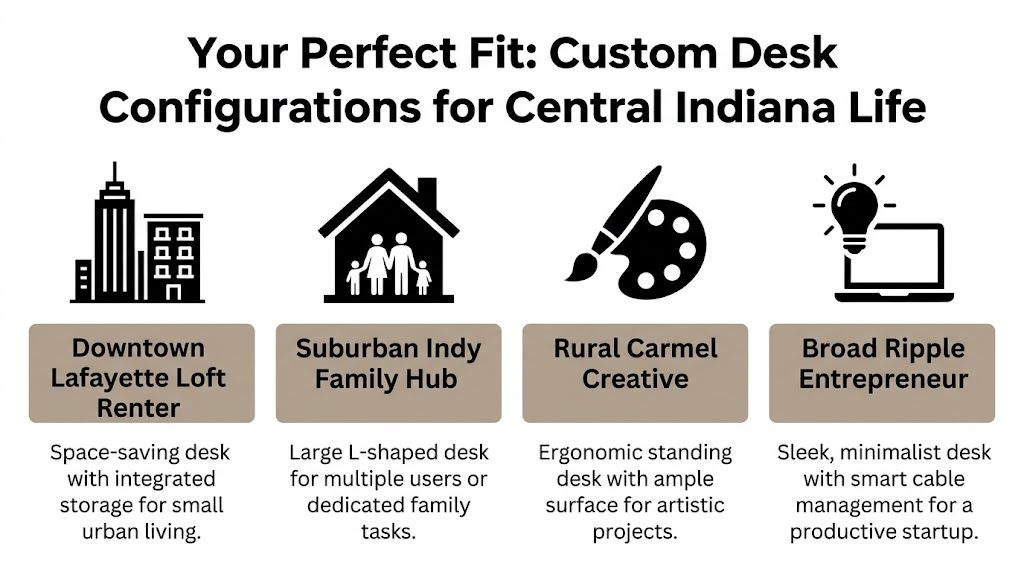
The downtown Lafayette loft renter
This person needs every inch to count. The desk may sit in a bedroom alcove or along one living room wall.
A compact straight desk with drawers or vertical shelving usually works best. It keeps the footprint contained and makes it easier to maintain a clean look in a smaller home. Lighter finishes can help the area feel less heavy.
The suburban family hub
This home often needs a desk that supports more than one role. One adult may work there during the day. Kids may use it later for schoolwork or projects.
An L-shaped desk is often the practical answer. One side can stay set up for a laptop or monitor, while the other stays open for paperwork, crafting, or family planning. In a larger room, nearby pieces like a sectional can define the lounge area while the desk anchors the work zone.
The creative freelancer
This person usually needs open surface area more than enclosed storage. Materials, notebooks, samples, or sketch tools need room to spread out.
A wider desk or standing desk with a clean top often works well. Modular storage nearby can hold supplies without interrupting the main work surface. If the desk sits near a window, the layout should support both natural light and screen visibility.
The entrepreneur in a shared room
Some people run a business from a guest room or mixed-use den. They need a professional backdrop, strong cable control, and a layout that feels polished on camera.
A clean-lined desk with hidden cord routing and limited visible clutter is a smart fit. Add a shelf, cabinet, or closed storage piece nearby, and the room can shift back to personal use after hours. The same logic applies outdoors too. If you're furnishing your whole home, keeping your office, living room, and even outdoor furniture style in sync creates a calmer overall feel.
Customizable desk configuration comparison
| Configuration | Best For | Typical Footprint | Lucas Furniture Example |
|---|---|---|---|
| Straight compact desk | Renters, bedrooms, small corners | Small and narrow | Desk with built-in storage or a slim profile custom order |
| Executive straight desk | Dedicated office users | Medium rectangular footprint | Larger writing or computer desk with matching storage |
| L-shaped desk | Families, multitaskers, dual-use rooms | Wraparound corner layout | Home office setup with expanded work zones |
| Height-adjustable desk | Users focused on movement and posture | Varies by top size | Adjustable desk paired with ergonomic accessories |
For more visual planning ideas, these home office furniture layout ideas can help you picture what works in real rooms.
Budgeting for Your Custom Desk Prices and Simple Financing
Price is where many shoppers freeze. They assume customization means the desk will jump into premium territory right away.
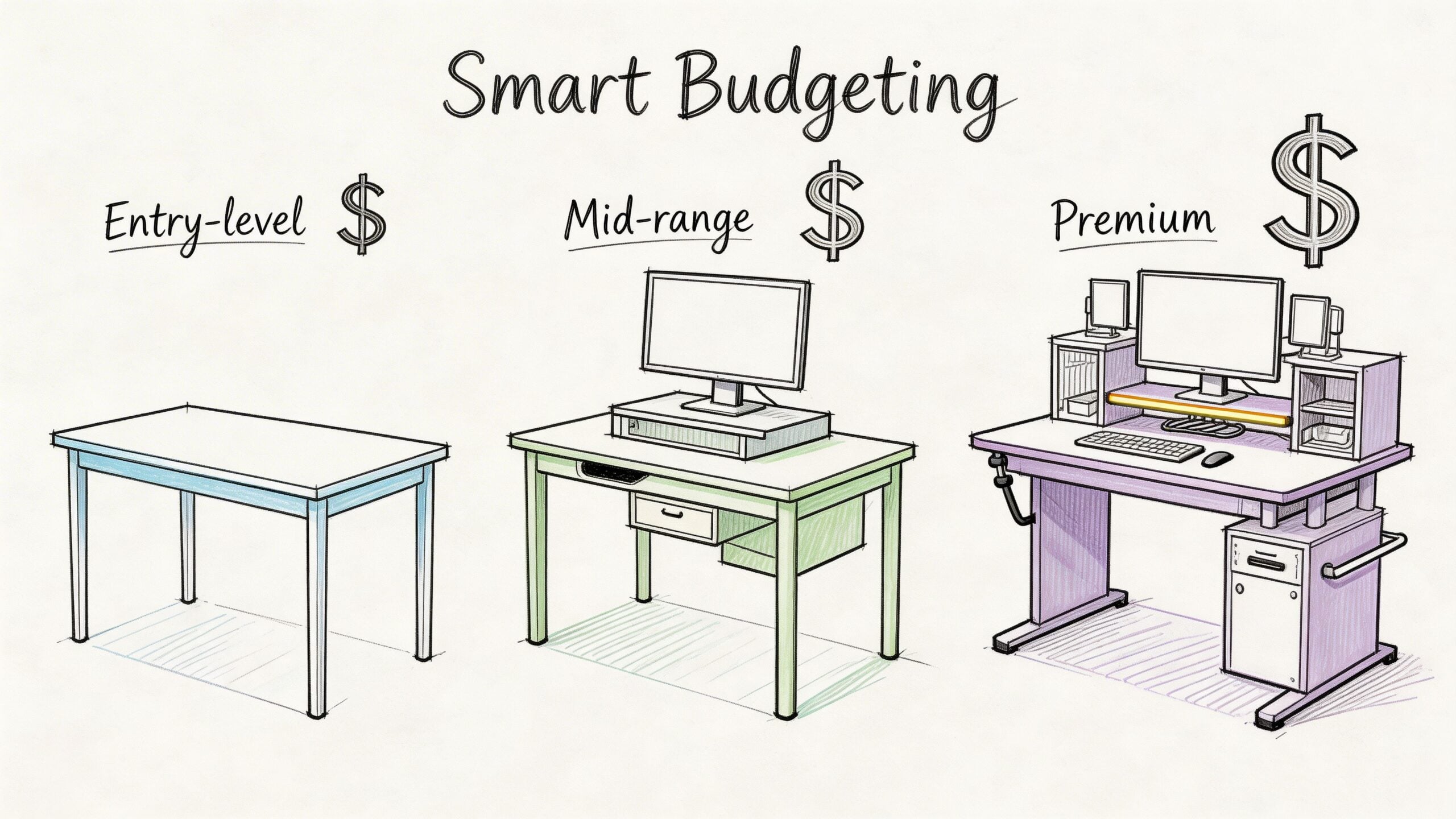
That isn't always true. Cost usually depends on which features you prioritize. Size, storage, materials, and adjustment type change the budget more than the word "custom" itself.
Where budgets usually go
If you keep the shape simple and focus on practical upgrades, a custom-feeling desk can stay much more approachable than shoppers expect. The budget usually climbs when you add motorized adjustment, larger surfaces, premium materials, and specialized storage.
A smarter approach is to rank your must-haves.
- Spend first on fit: Wrong size ruins the desk faster than a basic finish.
- Prioritize ergonomics you will use: Height adjustment matters if you'll change positions.
- Add storage with purpose: Don't pay for drawers you'll never open.
- Save on extras: Decorative add-ons can come later.
The budget trap to avoid
Some premium brands market desks with over 250 programmable positions, but much of the online advice still doesn't help budget-conscious buyers figure out how to get the most useful ergonomic features at a more affordable level, as discussed on Xdesk's l-shaped desk page.
That point matters. Not every advanced feature is necessary. They need a desk that supports comfortable height, solid monitor placement, and enough surface space for real work.
Buy the features that fix a daily annoyance. Skip the ones that only sound impressive in a product description.
Think beyond sticker price
A desk is easier to afford when you look at the full shopping path, not only the initial ticket. Clearance options, outlet finds, and simple financing can make a better setup realistic without forcing you to settle for the wrong size or style.
If you're comparing options and want to understand how payment plans work, these flexible financing options are useful to review before you shop.
That same value mindset often applies across the home. Many shoppers who upgrade a workspace are also comparing a mattress, replacing a sectional, or checking clearance pieces for another room. When you're planning multiple purchases, consistency in finish, function, and payment matters just as much as the desk itself.
Value doesn't mean bare-bones
A budget-friendly desk can still feel customized. A clean finish, the right width, monitor-ready depth, and thoughtful storage often matter more than luxury branding.
That's especially true for renters, first-time homeowners, and growing families. They usually need furniture that works hard now and adapts later.
The Lucas Furniture Process From Kokomo Showroom to Your Lafayette Home
Buying a desk goes more smoothly when you can picture the entire process before you start. Most shoppers want answers to practical questions. Can I browse online first? Can I see options in person? How does a custom order work? Who brings it to my house?
The path is fairly straightforward.
Start where you're comfortable
Some people want to compare styles online late at night after the kids are asleep. Others want to stand in front of a desk, open the drawers, and see how the finish looks in real light.
For local shoppers, the main showroom and outlet in Kokomo offers a broad in-person view of home furnishings, including home office options, along with related pieces like bedroom furniture, living room furniture, mattresses, and seasonal outdoor furniture. Shopping in person can make scale and finish decisions easier, especially if you're trying to coordinate a desk with existing furniture.
Use custom order options carefully
Custom order doesn't have to mean starting from scratch. Often it means selecting from available finishes, configurations, and complementary pieces so the final setup fits your room better.
That can be useful when:
- You need a specific finish: To coordinate with nearby storage or bedroom pieces.
- You want a certain layout: Such as a left-return or right-return desk shape.
- You need flexibility: Because the room serves more than one purpose.
- You're furnishing multiple rooms: So the home office doesn't feel disconnected from the rest of the house.
A lot of shoppers also bundle their planning. While choosing a desk, they may also look at bedroom furniture or review a mattress option for another room. If that's part of your project, the Mattress Guide is a practical resource to keep open in another tab.
Delivery matters more than people expect
A desk isn't a small impulse buy. Once you've chosen the right one, you want the final step to be simple.
In-home delivery to the Lafayette area removes a lot of stress from the process, especially with larger desks, L-shaped configurations, or homes where stairs and room access matter. That convenience can be the difference between a project that feels manageable and one that gets delayed for weeks.
Clearance and whole-home shopping can help
Many shoppers don't stop at the office. Once they improve one room, they start noticing the rest of the house.
That might mean checking clearance for a media console, replacing a worn mattress, adding a new sectional, or planning outdoor furniture for a patio. Looking at the whole home at once can lead to better style coordination and a clearer budget than buying each piece in isolation.
The easiest furniture projects are the ones where the desk fits your room, your routine, and the way you actually shop.
Maintaining Your Custom Desk for Years of Productivity
A desk lasts longer when you treat it like working furniture, not just decor. Daily habits matter.
Dust the surface often, and wipe spills quickly so they don't sit on the finish. Use the cleaning method that matches the material. Wood-look tops, laminate, and metal parts don't always respond the same way to sprays or abrasive cloths. If you're unsure, use a gentle cleaner and a soft cloth first.
For adjustable desks, keep the lifting area clear. Don't let cords snag during movement. Check hardware now and then so the desk stays steady, especially if you use dual monitors or shift the setup often.
A few easy habits help most:
- Use a mat or coaster: Protects the top from scratches and moisture.
- Avoid overloading one side: Better balance helps the desk feel solid.
- Manage cables regularly: Loose cords collect dust and catch on moving parts.
- Reset clutter weekly: A cleaner surface makes the desk easier to use.
A well-chosen desk should support years of work, study, planning, and everyday life.
If you're ready to create a workspace that fits your room and your routine, browse Lucas Furniture & Mattress online, explore clearance, financing, mattresses, sectionals, and custom order options, or make the trip to the Kokomo showroom. For Lafayette shoppers, in-home delivery makes it easier to bring the right desk and the rest of your furniture home without the hassle. Visit our showroom near Lafayette today, or browse our full inventory online with guaranteed in-home delivery to the Lafayette area!