Experience our new Lafayette showroom — Now Open! Come Visit Us -->

Hybrid Mattress vs Memory Foam: Lafayette Furniture Guide

A lot of Lafayette shoppers start the same way. They open a few browser tabs, read a few mattress descriptions, and quickly run into terms that sound helpful but don't feel clear: pressure relief, edge support, responsiveness, cooling, coil count, foam density.
That's where a local guide matters. For anyone looking for a furniture store near Lafayette IN or a dependable Lafayette furniture store for better sleep and full-home furnishings, the Kokomo showroom serving Lafayette gives shoppers a place to compare mattresses in person and arrange in-home delivery to the Lafayette area. That same trip can also cover a new sectional, dining set, home office setup, bedroom furniture, outdoor furniture, or clearance finds for the whole house.
The hybrid mattress vs memory foam question becomes clearer. Instead of guessing from product pages, Lafayette and Central Indiana shoppers can narrow the choice by understanding what's inside, how each type feels, and which one fits real-life sleep habits. For readers who want broader sleep habit ideas beyond the mattress itself, sleep-better habits and bedroom setup tips can help round out the decision.
Table of Contents
- Your Guide to Better Sleep from a Furniture Store Near Lafayette IN
- Deconstructing the Mattresses What Is Inside
- The Feel Factor A Head to Head Comparison
- Mattress Recommendations for Every Lafayette Sleeper
- How to Test and Buy Your Mattress Near Lafayette
- Why Lucas Furniture is Your Lafayette Mattress Destination
Your Guide to Better Sleep from a Furniture Store Near Lafayette IN
Mattress shopping usually gets confusing right at the moment a shopper thinks it should get easier. A bed may feel soft for thirty seconds in a showroom, but the important questions come later. Will it sleep hot. Will it support the lower back. Will the edge collapse when someone sits down to tie shoes. Will one partner feel every movement from the other side.
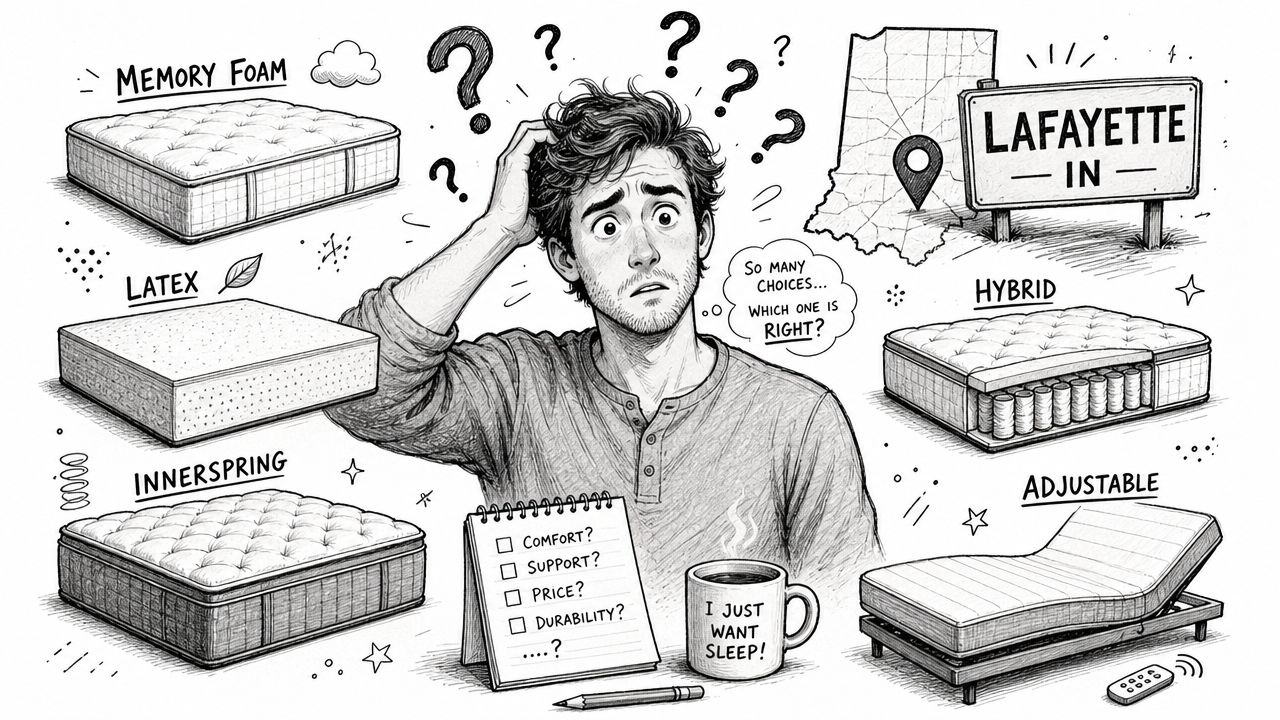
That confusion is common across Lafayette, West Lafayette, and the rest of Central Indiana. Many households aren't just buying a mattress. They're also furnishing a guest room, replacing a worn sectional, planning a custom order for a living room, looking at simple financing, or checking the clearance floor for value. A mattress decision often sits in the middle of a much bigger home decision.
A useful mattress guide should slow the process down and make the differences visible.
A mattress isn't only about softness. It's about how materials respond after hours of pressure, heat, turning, and repeated use.
For shoppers who want the short version first, this comparison helps.
| Feature | Hybrid Mattress | Memory Foam Mattress |
|---|---|---|
| Core build | Foam or latex over steel coils | Multiple foam layers only |
| Surface feel | More buoyant and responsive | More contouring and body-hugging |
| Cooling | Better airflow through coil base | Can retain more heat |
| Edge feel | More stable at the perimeter | More compression at the edge |
| Motion feel | Varies by build and partner size | Usually quieter and more absorbing |
| Best for | Shoppers wanting lift, airflow, and stronger edges | Shoppers wanting close contouring and reduced movement feel |
Lafayette shoppers often want unbiased help before they buy. That's especially true when the main showroom is in nearby Kokomo and delivery matters just as much as comfort. A good local furniture resource should make the trip worthwhile, answer questions in plain language, and help the customer leave with confidence instead of more confusion.
Deconstructing the Mattresses What Is Inside
The easiest way to understand hybrid mattress vs memory foam is to think about structure first. The inside of the mattress decides most of what happens on top of it.
What makes a hybrid a hybrid
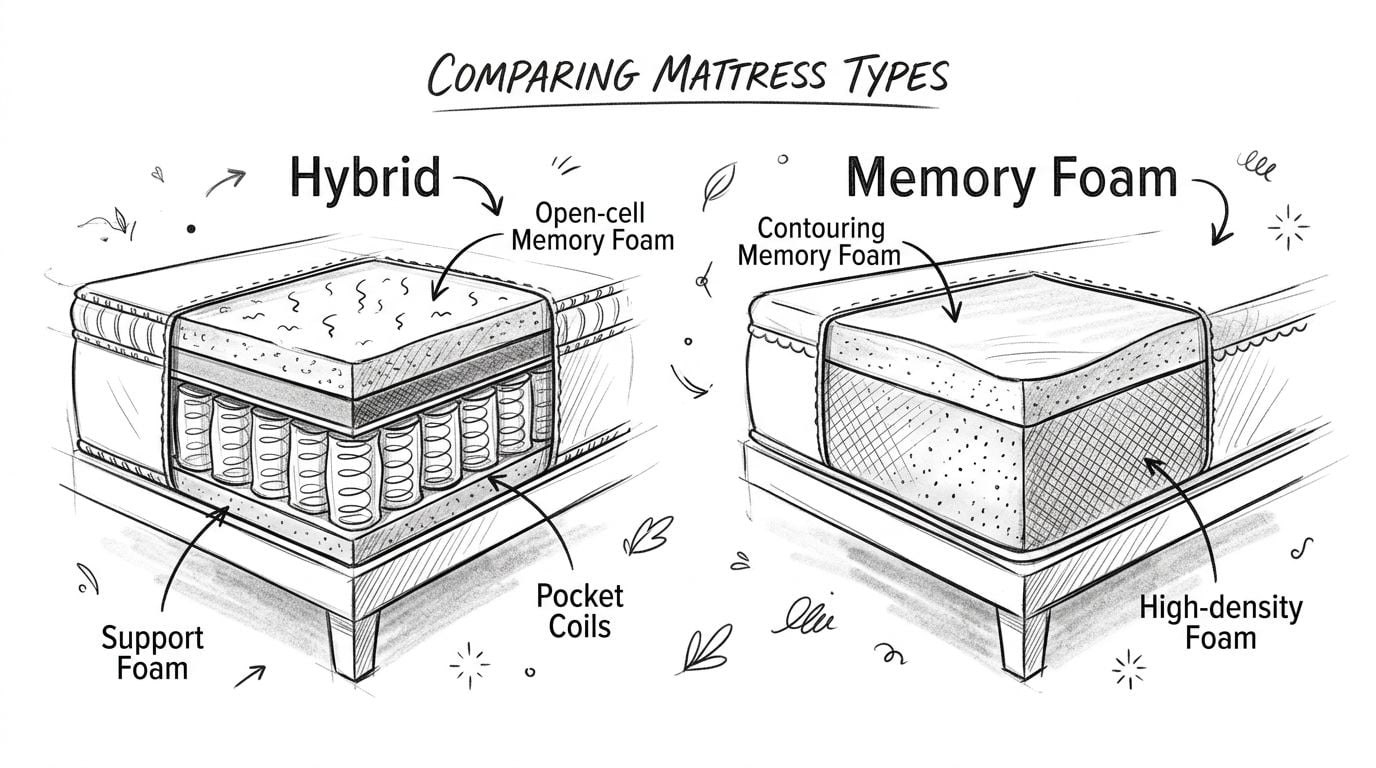
A hybrid mattress blends foam comfort layers with a coil support system. The construction matters because each layer has a different job. The top layers cushion shoulders, hips, and ribs. The lower coil unit does the heavy lifting for support and structure.
A hybrid mattress typically combines 2 to 4 inches of memory foam or latex over a support core of 600 to 1000+ steel coils, with coil density thresholds of 1 coil per 1.5 to 2 sq in for medium-firm models and 1 coil per 1 to 1.2 sq in for firm models, directly impacting pressure relief and edge support.
That sounds technical, but the takeaway is simple. More substantial coil support usually creates a mattress that feels more stable, especially near the sides. Shoppers who want more background on this construction can use a closer look at how a hybrid mattress is built.
What memory foam is doing under the cover
A memory foam mattress skips the coil system and relies on foam layers from top to bottom. Those layers respond to body heat and pressure by softening and shaping around the sleeper. That's why memory foam often gets described as a “hug” feel.
Verified construction details matter here too. Memory foam mattresses use 4 to 8 inches of viscoelastic polyurethane foam with density ratings of 3 to 5 lbs per cubic foot (PCF), where lower-density foams under 3.5 PCF soften faster with body heat and higher-density foams can hold shape longer. Density affects how quickly the bed changes feel during the night and how far a sleeper settles in.
Why shoppers feel the difference so quickly
A simple analogy helps. A memory foam mattress is like a layered cushion from top to bottom. A hybrid is more like a cushion built over a springy frame. Both can feel comfortable, but they distribute weight in different ways.
- Hybrid build: pushes back more quickly when someone changes position
- Memory foam build: takes the body shape more slowly and closely
- Hybrid perimeter: usually feels steadier when sitting or sleeping near the edge
- Memory foam perimeter: tends to compress more under concentrated weight
Practical rule: If a shopper dislikes the feeling of being “stuck” in bed, construction is usually the reason. The coil base changes that experience before firmness even enters the conversation.
This is why two mattresses labeled “medium” can feel completely different. Firmness tells only part of the story. Materials tell the rest.
The Feel Factor A Head to Head Comparison
A shopper in Lafayette might lie down on two mattresses labeled “medium” and still get two very different reactions in the first 30 seconds. One feels buoyant and easy to move on. The other settles in around the shoulders and hips like a mold that slowly takes shape. That immediate difference is what many people are really trying to sort out.
Feel and responsiveness
Hybrid mattresses usually feel more lifted and mobile. You get some cushioning at the top, but the coil system underneath adds a light pushback that helps the body change position without much effort. For combination sleepers, that can feel a lot like walking on packed grass instead of soft sand.
Memory foam feels closer and slower. It absorbs pressure and motion well, which many side sleepers and light sleepers appreciate, especially if a partner tosses and turns. The tradeoff is that some shoppers notice a “held in place” feeling when they try to roll over.
A simple way to separate the two. Hybrids tend to feel easier to move on. Memory foam tends to feel more body-conforming.
Temperature regulation
Temperature is often the deciding factor for Indiana shoppers who sleep warm. A hybrid usually gives heat more places to escape because air can move through the coil layer. Memory foam has fewer open pathways, so it can hold warmth closer to the body, even when the cover includes cooling features.
This part confuses a lot of shoppers. A cool-to-the-touch cover and a cool-sleeping mattress are not always the same thing. The cover affects the first few minutes. The support core affects how the bed handles heat over the course of the night.
At Lucas Furniture, this is one of the easiest differences to feel in person after a few minutes on each style, especially for couples comparing airflow against pressure relief.
Edge support and usable sleep space
Edge support changes how much of the mattress feels usable. That matters for couples, anyone who sits on the side of the bed to get dressed, and older adults who want a steadier perch getting in and out.
Hybrids often feel more secure along the perimeter because coils can be reinforced around the outside. Memory foam edges usually compress more under concentrated weight. If you sleep near the edge or share a queen with a partner, that steadier border can make the bed feel bigger than its measurements suggest.
Motion control and shared sleep
Here memory foam often has the advantage. Its slower response can soften the ripple from a partner getting up early, a child climbing into bed, or a pet shifting around at the foot of the mattress. Hybrids can still perform well, but they usually feel a bit livelier because springs recover faster.
That does not make one category better. It just means couples often have to choose which annoyance matters more. Extra warmth and less contouring, or easier movement with a little more bounce.
For shoppers comparing specialty sleep surfaces too, the Aspen Falls guide to air beds is a helpful reference point because it shows how adjustable support feels different from both hybrids and memory foam.
Durability and long-term comfort
Long-term comfort depends on how well the mattress keeps the same feel over time. Hybrids often hold a more consistent surface because the coil unit carries part of the support load. Memory foam models can still last well, but lower-quality foams are more likely to show body impressions or a deeper settled-in feel as the years pass.
This is why firmness labels only tell part of the story. A “medium” hybrid and a “medium” memory foam mattress can start in the same category and age differently. If you want help sorting out feel versus firmness, this mattress firmness guide for different sleep styles and comfort preferences makes that distinction much clearer.
Quick decision view
| If the shopper wants… | Better fit |
|---|---|
| A more lifted, easier-to-move-on feel | Hybrid |
| Closer contouring around shoulders and hips | Memory foam |
| Better airflow for warm sleeping | Hybrid |
| Less partner disturbance from movement | Memory foam |
| A steadier edge for sitting or sleeping near the side | Hybrid |
| A slower, more cushioned response | Memory foam |
Softness alone is not enough to choose well. The better question is how you want the mattress to respond when you move, heat up, sit on the edge, or share the bed.
Mattress Recommendations for Every Lafayette Sleeper
The right choice depends less on trend and more on who's sleeping on the mattress. Sleep position, body weight, and whether the bed is shared change the answer quickly.
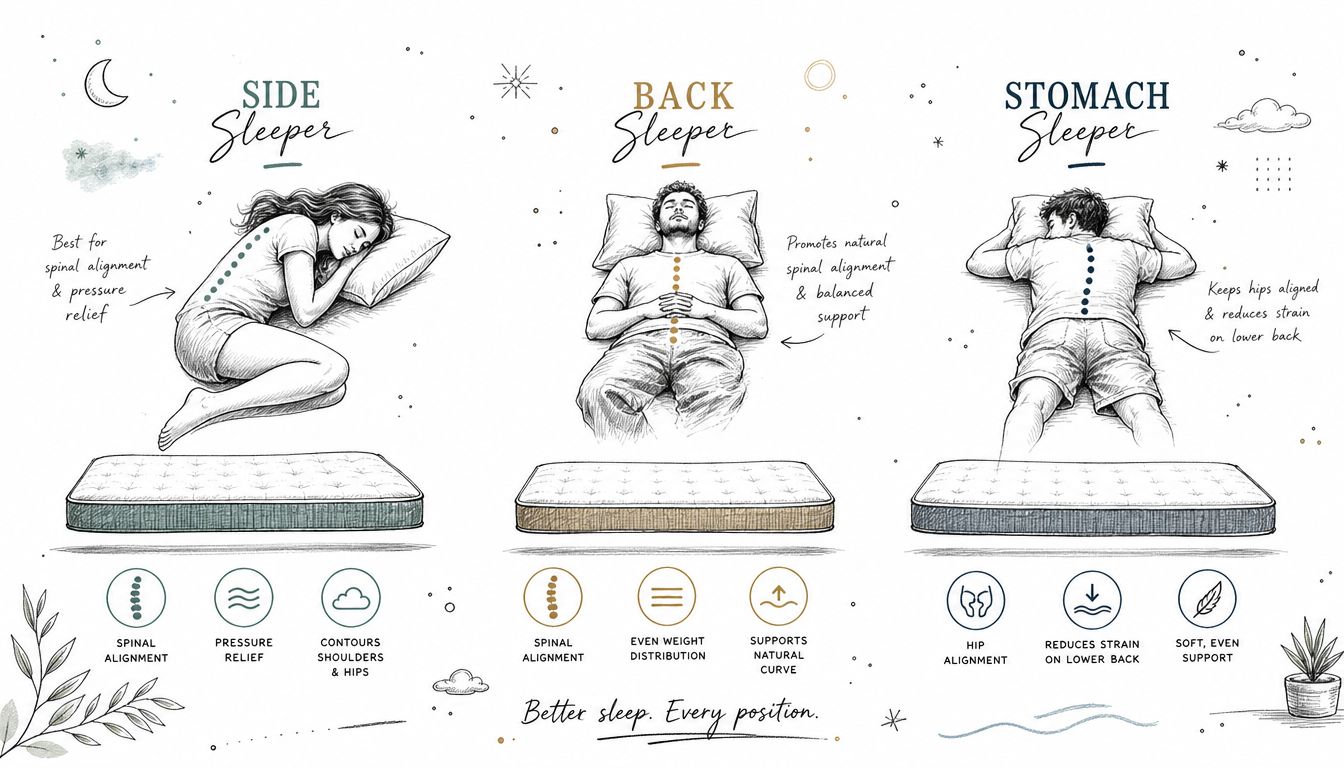
Side sleepers, back sleepers, and stomach sleepers
Side sleepers usually need enough give at the shoulder and hip so the spine doesn't bend awkwardly. Memory foam often appeals here because it contours closely. But side sleepers also need enough support underneath that contouring so the body doesn't drift out of alignment.
Back sleepers often want a balanced feel. Too much sink can flatten the lower back area. Too much firmness can create pressure. Many back sleepers end up comparing medium to medium-firm options across both mattress types.
Stomach sleepers usually need a flatter, steadier surface so the midsection doesn't dip too far. That often pushes the decision toward a more supportive build.
The weight threshold paradox
This is one of the most important details many mattress articles skip. According to guidance on hybrid vs memory foam for heavier sleepers, individuals over 230 lbs often require coil support to prevent spinal collapse, yet can lose some pressure relief benefits. The same source notes that 42% of heavy side sleepers over 230 lbs report hybrid discomfort, while 68% of memory foam users in this weight group wake with pressure points.
That creates a real tradeoff. Heavier side sleepers often need the structural support of coils, but they may still crave a comfort layer that softens sharper pressure at the shoulder and hip.
A heavier side sleeper usually shouldn't choose the softest mattress in the room or the firmest one by default. The better target is support underneath with enough comfort material on top.
Couples and uneven body sizes
Couples often assume memory foam is automatically better because it absorbs motion well. Sometimes that's true. But partner size changes the answer.
For shoppers considering other adjustable sleep surfaces while comparing mattress types, Aspen Falls guide to air beds offers a helpful overview of another sleep option and what it can mean for comfort preferences.
A couple with similar builds may prefer one feel together. A couple with very different builds often needs to think beyond a simple “foam isolates motion” rule. That's one reason how to choose a mattress is often more useful when the shopper starts with body type and sleep style instead of brand names or buzzwords.
Simple matching guide
- Mostly side sleeping: lean toward pressure relief first, but don't ignore support under the hips and ribs.
- Mostly back sleeping: look for even support with enough cushioning to avoid stiffness.
- Mostly stomach sleeping: prioritize steadiness and reduced sink through the center of the mattress.
- Over 230 lbs: pay close attention to support structure, not just plushness on top.
- Sharing the bed: test movement, edge feel, and how each partner settles into the surface.
How to Test and Buy Your Mattress Near Lafayette
Reading helps. Lying down helps more.
A shopper visiting a showroom near Lafayette should test a mattress the same way it will be used at home. Sitting on the edge for a few seconds doesn't reveal much about pressure relief, alignment, or partner motion.
What to do in the showroom
Start with the usual sleep position. A side sleeper should lie on the side. A back sleeper should lie flat with arms in a normal resting position. A combination sleeper should roll once or twice and notice whether the mattress helps or resists movement.
Then check three things:
Pressure points
Shoulders, hips, and lower back shouldn't feel jammed or unsupported.Spinal posture
The body should look level and relaxed, not folded into the middle.Edge confidence
The perimeter shouldn't feel unstable if someone sits or lies near it.
What couples should notice
For couples, motion isolation should be tested together. One person should shift positions while the other stays still. The reaction often says more than product tags do.
According to motion-isolation guidance for hybrid and memory foam couples, in couples with more than a 100 lb weight gap, 57% of lighter partners report better sleep on hybrids due to independent coil response, while 71% of heavier partners report improved motion isolation on memory foam. That's a nuanced result, and it's exactly why couples should test side by side rather than assuming one material wins for everyone.
A shared mattress should be judged by the lighter sleeper, the heavier sleeper, and the space between them. One opinion isn't enough.
Buying with more confidence
A shopper should also ask practical questions before purchase:
- Delivery details: confirm in-home delivery to Lafayette and how setup is handled.
- Warranty language: read what counts as a defect versus normal softening.
- Price protection: ask how a Low Price Promise works on comparable products.
- Trial mindset: compare notes immediately after testing instead of relying on memory later.
For shoppers who want a checklist before visiting Kokomo, this mattress shopping guide can help organize the questions that matter most.
Why Lucas Furniture is Your Lafayette Mattress Destination
Buying a mattress often connects to a bigger home project. A Lafayette family may start with better sleep, then realize the guest room still needs a dresser, the living room needs new seating, or the patio could use an outdoor set before fall. Shopping at a full-home store makes that process easier because the pieces can be seen together instead of chosen from separate places.
Why choose Lucas Furniture our value proposition
Lucas Furniture & Mattress serves Lafayette from its Kokomo showroom and outlet. For Central Indiana shoppers, that means a nearby place to compare mattresses in person, then keep going if the bedroom project turns into a room project. The store is locally owned, focused on practical guidance, and built for shoppers who want clear answers without pressure.

That shows up in ways Lafayette shoppers can use:
- Low Price Promise: more confidence that the price is fair.
- Outlet and clearance selection: helpful for households balancing a mattress with other furniture needs.
- In-home delivery to the Lafayette area: less guesswork on how the mattress gets from showroom to bedroom.
- In-store and online shopping options: useful for shoppers who want to research first and test later.
Furnish every room and save big
A mattress is only one part of how a room works. If the bed supports your back but the bedroom still lacks storage, lighting, or a matching frame, the space can still feel unfinished. A store with living room furniture, dining sets, bedroom pieces, home office furniture, entertainment furniture, recliners, lift chairs, and outdoor furniture gives shoppers more ways to finish the job in one trip.
That matters for first-time homeowners, renters updating a whole apartment, and growing families making careful budget decisions.
Achieve better sleep and customize the purchase
Good mattress shopping also depends on clear explanations. Foam density, coil support, edge strength, and cooling materials can sound technical online. On a showroom floor, those details become easier to understand because you can connect the words to the feel. It works like test-driving a car after reading the spec sheet. Research helps, but your body confirms the choice.
A shopper who wants more flexibility can also look at our flexible financing options and clearance and outlet furniture savings. Many households also need a custom order to get the right fabric, finish, or configuration for the room, especially while matching a new mattress purchase with other furniture.
Shop your way online in-store and delivered to Lafayette
Some Lafayette shoppers want to lie on several beds, compare pressure relief, and ask questions face to face. Others prefer to browse online first, narrow the list, and visit only after they know what they want to test. Both approaches are reasonable, and a good local store should support both.
Lucas Furniture & Mattress gives Lafayette shoppers a nearby place to connect online research with an in-person decision. That closes a gap many people run into. Reading about hybrid vs memory foam is helpful, but confidence usually comes from trying the mattress, checking the height, feeling the edge support, and talking through delivery, financing, and room fit with someone who does this every day.
Visit the showroom near Lafayette today, or browse the full inventory online with guaranteed in-home delivery to the Lafayette area. Shoppers in Lafayette, Kokomo, and across Central Indiana can explore mattresses, sectionals, outdoor furniture, custom order options, simple financing, and clearance savings at Lucas Furniture & Mattress.