Experience our new Lafayette showroom — Now Open! Come Visit Us -->

Power Recliner vs Manual: Which Is Best for You?

Settling into a recliner at the end of a long day sounds simple. Choosing the right one often isn't. Many shoppers start with one practical question, then quickly run into several more: should the chair recline with a button or a lever, will it be comfortable every day, what happens during a power outage, and which option gives the better value over time?
For anyone looking for guidance from a furniture store near Lafayette IN, this decision matters because a recliner isn't just another seat. It often becomes the most-used spot in the house for reading, watching TV, recovering after work, or getting a few quiet minutes. Shoppers searching for a Lafayette furniture store usually want more than a quick yes-or-no answer. They want a complete ownership picture.
That's especially true for families across Lafayette, IN and Central Indiana, where room layouts, outlet placement, long-term maintenance, and occasional power interruptions can all affect whether a power model or a manual model feels like the smarter fit. Shoppers who visit the main showroom and outlet in Kokomo often compare recliners alongside a new sectional, a mattress, or even a whole living room refresh, and reliable in-home delivery makes that process easier for the Lafayette area.
Your Guide from the Furniture Store Near Lafayette IN
A good recliner choice starts with how the chair will be used. Someone recovering from a physically demanding job may care most about effortless reclining. A budget-focused shopper may want reliable comfort with fewer moving parts. A household replacing an older sofa may be thinking about how a recliner pairs with a sectional, fits a media room, or works in a smaller living space.
That's why the power recliner vs manual question is better treated as a decision about daily life, not just features on a tag. The best answer depends on body comfort, mobility needs, outlet access, and how much maintenance the household wants to deal with later.
For shoppers using a furniture store near Lafayette IN to narrow down options, it helps to start with buying basics before comparing mechanisms. A practical place to begin is this recliner buying guide, which walks through sizing, room planning, and comfort considerations.
What usually confuses shoppers first
The most common misunderstanding is assuming that power automatically means better and manual automatically means basic. In reality, each type solves a different set of problems.
- Power models work well for people who want smooth movement and precise angle control.
- Manual models appeal to shoppers who want simpler operation and more freedom to place the chair anywhere.
- Both types can feel comfortable in a showroom, but ownership differences show up later, once the chair is in everyday use.
A recliner can feel great for five minutes in a showroom and still be the wrong fit for a room, a budget, or a household routine.
Why local context matters in Lafayette
A shopper in a downtown apartment may focus on space and cord placement. A homeowner outside town may think harder about outages and long-term upkeep. Someone furnishing a whole room may also be weighing recliners against a custom order sofa, home office seating, clearance finds, or simple financing options for a larger purchase.
That local, practical view is what makes this comparison useful. Comfort matters. So do reliability, value, and how the chair fits real life in Lafayette.
How Each Recliner Works A Mechanical Deep Dive
The biggest difference between these recliners sits underneath the seat. Once that mechanism makes sense, the comfort trade-offs become much easier to understand.
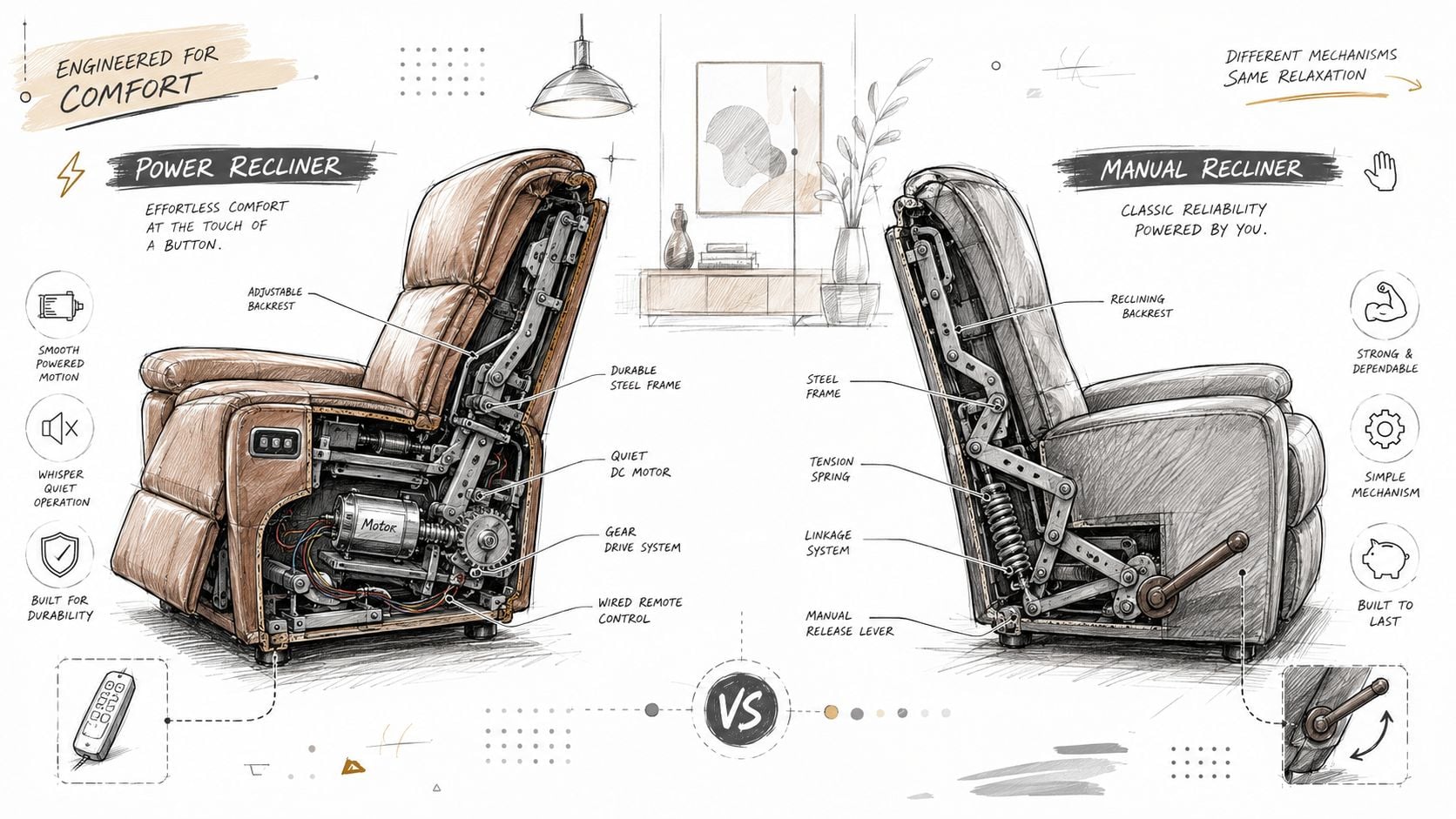
A power recliner uses a 29V DC electric motor connected to a motorized scissor lift. That setup allows infinite position locking and smooth motion without physical effort, according to this comparison of power and manual recliner mechanisms. A manual recliner, by contrast, relies on a cable-actuated lever system or the user's body weight, which usually limits the chair to a set number of discrete locking positions.
How a power recliner moves
When someone presses the control button, the motor drives the mechanism gradually. The back and footrest move with controlled precision instead of snapping into one or two preset angles.
That mechanical design matters because it allows micro-adjustments. If a reader wants the back slightly higher, or a napper wants the footrest up without leaning too far back, the chair can stop at that exact point instead of forcing the user into the next fixed stop.
A helpful follow-up for shoppers comparing feature sets is this guide to types of power reclining seating.
How a manual recliner moves
Manual recliners are simpler. A lever releases the mechanism, or the user shifts body weight to move the chair back. That simplicity is part of the appeal.
The trade-off is that manual chairs usually move through a smaller set of fixed positions. For some people, that's perfectly fine. They want upright, lightly reclined, or fully reclined, and nothing in between. For others, especially anyone particular about back angle or leg support, those fixed stops can feel limiting.
What the mechanics mean for everyday comfort
The mechanical difference changes the whole user experience.
Power recliner experience
The chair does the work. The user makes small, exact changes with little effort.Manual recliner experience
The chair responds to force and mechanical engagement. The user works with the mechanism instead of directing it precisely.
Practical rule: If exact positioning matters more than simplicity, the motorized mechanism usually makes the difference.
That doesn't make manual recliners outdated. It means each design is built around a different idea of comfort. One prioritizes precision. The other prioritizes straightforward function.
Comparing Day to Day Comfort and Ease of Use
The daily experience is where most households decide what matters most. A recliner may look similar across models, but living with it every evening reveals big differences.
Power vs Manual Recliner At a Glance
| Feature | Power Recliner | Manual Recliner |
|---|---|---|
| Operation | Button-controlled movement | Lever or body-weight operation |
| Recline positions | Infinite position locking | Set number of locking positions |
| Fine tuning | Micro-adjustments for comfort | Limited adjustment points |
| Effort required | Minimal physical effort | Requires physical input |
| Added convenience | Often includes comfort-focused extras such as adjustable support and charging features | Simpler design with fewer built-in extras |
| Outlet need | Yes | No |
What comfort feels like in real life
A power recliner tends to offer a more custom fit. Instead of choosing between “not enough” and “too far back,” the user can stop almost exactly where the body feels supported. That's especially useful for someone alternating between reading, watching TV, and dozing off in the same chair.
Manual recliners feel more straightforward. Many people enjoy that simplicity because there's less to think about. Pull the lever, lean back, and relax. If the available positions line up with the user's preferences, the chair can feel completely satisfying without any extra electronics.
Shoppers looking specifically at support concerns may also find this guide to recliners for back support useful.
Why power models keep gaining attention
Consumer preference has shifted toward motorized recliners. Power recliners are projected to capture over 50% of all recliner sales in 2026, reflecting stronger demand for motorized convenience and precise positioning, according to this overview of recliner trends.
That shift makes sense when viewed through everyday use. Many shoppers don't just want a chair that reclines. They want a chair that lets them make small comfort changes without bracing their legs, pulling a lever, or settling for an angle that feels close enough.
Where people often get stuck
The confusion usually comes from testing a chair too briefly. In a showroom, both styles may seem comfortable. The difference shows up after repeated use.
- For someone with joint stiffness a manual chair may feel harder to operate than expected.
- For someone who likes simplicity a power chair may feel like more mechanism than necessary.
- For shared household seating the power model often adapts better to different body types and comfort preferences.
The best recliner isn't the one with the most features. It's the one the household will enjoy using every day without frustration.
Power recliners also tend to be associated with features such as adjustable headrests, lumbar support, and USB charging. Those extras don't matter to every shopper, but they do support the broader appeal of motorized convenience. Manual recliners remain strong options when lower complexity and straightforward operation matter more than customization.
Reliability Maintenance and Power Needs
Comfort sells the chair. Ownership experience decides whether the purchase stays satisfying.
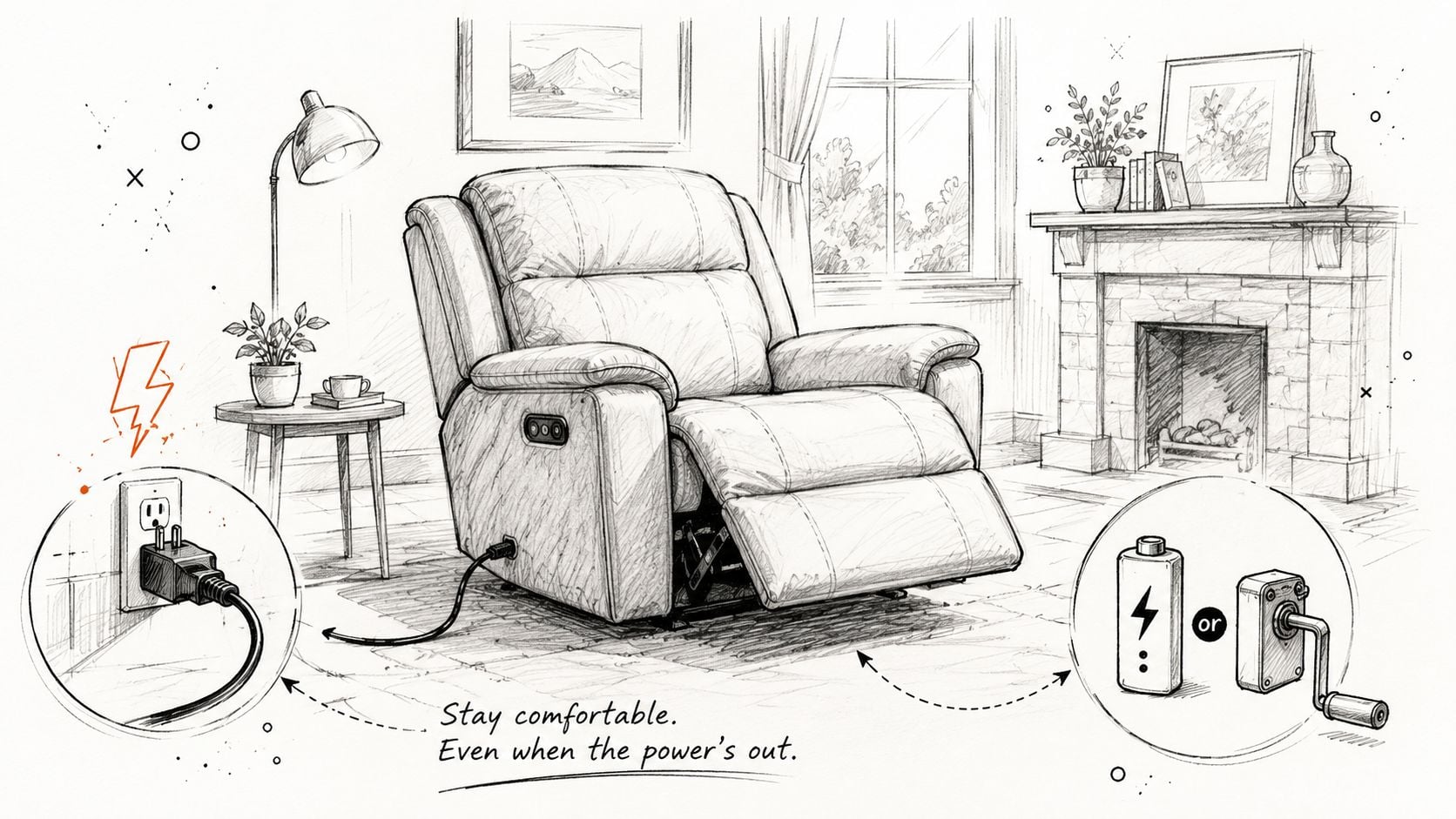
The issue most buying guides skip is what happens when electricity disappears. That's a real concern in Central Indiana, especially for homes where outages happen often or the chair sits far from the most convenient outlet. According to this discussion of the emergency return gap in power recliners, 12% of power recliner service calls in 2024–2025 were due to users being unable to return the chair after power loss.
The power outage problem
A manual recliner can usually be returned upright with body weight or the release lever. A power recliner may need a manual override release, often a hidden cord or key, if the motor stops or the power goes out mid-recline.
That doesn't mean power recliners are a bad choice. It means buyers should ask one simple question before purchase: how does this chair return to upright if electricity fails?
A good background read for that topic is this explanation of what a power recliner is.
A buyer who knows where the manual override is before delivery will handle an outage far more calmly than a buyer discovering it for the first time in the dark.
Simplicity versus complexity
Manual recliners benefit from having fewer systems involved. Fewer electrical parts usually means fewer things that can go wrong. They also don't need to live near an outlet, which gives more freedom in furniture placement.
Power recliners ask for more planning. Cord placement matters. Outlet access matters. Long-term maintenance can involve both the mechanical frame and the powered components.
Cleanliness and protection over time
Maintenance isn't only about repairs. It also includes daily wear, upholstery care, and keeping moving parts clear of debris. Households with pets, kids, or heavy daily use often think about this after the purchase, not before it.
For readers exploring practical fabric protection ideas and general upkeep habits, recliner covers for Australian homes offers useful inspiration on preserving appearance and managing wear in active households.
Placement questions worth asking
- Is there an outlet where the chair will sit?
- Will the cord path stay safe and tidy?
- Would an outage be a minor nuisance or a serious problem for the person using the chair most?
- Is the household more comfortable with simple mechanics or powered convenience?
For some homes, those answers push the decision strongly toward manual. For others, the comfort benefits of power still outweigh the extra planning.
Cost and Value A Complete Financial Picture
Price matters, but the sticker price alone doesn't answer the value question. A recliner purchase works better when the shopper separates upfront cost from day-to-day payoff.
What the price gap looks like
According to this breakdown of power and manual recliner pricing, power recliners retail for an average of $200 to $800 more than comparable manual models. The same source notes that manual recliners typically start around $500 and fall within the $500 to $1,500 range, while power recliners often start around $1,400 and extend to $3,000 or higher.
That gap usually comes from the added motor, wiring, and electronic components. In other words, shoppers aren't just paying for movement. They're paying for powered movement, finer control, and a more feature-rich setup.
Where value can outweigh cost
A higher price can make sense if the chair solves a daily problem. If a user struggles with physical effort, wants exact positioning, or spends long stretches in the chair, the comfort return may justify spending more.
A manual recliner often delivers better value when the goal is simple, reliable relaxation without extra complexity. For many households, that's enough. The lower entry price can also free up budget for other room needs, such as a new mattress, home office furniture, or an upgraded sectional.
Making a larger purchase manageable
Furniture shoppers rarely buy in isolation. A recliner purchase can happen alongside a bedroom update, a dining room refresh, or outdoor furniture for the season. That's where pricing flexibility becomes part of the value conversation.
Options like flexible financing for furniture can help shoppers spread out costs when they'd rather choose the chair that fits their body and lifestyle instead of settling for the lowest upfront number.
Value check: The better financial choice isn't always the cheaper recliner. It's the one that meets the household's comfort needs without creating regret later.
Clearance and budget strategy
Shoppers who want power features but need more room in the budget often benefit from looking at clearance and outlet inventory first. That approach can open access to upgraded comfort while still keeping the total purchase practical. It also helps households balancing multiple priorities, especially when a recliner is just one part of furnishing an entire room.
Making the Right Choice for Your Lafayette Home
A clear choice usually appears once the recliner is matched to the person using it most. The room matters, but the user matters more.
For seniors and limited mobility
A power recliner usually fits best when physical effort is the biggest obstacle. Button-controlled movement makes the chair easier to adjust and easier to enjoy consistently. Small positioning changes can matter a lot for someone who needs support without strain.
In these homes, convenience isn't a luxury feature. It's part of daily comfort and usability.
For the budget-conscious shopper
A manual recliner often makes the most sense for shoppers who want dependable comfort and a lower entry price. It keeps the purchase simpler and avoids powered components that may not be necessary.
That can be an especially practical choice for first apartments, starter homes, guest rooms, or mixed-room furnishing projects where budget has to stretch across more than one category.
For the tech-forward household
Some shoppers want a chair that feels more integrated into modern living. They value precision, smoother movement, and comfort-focused extras. In that setting, a power recliner usually feels more satisfying over time because it aligns with the rest of the home's convenience expectations.
Households thinking about how the recliner fits a broader room design may also appreciate outside perspectives such as Revellia's insights on tricky decor, especially when balancing comfort with style choices that need to work long term.
For homes with kids and pets
This is often the hardest category because both options have advantages. A manual recliner has fewer powered components to worry about. A power recliner offers smoother motion and more precise stopping points.
The better fit depends on household habits:
- Choose manual if the household wants straightforward operation and fewer systems to think about.
- Choose power if the main user wants easier adjustment and more personalized comfort.
- Think about upholstery carefully if the chair will handle spills, pet hair, or heavy daily use.
For shoppers furnishing the full room
A recliner decision doesn't happen in a vacuum. It has to work with the size of the room, nearby seating, walking paths, and the look of the rest of the space. Some homes need a recliner that visually complements a sectional. Others need a custom order fabric to tie everything together.
The right answer for a Lafayette home often comes down to this: choose power when ease and precise support matter most. Choose manual when simplicity, placement freedom, and lower upfront cost matter most.
Why Lafayette Chooses Lucas Furniture and Mattress
The recliner decision is only one part of furnishing a comfortable home. Shoppers in Lafayette and across Central Indiana often need a place that combines variety, value, and practical help, not just a sales floor.
Why Choose Lucas Furniture? Our Value Proposition
Lucas Furniture & Mattress serves the Lafayette area from its main showroom and outlet in Kokomo, making it a practical option for shoppers who want a trusted Lafayette furniture store experience without giving up selection. The store is locally owned, known for strong customer reviews, and focused on comfort, value, and personal service.
The Low Price Promise speaks to shoppers who want confidence that they're getting a fair deal, whether they're buying one recliner or furnishing multiple rooms.
Furnish Every Room & Save Big
A recliner shopper often ends up comparing other categories too. Lucas Furniture serving Lafayette offers options for living rooms, dining rooms, bedrooms, entertainment spaces, and home office setups. Shoppers can also browse outdoor furniture, which matters for anyone updating a patio or deck seasonally.
For value-focused buyers, clearance and outlet savings are a major advantage, with savings up to 70% off clearance/outlet inventory. That can make a big difference for families balancing a recliner purchase with a new sectional, bedroom set, or dining table.
Achieve Better Sleep Your Mattress Options
Comfort doesn't stop in the living room. Lucas also offers a dedicated mattress center for shoppers who are improving both seating and sleep at the same time.
A strong starting point is the Mattress Guide, which helps narrow down comfort levels and sleep preferences in plain language.
Customize Your Comfort Simple Financing and Custom Orders
Some households need flexibility, not just inventory. Simple financing helps shoppers furnish now and pay over time, which can be useful when buying for a new home, a growing family, or a multi-room project.
Custom shoppers also have options. Custom order programs allow many pieces to be customized through fabric, finish, or configuration choices, which is especially helpful when a standard floor sample doesn't quite fit the room.
Shop Your Way Online, In-Store, and Delivered to Lafayette
Some shoppers prefer to browse online first. Others want to sit in the recliner, test the seat depth, and compare fabrics in person. Lucas supports both approaches.
The Kokomo showroom gives Lafayette-area shoppers a full in-person experience, while online browsing makes it easy to narrow down choices from home. Reliable in-home delivery to the Lafayette area helps finish the process without unnecessary hassle.
Visit Lucas Furniture & Mattress to compare power and manual recliners, explore clearance savings, review simple financing options, and shop a full selection of recliners, sectionals, mattresses, home office pieces, and outdoor furniture. Shoppers in Lafayette can browse online or stop by the Kokomo showroom, with guaranteed in-home delivery to the Lafayette area.