Experience our new Lafayette showroom — Now Open! Come Visit Us -->

Board under mattress: Pros, Cons, & Benefits


A mattress can feel fine for years, then suddenly start giving you that telltale dip in the middle. You wake up stiff, roll toward the center, and start wondering whether you need a whole new bed or just a smarter fix.
That’s where the old board under mattress trick comes in. People across Lafayette try it for the same reasons. A frame feels too flexible. Slats are too far apart. A box spring has lost its strength. Renters want a simple fix before replacing everything.
If you’ve been searching for help from a furniture store near Lafayette IN or a Lafayette furniture store, you’re probably not looking for theory. You want to know whether a board under your mattress will help, whether it could hurt your warranty, and when it makes sense to stop patching the problem and replace the support system instead.
Lucas Furniture & Mattress serves Lafayette from its Kokomo showroom and outlet, with reliable in-home delivery throughout the area. That matters because support problems rarely stop with the mattress alone. Sometimes the issue is the frame, the foundation, or the way the whole bed was set up in the first place.
Introduction
A sagging bed usually starts with a small clue. One side feels softer. The middle bows a little. You notice you sleep better in a hotel or even on the guest bed. Then one night you strip the sheets, look at the frame, and realize the mattress may not be getting the support it needs.
That’s a common situation in Lafayette homes, apartments, and student rentals. A mattress might still have life left in it, but the support underneath has changed. Slats shift. Box springs wear out. Metal frames flex more than people expect.
The appeal of a board under mattress is simple. It feels like a practical home fix. Put something firm underneath, flatten the surface, and stop the sag.
Sometimes that works. Sometimes it only hides a bigger issue.
A Lafayette furniture store should be able to explain the difference clearly, and that’s what this guide does. If you’re comparing advice from a furniture store near Lafayette IN, keep this in mind. The smartest sleep setup isn’t always the cheapest short-term patch. It’s the one that supports the mattress correctly, protects its life, and fits how you use the bed.
The Sagging Mattress Problem and the Plywood Solution
You strip the bed, press down on the center, and notice the problem is not always the mattress alone. A sag often starts lower down. The comfort layer on top gets blamed first, but the support system under it is what decides whether the mattress stays level or starts dipping.
A mattress sags for a few common reasons. The materials inside the mattress can wear out. The box spring or foundation can weaken with age. The frame or slats can leave too much open space, so the mattress bends where it should be held up.
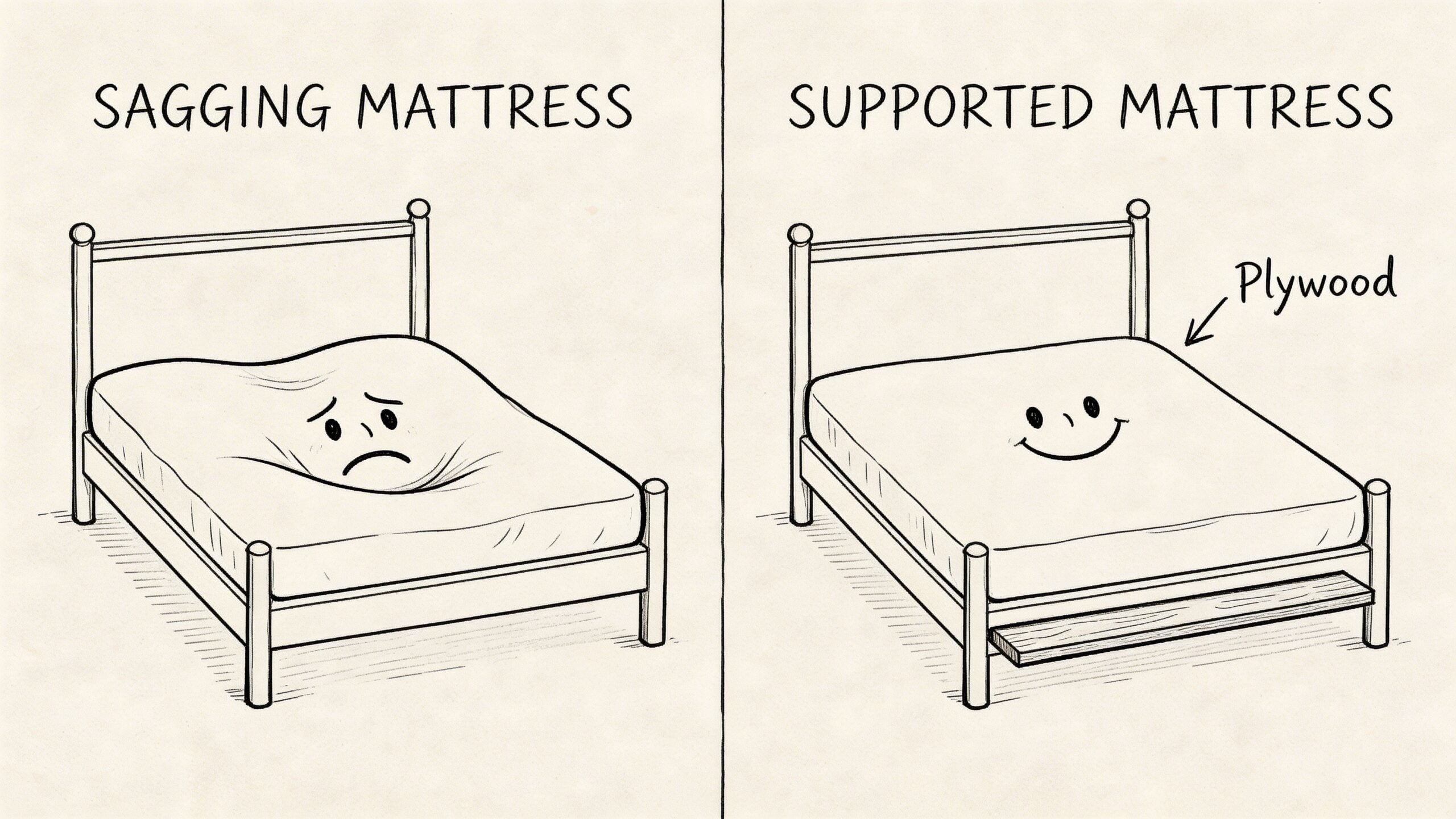
How sag happens
A mattress works a lot like a stretched canvas. If the frame underneath holds tension evenly, the surface stays flatter. If one part of the frame is weak, spaced too far apart, or bowed, the surface above starts to dip into that gap.
That is why two beds with the same mattress can feel completely different.
Common support problems include:
- Wide slat gaps that let the mattress sink between support points
- An aging box spring that no longer holds weight evenly
- A metal frame with flex in the center or along the rails
- A mattress with decent materials that is being let down by what sits under it
Why plywood seems to work
Plywood changes the surface under the mattress from uneven to flatter. Instead of the mattress pressing into spaces between slats or over a soft spot, the board spreads weight across a broader area. That can make the bed feel firmer and more even, at least for a while.
The key point is simple. A sheet of plywood does not rebuild worn foam or repair broken coils. It acts as a buffer between the mattress and a support system that is not doing its job well.
That is why this hack can be useful in the right situation. It can also be misleading. If the underlying problem is deep body impressions, a bowed frame, or a foundation that has reached the end of its life, the board may only cover up symptoms.
If you like practical household fixes, the same principle shows up in other rooms too. People dealing with a soft, uneven base sometimes look into installing a temporary wood floor over carpet to create a firmer layer above it. A mattress setup follows similar logic. The top performs better when the layer below is stable.
Temporary patch or part of a better sleep setup
For Lafayette households, a board under the mattress makes the most sense as a short-term test or a stopgap measure. It can help you figure out whether poor support is the issue before you spend money on a replacement. It can also buy a little time if slat spacing is the main problem.
Still, a board is not a full sleep solution strategy by itself. It does not address airflow, proper height, manufacturer support requirements, or the long-term strain on the mattress. In some cases, using the wrong support can also create warranty trouble later, which many generic DIY guides skip over.
If you are trying to sort out whether your bed should have a foundation, box spring, or another support system altogether, this guide on why you really do need a box spring for your bed explains how to match the support under the bed to the mattress on top.
What a Board Under Your Mattress Does
You feel it the moment you lie down. The bed seems softer in one spot, flatter in another, and you start wondering whether a simple board underneath will fix the whole problem.
A board can help, but only if you know what job it is doing.
Some Lafayette shoppers use “board under mattress” to mean any flat layer placed between the mattress and the bed frame. That can refer to a sheet of plywood from a hardware store or a bunkie board made for bedroom furniture. They can create a similar result, but they are not the same product and they are not meant for the same long-term use.
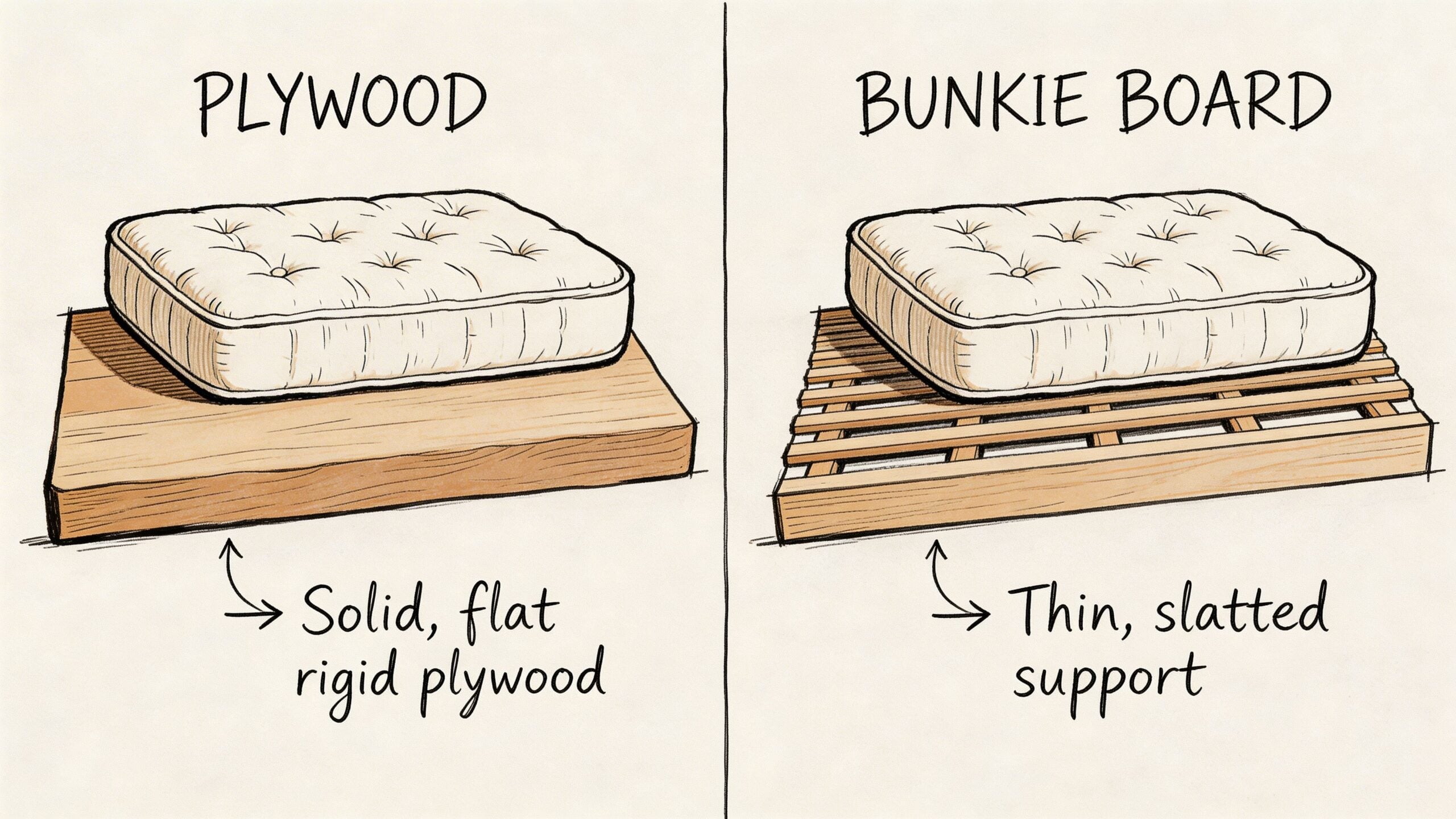
Plywood versus bunkie board
A bunkie board is a low-profile support layer built for beds that need a flatter surface without much added height. Mattress Warehouse explains that bunkie boards are usually 1 to 3 inches thick and were first used with bunk, trundle, and day beds before becoming common with many mattress types. The same source notes that 2 inches is a popular height because it helps keep the bed easier to get in and out of (Mattress Warehouse).
Plywood is simpler. It is a wood panel, not a mattress support product. It may firm up the surface, but it does not come with the design details you usually get from furniture-grade support pieces.
A clear way to separate them is this:
- Plywood is a DIY support layer.
- Bunkie board is a purpose-built support accessory.
- Foundation is the full base system matched to the bed and mattress.
That distinction matters because people often treat all three as interchangeable. They are not. A board changes how the mattress sits. A foundation is part of how the mattress is supposed to perform.
What the board changes
Putting a board under a mattress usually changes three things.
First, it makes the bed feel firmer because the surface beneath the mattress flexes less.
Second, it can smooth out an uneven feel caused by slats that are spaced too far apart or a support area that dips more than the rest. It works like placing a clipboard under a stack of papers. The top layer stops sinking into the gaps below.
Third, it can reduce the “between-the-slats” dip that some sleepers notice with foam and hybrid mattresses.
What it does not do is rebuild worn-out comfort layers inside the mattress. If the foams or coils are already breaking down, the board may make the bed feel different, but it will not make the mattress new again.
A board changes the support under the mattress. It does not repair wear inside the mattress.
Where people get mixed up
Homeowners usually expect a board to solve more than one problem at once. In practice, it helps most with support gaps. It may change firmness. It does very little for internal mattress wear.
That is why one person calls it a smart fix and another says it did nothing.
The better way to look at it is as one part of a larger sleep setup. If your mattress is in decent shape and the frame support is the weak point, adding a proper support layer can make sense. If the mattress is already aging, trapping heat, or showing body impressions, a board is only a partial fix. Good support works best alongside regular care, and these mattress maintenance and cleaning tips to extend its lifespan can help you get more life from the bed you already own.
If your issue is sliding rather than sagging, that is a different problem. Support and movement are connected, but they are not the same thing. This guide on how to stop a mattress from sliding is useful when the bed shifts even though the surface still feels level.
Critical Risks and Warranty Considerations
The internet tends to present a board under mattress as a harmless hack. It isn’t always harmless.
The two big concerns are wear and warranty compatibility. Foam and hybrid mattresses are the most sensitive to support problems, and that’s where homeowners and renters get into trouble.
Wide gaps and faster wear
A recent report cited in the verified data says 40% of foam mattress users with wide-frame boards experience 20% faster wear, and it links that wear problem to inadequate support and loss of mattress integrity (casper.com).
That matters because many people add a board without checking the full setup. They focus on the board itself and ignore the frame underneath. If the support system is still uneven, the mattress may continue wearing in the wrong places.
The airflow issue
Solid boards can also reduce airflow under the mattress. That’s especially important with foam. Foam tends to hold more heat than traditional innerspring builds, and a fully closed surface underneath can make the bed feel stuffier.
Moisture is another issue. Bedrooms aren’t sterile spaces. Bodies release heat and humidity overnight. A support layer that traps that moisture can create conditions you don’t want under a mattress.
Some bed problems don’t start in the mattress. They start below it, where poor airflow and weak support go unnoticed.
Warranty questions people miss
Many mattress warranties require the bed to sit on a support surface that meets the manufacturer’s rules. Those rules often address slat spacing and foundation type.
If you replace the intended support system with a DIY board, you need to know whether that setup still qualifies. If it doesn’t, a future claim can become much harder.
Here’s a plain-language comparison.
| Support choice | Good for | Main risk |
|---|---|---|
| DIY plywood board | Short-term leveling over weak slats | May reduce airflow and may not match warranty requirements |
| Bunkie board | Low-profile support where approved | Must still fit mattress and frame requirements |
| Proper foundation | Long-term matched support | Requires replacing part of the setup |
| New platform or frame | Full reset of support system | Bigger upfront decision |
When to pause before adding a board
Don’t rush into the plywood fix if any of these are true:
- You own a newer foam or hybrid mattress. Check support rules first.
- You still have an active warranty. Read the fine print before changing the foundation.
- The room feels humid. A solid sheet may make airflow worse.
- The mattress already shows visible wear. A board may not solve the core problem.
For routine care that helps you get more life from your bed, this guide to mattress maintenance and cleaning tips to extend its lifespan is worth keeping handy.
Your Guide to Proper Mattress Support from Lucas Furniture
A board under the mattress works best as a quick test, not a full sleep strategy.
If a bed feels noticeably better after you place a firm board under it, that usually points to a support problem under the mattress rather than comfort being the only issue. That clue matters. It can save a Lafayette shopper from replacing a mattress when the issue is a tired foundation, bent center support, or slats that no longer hold weight evenly.
Support affects more than feel on night one. As noted earlier, poor support is linked to a surprising share of mattress problems and returns, while proper support can help a mattress last much longer. That is why Lucas treats the board trick as a diagnostic step. It helps you identify the problem, then choose a setup that fits your mattress, frame, and budget.
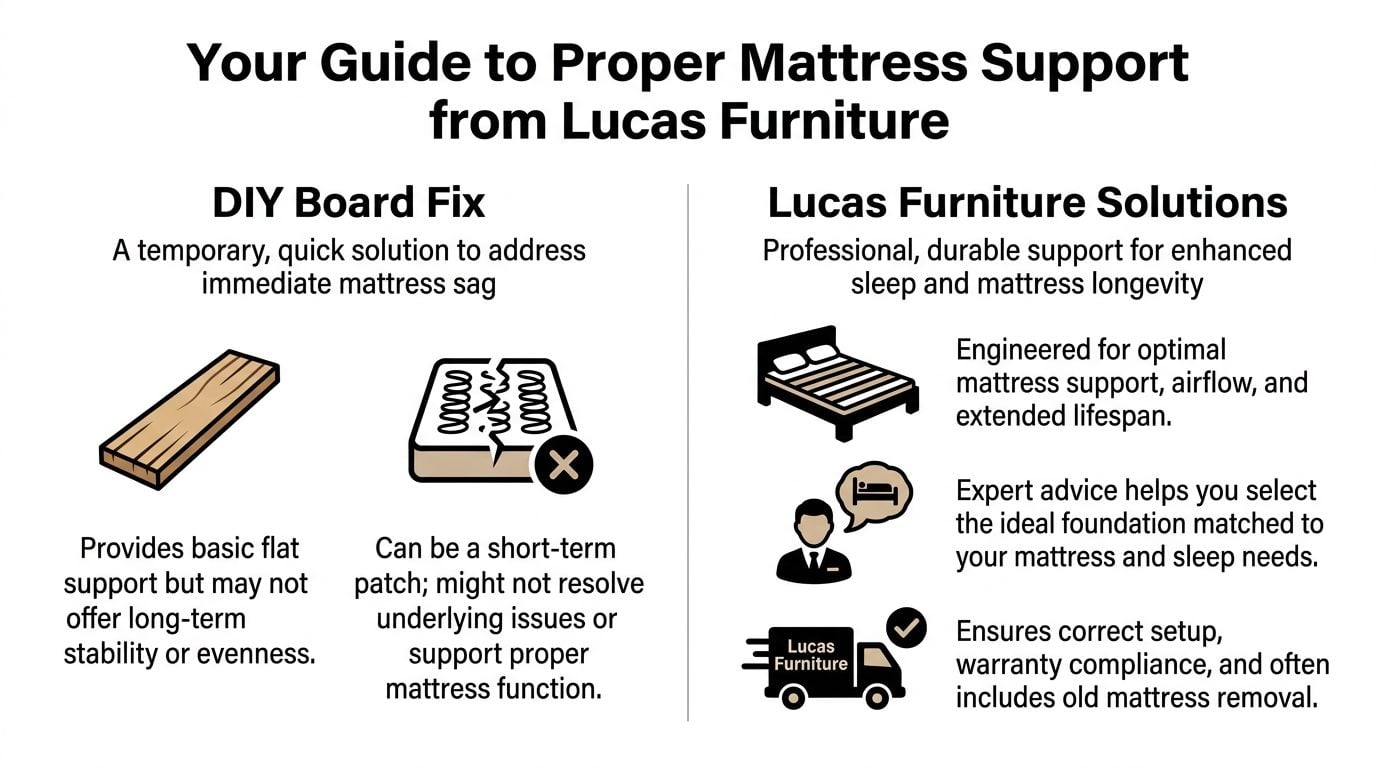
Four support paths people usually compare
Local shoppers usually compare the same four options. The right one depends on whether you are troubleshooting a sag, correcting an aging base, or rebuilding the whole bed setup.
| Support Solution | Best For | Pros | Cons |
|---|---|---|---|
| DIY board | Short-term troubleshooting | Fast, inexpensive, can flatten an uneven surface for testing | Can trap airflow, may shift, and is not always a good long-term match |
| Bunkie board | Low-profile beds that need a firmer layer | Slim, cleaner-looking, designed for mattress support | Must still match the mattress and frame |
| New box spring or foundation | Beds built for separate support units | Better long-term structure, more consistent support | You have to choose one approved for the mattress |
| Platform bed or updated frame | Worn-out frames or full bedroom updates | Improves stability and support in one change | Costs more upfront and changes bed height |
A simple way to picture it is this: a board is like wedging cardboard under a wobbly table leg to confirm where the wobble starts. It can prove something is wrong. It is rarely the final repair you want to live with for years.
How to decide which one fits your bed
Start by checking what improves and what does not.
If the mattress feels comfortable once it is resting on a flat, stable surface, the mattress may still have useful life left. In that case, replacing the foundation or frame often gives you more value than replacing the mattress first.
If the bed still feels uneven, lacks support, or shows body impressions even after the base is improved, the mattress itself may be worn out. A firmer surface underneath cannot rebuild foams or coils that have already broken down.
Use this decision pattern:
- Use a board temporarily if you are trying to confirm whether sagging starts below the mattress.
- Choose a bunkie board if your bed sits low and your mattress manufacturer allows that style of support.
- Choose a proper foundation if the mattress is still in good shape and the current base is the weak point.
- Replace the frame or move to a platform bed if the structure underneath has become part of the problem.
Worth checking: If you want a broader plain-English breakdown of different options for mattress support, that resource gives a useful overview before you compare products in person.
Why expert matching beats guesswork
Mattress support works like the suspension under a car. Two vehicles can use four tires and still ride very differently because the structure underneath is doing different jobs. Beds work the same way. A support system that feels fine under one innerspring can be a poor match for a foam or hybrid mattress.
That is where in-store guidance saves money. A Lucas team member can help you sort out whether the issue is the mattress, the slats, the center rail, the foundation, or a combination of all four. That keeps you from spending on a quick fix that only hides the problem for a few months.
If you are replacing more than one part of the setup, this guide on how to find the best mattress for your sleep style and support needs is a strong place to start. It helps you connect comfort, support, and bed design so the whole system works together.
Why Lafayette Chooses Lucas Your Local Furniture Store
A bed problem rarely stays in the bedroom alone. Once people realize support affects comfort, they start looking at the whole house differently. The sectional that doesn’t fit quite right. The dining set they’ve been meaning to replace. The home office that still feels temporary.
That’s one reason shoppers look for a furniture store near Lafayette IN instead of trying to piece everything together from random online orders.
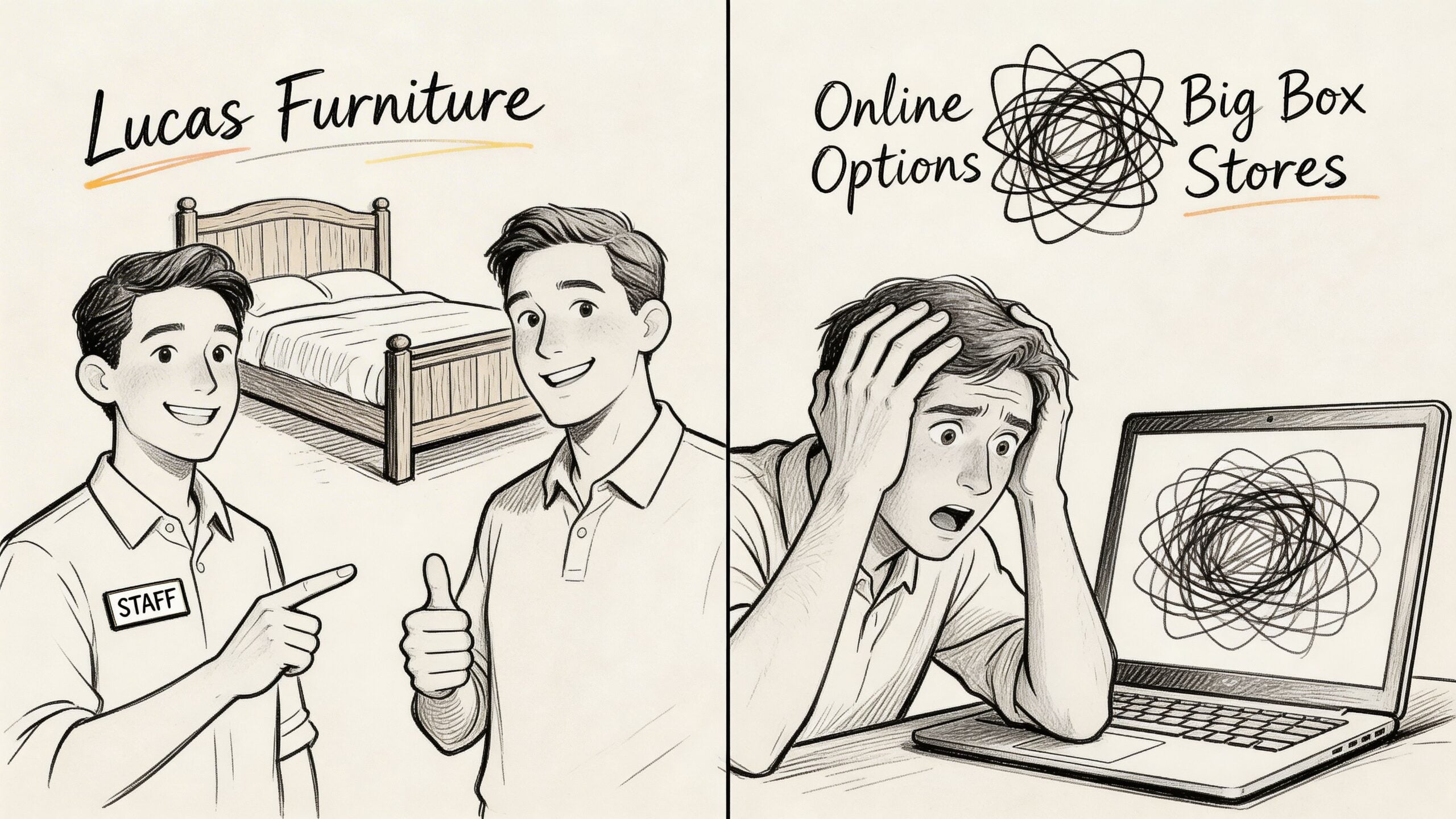
Why local guidance matters
A good local store does more than display products. It helps you avoid mismatched purchases.
That matters with mattresses, but it also matters with:
- Sectionals that need the right configuration for the room
- Bedroom furniture that has to work with bed height and layout
- Dining sets that fit the space without crowding traffic flow
- Home office pieces that need function, not just looks
A Lafayette furniture store should also understand the practical side of shopping in Central Indiana. Families move. Kids outgrow rooms. Renters need value. New homeowners want quality but don’t want to overspend correcting mistakes later.
The value side of the equation
Lucas Furniture is locally owned, serves Lafayette from Kokomo, and gives shoppers more than a single-price-path approach. That matters if you want options.
You can shop:
- Clearance and outlet pieces when savings lead the decision
- Custom order furniture when fit and finish matter most
- Mattress options across different comfort preferences
- Outdoor furniture when it’s time to improve the patio or deck too
The Low Price Promise, simple financing, strong reviews, and outlet savings up to generous discounts all make the store relevant for shoppers who want value without guessing. The point isn’t just to buy more. It’s to buy once, buy correctly, and avoid paying twice for the same room.
Buying local often means getting better answers before a purchase, not apologies after one.
Furnish Every Room and Save with In-Home Delivery to Lafayette
Once you solve the mattress support problem, the next step is usually straightforward. Decide whether you only need a sleep fix or whether this is the moment to upgrade more of the home.
For many Lafayette shoppers, it becomes a whole-room or whole-home project. The bedroom gets a better mattress setup. The living room gets a new sectional or recliner. The dining room finally gets finished. The home office stops looking like a spare corner.
What you can shop for
Lucas offers a broad mix of home furniture categories, including:
- Living room furniture such as sofas, sectionals, recliners, and lift chairs
- Bedroom furniture including beds, dressers, and coordinating pieces
- Dining room collections for everyday family use or a more polished look
- Home office furniture that helps the space function better
- Outdoor furniture for seasonal patio and deck updates
- Mattress choices for different comfort levels and budgets
- Clearance inventory for shoppers focused on savings first
How to make the process easier
A lot of people delay furniture purchases because they assume the process will be complicated. It doesn’t have to be.
A simple approach works best:
- Start with the problem room. If sleep is the issue, begin with the mattress and support setup.
- Set your budget range. That helps you decide whether to shop clearance, current collections, or custom order options.
- Use financing when it helps. Spreading purchases out can make a larger update manageable.
- Ask about custom orders. This matters with sectionals, fabrics, and finishes.
- Plan delivery early. For many households, in-home delivery is what turns a furniture purchase from stressful to easy.
Reliable delivery is a major part of the value for Lafayette customers. If you’re comparing options, in-home delivery details are available here.
Shopping online also helps narrow choices before visiting the Kokomo showroom. That’s useful if you want to browse at your own pace, compare styles, and then make a shorter, more confident in-store trip.
The biggest advantage is that you don’t have to solve everything alone. Whether you need a mattress, a supportive bed setup, a clearance bedroom set, a custom sectional, or updated outdoor furniture, one good decision can turn into a more comfortable home overall.
Visit Lucas Furniture & Mattress to browse online anytime or stop by the Kokomo showroom serving Lafayette and Central Indiana. If you need better sleep, a new mattress setup, clearance savings, custom order options, or simple financing for a full-home update, Lucas makes it easy with reliable in-home delivery to the Lafayette area.