Experience our new Lafayette showroom — Now Open! Come Visit Us -->

Fake Tree Stumps: Decor Ideas for Indiana Homes


A homeowner in Lafayette can make a room feel finished with the right natural accent, but a real stump is usually the wrong answer. It rots, gets heavy fast, attracts trouble outdoors, and rarely lands where a modern living room or patio needs it. That's why fake tree stumps have become a smart styling choice for people who want rustic character without the mess, especially when they're shopping at a furniture store near Lafayette IN and want the whole home to work together.
The best versions do more than sit there and look “woodsy.” They disguise ugly bases, hold a plant, act as a stool, or add height beside a sectional or entry console. For Lafayette shoppers who want practical style, the key question isn't whether the stump looks convincing. It's whether it fits the room, survives real use, and still makes sense after the first season.
Why Fake Tree Stumps Are Trending in Modern Decor
A typical Lafayette homeowner does not start with a design trend, they start with a problem. Maybe an artificial tree base looks cheap in the middle of a sunroom, or a patio corner feels empty next to a sectional and fire pit. A fake tree stump solves both problems at once, because it brings in the look of natural wood while avoiding the upkeep and weight of a real stump.
Why the look works now
The appeal is straightforward. Homeowners want spaces that feel warmer, more layered, and less staged, and stump-style accents fit that shift well when they are used with restraint. The right piece can create a visual break between upholstery and flooring, and if you want a room layout that handles that balance well, this furniture layering guide shows how to build those transitions with purpose.
That matters because natural-looking accents are doing more work than decoration alone. They hide clunky bases, give planters a grounded look, and make smaller spaces feel intentional instead of crowded. A good layout keeps the piece useful, not just decorative. Choose one with a clear job, or it will read as clutter.
From wartime utility to modern decor
The phrase fake tree stumps has a real historical meaning too. One major use of the concept dates to 1915, when French painter Lucien-Victor Guirand de Scévola and the French Army's Section de Camouflage created disguised observation posts that looked like damaged trees, first used in May 1915 during the Second Battle of Artois. Records also note that France, the United Kingdom, and Germany used camouflage trees in trench warfare, and a later summary says the British deployed only about 45 of these fake-tree observation posts, with at least 6 destroyed by enemy shellfire. That history shows the core idea clearly, a hidden structure that looks natural from a distance.
The modern decor version is different, but the logic stays the same. People want the convenience of a manufactured object and the visual comfort of something organic. That is why the trend has moved beyond novelty and into practical styling.
Comparing Materials and Construction Methods
A fake stump only works if the build matches the job. An indoor accent can stay lightweight and purely decorative, while a patio stool or base-disguise piece needs real structure, better finish work, and enough stability to hold up to use. Pick the wrong build and the failure shows fast. It dents, chips, warps, or becomes too awkward to move.
What each build type really gives you
Spray foam builds are easy to shape and easy to move, which makes them practical for indoor decor or temporary staging. They are also the least forgiving outside, because finish layers carry most of the burden and rough handling can scuff the surface quickly.
Resin-cast commercial pieces usually give you cleaner, more repeatable shapes. That consistency matters for matched sets, retail displays, and homeowners who want the same look across more than one room or outdoor area.
Concrete-mortar versions feel solid and stay put. That weight helps when the stump needs to function as seating, a planter base, or a fixed accent on a patio, but the finish takes more work and the piece usually needs reinforcement if people will sit on it.
Hand-shaped artisanal stumps often look the most organic, but size and shape can vary from one piece to the next. That variation is fine for a single accent, but it makes life harder when a room needs symmetry or when a buyer wants a second piece that matches the first.
Fake Tree Stump Materials Compared
| Material | Weight | Durability | Weather Resistance | Best Use Case |
|---|---|---|---|---|
| Spray foam | Light | Moderate indoors | Low without sealing | Indoor accents, temporary displays |
| Resin-cast | Light to moderate | Good | Moderate | Decorative stools, commercial displays |
| Concrete-mortar | Heavy | High | Better when sealed and reinforced | Outdoor seating, anchored planters |
| Hand-built mixed materials | Varies | Varies | Varies | Custom styling, irregular natural looks |
Commercial faux stump products are often offered in standardized heights of 6, 12, 18, and 25 inches, with custom sizing also available. That matters because height decides whether the piece reads as a pedestal, a stool, or a side table. Commercial faux stump sizing
For shoppers comparing furniture construction more broadly, the same logic applies. Lucas Furniture's solid wood construction guide is a useful way to judge how weight, structure, and finish affect long-term use in the home.
Practical Uses From Planters to Patio Seating
A faux stump earns its place when it does a real job. The strongest versions are the ones that either hide something ugly or replace a piece you were already planning to buy. That's the standard Central Indiana homeowners should use before bringing one home.
Match the height to the function
A 12-inch stump usually works best as a side table or plant stand, because it sits low enough to feel stable beside seating without blocking sightlines. An 18-inch version is more comfortable when the goal is casual seating, especially on a patio or around a fire pit where people gather informally. Shorter pieces are also easier to tuck into tight corners or under a window.
Planters are another strong use. A stump-shaped planter gives succulents, trailing vines, or seasonal greens a more grounded look than a plain pot. The trick is not to overload the surface with too many small items, because that makes the piece look staged rather than natural.
A stump should either hold something, hide something, or support someone. If it does none of those, it's decoration without purpose.
For anyone designing an outdoor seating zone, the R.E. and Sons Landscaping seating guide is a helpful reminder that scale and traffic flow matter as much as the materials themselves.
Use it to disguise what shouldn't be seen
One of the smartest uses for fake stumps is concealment. They can hide artificial tree bases, soften utility elements, or make a manufactured feature feel more natural in a room or garden. That's the direction many homeowners are moving in, because the goal isn't always to showcase the stump itself. Sometimes the goal is to make the rest of the space look better.
For shoppers who want layout ideas tied to seat spacing, Lucas Furniture's bench seating dimensions guide is a practical reference point. It helps when a faux stump needs to work as a companion piece rather than a standalone object.
Styling Strategies for Indoor and Outdoor Spaces
A faux stump looks best when it plays a supporting role. Indoors, that means using it to warm up sharp lines and bring a little texture to modern furniture. Outdoors, it should help the patio feel layered, not themed. The style goal is balance, not rustic overload.
Indoor styling that feels intentional
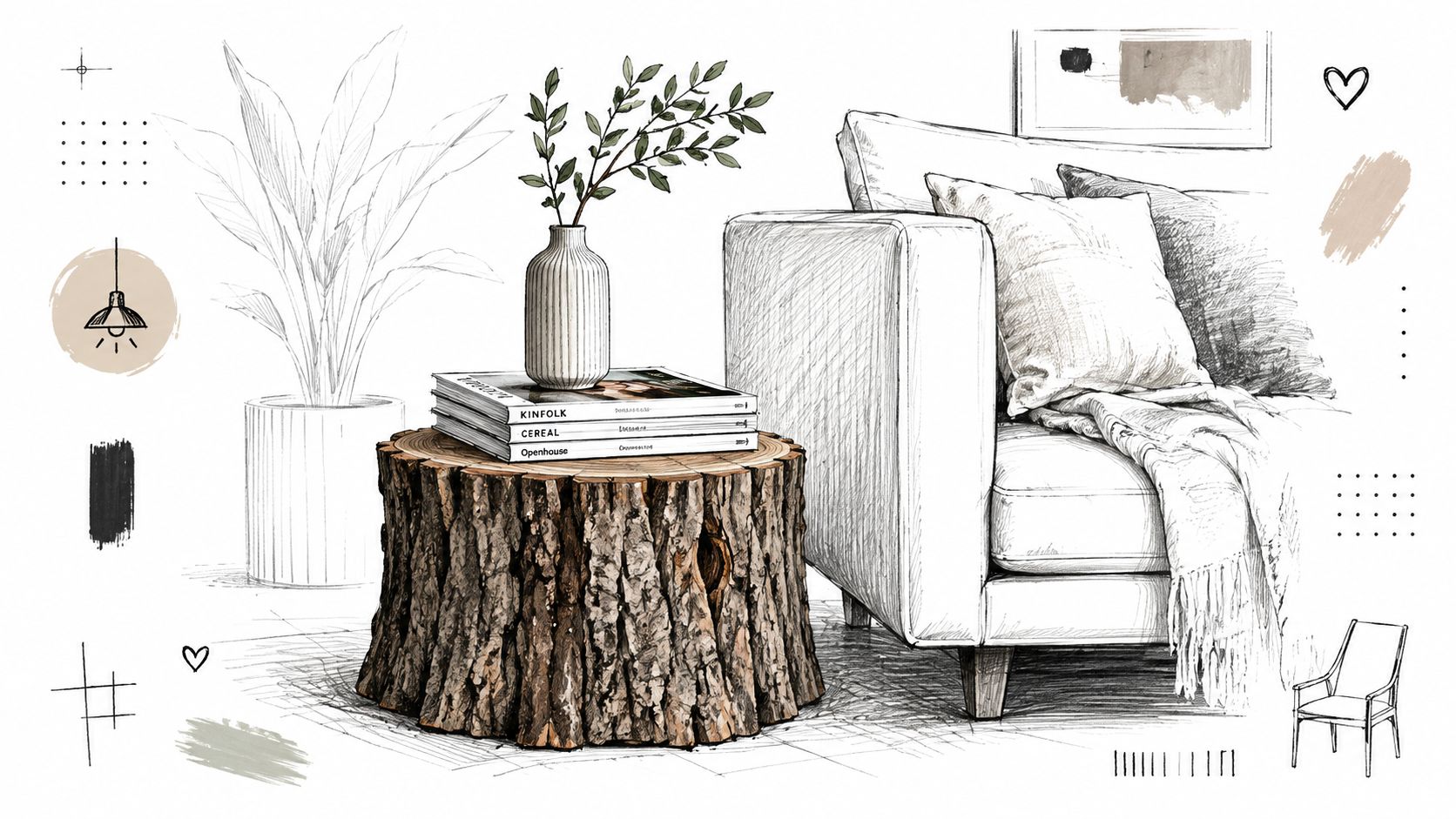
In a living room, a stump accent works best near a sectional, beside a chair, or under a lamp where it can echo other natural materials like linen, woven baskets, or warm wood furniture. In an entryway or sunroom, it can hold a vase, a stacked book, or a simple plant without making the space feel busy.
The most reliable formula is contrast. Pair a rough-looking stump with smoother pieces, cleaner upholstery, or a glass-and-metal table, and the room feels more composed. If everything in the room is already rustic, the stump will vanish into the background and lose impact.
For a sunroom layout that needs natural texture without visual mess, Lucas Furniture's how to decorate a sunroom page is a useful planning reference.
Outdoor styling that lasts through the season
Outside, fake stump accents work well near patio furniture, planters, fire pits, and garden beds. They should echo the shape language of the space, not fight it. A low stump beside a lounge chair can feel relaxed and useful, while a taller one can anchor a display group near a deck edge.
Color matters more outdoors than many people expect. If the patio already has dark seating and stone tones, a stump with medium bark color usually blends better than a very pale one. If the surrounding space is green-heavy, the stump should stay visually quiet and let the plants do the talking.
For compact displays, a bonsai-style stand can help a faux stump or plant grouping feel more deliberate. The bonsai tree outdoor stands guide is a useful cue for keeping the base proportionate and stable.
Buying Guide and Local Sourcing in Central Indiana
A smart buyer starts with three checks, height, realism, and purpose. A stump that is too light shifts around and feels cheap. A stump that is too heavy becomes a pain to move, clean, or restage.
What to inspect before buying
Start with the finish. Texture should read as believable from normal viewing distance, not only in product photos. Color should also sit comfortably with the room's flooring, furniture, or patio materials instead of fighting them.
Size options matter just as much. Standard 6, 12, 18, and 25 inch heights give buyers predictable placement choices, and custom sizing helps when the stump has to fit under a window, beside a sofa, or inside a tight garden layout. For a broader look at proportion and outdoor placement, Lucas Furniture's outdoor furniture buying guide is a practical starting point.
Shoppers in Lafayette should see pieces in person whenever possible. Online photos can hide awkward proportions, glossy finishes, or surfaces that feel too artificial once the piece is in the room. A local showroom also makes it easier to compare the stump with nearby furniture and accessories before you commit.
Lucas Furniture & Mattress has operated since 2002 and serves Kokomo, Lafayette, and Central Indiana, with a main showroom in Kokomo at 96 West 300 South and a Lafayette showroom at 3210 Builder Dr, Lafayette, IN 47909. The retailer also says its Kokomo showroom is 35,000 square feet, and it provides in-home delivery to the Lafayette area. Central Indiana showroom details That matters because a faux stump should be judged as part of the full room plan, not as a standalone object.
For shoppers who already have a real stump in the yard and want it gone before they style the space, the Pool & Landscaping of Vistancia stump guide is a useful reference. A clean site gives you more freedom to choose the right faux piece and place it where it works.
DIY Alternatives and Safety Considerations
DIY fake stumps look easy online, but the trade-offs show up after the piece has to move, survive weather, or support weight. Spray foam, paper mache, and concrete mortar can all create convincing shapes, yet each one brings a different set of problems that buyers should think through before starting.
Where DIY goes wrong
Spray foam is light and simple to shape, but it needs proper ventilation and a careful finish if it's going to hold up. Paper mache can create a surprisingly natural silhouette, but it's better for indoor display than for a stool or anything exposed to moisture. Concrete mortar can feel the strongest, but it adds weight fast and usually needs internal support if the stump is going to be sat on.
Weather is the part people underestimate. Painted foam and mortar can weather differently depending on moisture, freeze-thaw cycles, and sun exposure, so a piece that looks good on day one may need ongoing maintenance outside. That's why a commercial product often makes more sense for a patio or a high-traffic spot.
If the stump has to survive winter, people stepping on it, or repeated moving, build quality matters more than a clever finish.
A backyard project also needs safe placement. The stump should sit level, stay secured against wind if it's lightweight, and never become a hidden trip hazard near walkways or seating areas. That's especially important in yards where kids, guests, or pets move through the space quickly.
For homeowners considering whether removal or replacement is the issue, the Pool & Landscaping of Vistancia stump guide is a useful reminder that some tree stump problems should be solved before decorative styling begins.
Visit Lucas Furniture for Your Next Home Project
The cleanest answer for Lafayette shoppers is simple. Choose the faux stump that fits the job, then make sure the rest of the room supports it with the right seating, tables, mattress, or outdoor pieces. Lucas Furniture & Mattress makes that easier with a Low Price Promise, simple financing, custom order options, and in-home delivery to Lafayette.
Visit the Kokomo showroom if the goal is to compare textures and room pairings in person, or browse online if convenience matters more. For shoppers who want fake tree stumps, sectionals, mattresses, outdoor furniture, and clearance savings in one local stop, Lucas is the right place to start.
Visit Lucas Furniture & Mattress to explore styles that can ground a living room, patio, or sunroom with the same practical, natural look. Lafayette shoppers can count on the Kokomo showroom, online browsing, and in-home delivery to the Lafayette area when it's time to finish the space the right way.