Experience our new Lafayette showroom — Now Open! Come Visit Us -->

Hybrid Mattress vs Innerspring: Lafayette Buyer’s Guide

A mattress search usually starts the same way in Lafayette. A shopper walks into a Lafayette furniture store or starts browsing online, sees “hybrid,” “innerspring,” “cooling,” “plush,” and “firm,” and quickly realizes that the labels don't explain much. The core question isn't which term sounds newer. It's which mattress will feel right at bedtime, hold up over time, and fit the budget without regret.
For shoppers looking for a furniture store near Lafayette IN, Lucas Furniture & Mattress serves the area from its Kokomo showroom and outlet, with reliable in-home delivery to Lafayette. That matters because mattress shopping is easier when a local team can explain the differences clearly, show the options in person, and deliver the final choice without adding stress. A mattress is part of a bigger home-comfort decision too, especially for families also shopping for a sectional, bedroom set, outdoor furniture, home office pieces, or clearance finds.
Sleep quality also connects to the whole room, not just the bed. Readers interested in creating a mindful bedroom may find that lighting, texture, and layout can support better rest alongside the right mattress choice. For more sleep habits that go beyond the mattress itself, Lucas also offers guidance on how to sleep better at night.
Your Guide to Better Sleep in Lafayette
A new mattress is one of the few home purchases that affects every single day. If the fit is wrong, the body notices it at bedtime, during the night, and again the next morning. That's why the hybrid mattress vs innerspring decision deserves more than a quick lie-down and a glance at the price tag.
For many Lafayette households, the challenge isn't finding a mattress. It's sorting through mattress jargon without getting pulled off course by marketing language. One label says “hybrid,” another says “traditional support,” and both can sound convincing even when the construction is very different.
Why local shoppers often get stuck
Mattress shopping is an infrequent activity. Shoppers remember broad ideas. Innersprings feel familiar. Hybrids sound upgraded. But few shoppers walk in knowing how coil type, padding thickness, and motion control change the experience.
That confusion gets even bigger when the mattress purchase is tied to other priorities:
- Budget pressure: A family may be balancing a mattress purchase with a sectional, dining set, or bedroom upgrade.
- Timing needs: A move, guest room refresh, or child's room update may require fast in-home delivery.
- Whole-home decisions: Many shoppers also want clearance values, simple financing, or a custom order for other rooms while they're buying a mattress.
A mattress isn't just a product category. It's a long-term comfort choice that affects daily life more than almost any other furniture purchase.
Why the showroom still matters
Photos help, but mattresses have to be felt. A Kokomo showroom that serves Lafayette gives shoppers a chance to compare support, bounce, pressure relief, and edge feel side by side. That makes it easier to judge whether a mattress feels stable, soft, springy, or too firm before it comes home.
That same trip often helps with broader home projects too. A shopper may come in for a mattress and also look at outdoor furniture, a new recliner, a home office desk, or clearance bedroom pieces. That's often more practical than making separate trips across different stores.
Deconstructing the Differences Hybrid vs Innerspring
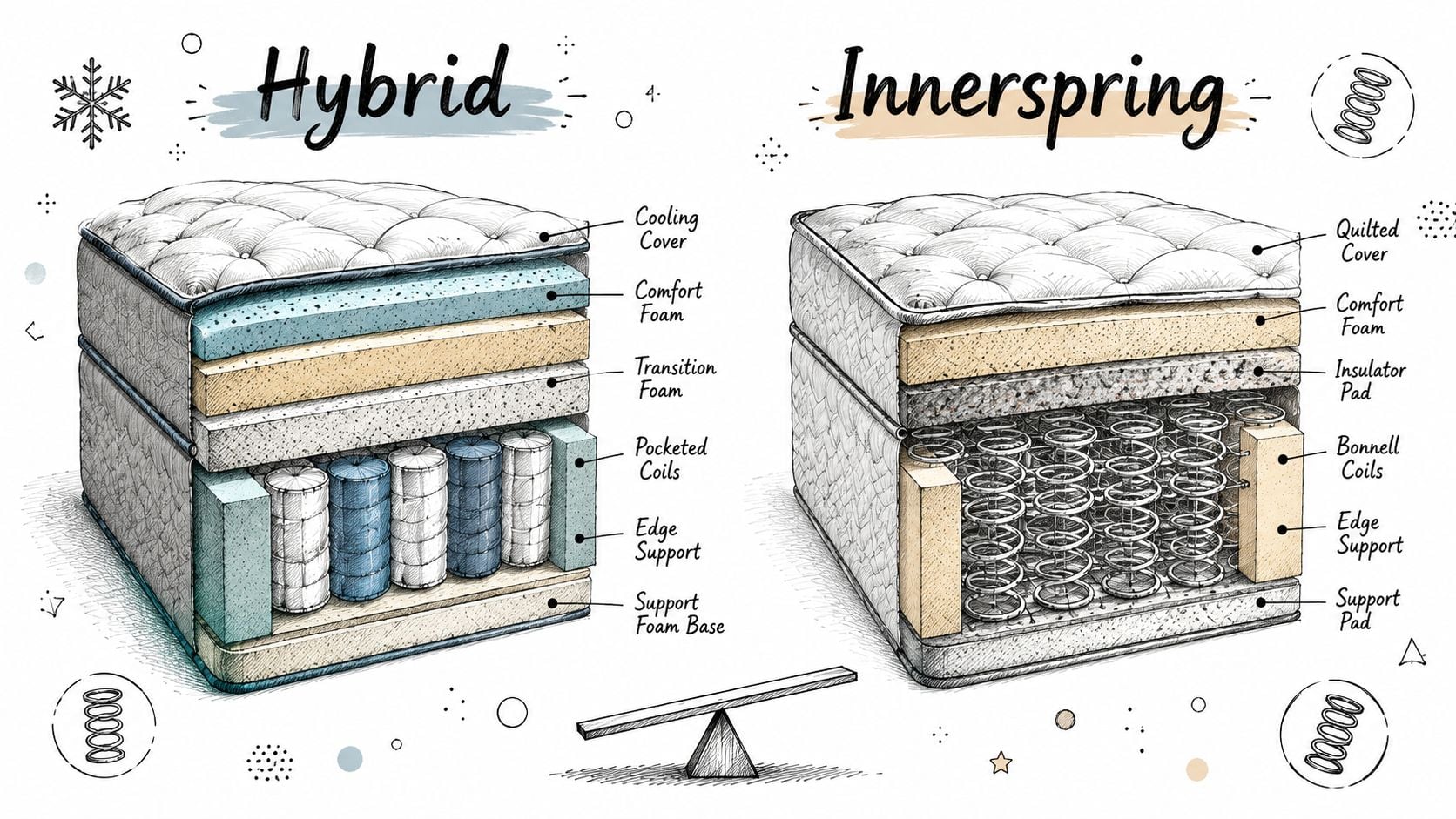
The simplest way to understand hybrid mattress vs innerspring is to look inside the mattress. From the outside, both can appear similar. Inside, they're built for different results.
Here is a quick side-by-side comparison.
| Feature | Hybrid mattress | Innerspring mattress |
|---|---|---|
| Core construction | Pocketed coils with thicker comfort layers | Coil system with thinner comfort layers |
| Typical comfort material | Foam or latex over coils | Minimal padding over coils |
| Feel | Balanced cushioning and support | More traditional bounce |
| Motion control | Better at absorbing movement | More movement travels across the bed |
| Best fit for many shoppers | Couples, side sleepers, combo sleepers | Shoppers who want a firmer, classic spring feel |
What makes a hybrid a hybrid
A true hybrid blends two systems. It uses coils for support and a thicker comfort layer for cushioning near the surface. According to Mattress Clarity's breakdown of hybrid vs innerspring construction, the primary technical distinction lies in coil type and comfort layer thickness: hybrids almost exclusively use pocketed coils with at least 2+ inches of comfort material, whereas innersprings often use continuous interconnected coils with less than 2 inches of padding.
That sentence matters because it clears up two common points of confusion.
First, pocketed coils move more independently. They don't pull the whole surface along with them the way connected coils can. Second, 2 inches or more of comfort material gives the top of the mattress a different job. It cushions shoulders, hips, and curves instead of serving as a cover for the springs.
Lucas has a helpful resource for shoppers who want a plain-language look at these categories in more depth through its guide to mattress types explained.
What defines a traditional innerspring
An innerspring keeps the focus on the spring unit. It usually has thinner padding on top and a more uniform, lifted feel. Many people describe that as sleeping “on” the mattress rather than “in” it.
A simple analogy helps. An innerspring is closer to a basic sedan. It does the job, feels familiar, and keeps the ride straightforward. A hybrid is closer to a modern crossover. It still has structure underneath, but the ride is tuned for more cushioning and control.
Practical rule: If a shopper wants to know what the mattress will feel like, the first question shouldn't be “What's the brand?” It should be “What kind of coils are inside, and how thick is the comfort layer?”
The Feel Factor Comfort and Pressure Relief
Construction only matters because it changes the feel. At this point, shoppers usually stop thinking like product researchers and start thinking like sleepers. What happens to the shoulders, hips, lower back, and knees after several hours in one position?
Why side sleepers often lean toward hybrids
Side sleeping puts more pressure on the shoulders and hips. A mattress that feels fine for one minute in a showroom can feel too sharp or rigid by the middle of the night if it doesn't cushion those points well. Hybrids tend to do a better job here because the thicker upper layers soften the surface before the sleeper reaches the coils.
That doesn't mean every hybrid feels plush. Some feel medium-firm. Some feel firmer and more lifted. The difference is that the top section usually has enough depth to contour more than a standard innerspring.
Shoppers focused on body relief can also compare features in Lucas's guide to the best mattress for pressure relief.
Why some sleepers still prefer innerspring
Not everyone wants contouring. Some people want a flatter, firmer, springier surface that makes position changes easy. That's often where innersprings still make sense.
This pattern shows up often by sleep position:
- Side sleepers: Often prefer more cushioning around hips and shoulders.
- Back sleepers: Often like a balance between support and surface comfort.
- Stomach sleepers: Often prefer a firmer, more level feel that doesn't let the midsection sink too far.
- Combination sleepers: Often want some bounce for easy movement, with enough comfort to avoid pressure buildup.
A useful way to think about it is comfort versus resistance. A hybrid usually gives more contour first, then support underneath. An innerspring usually gives support first, with less contour on top.
If a shopper regularly wakes with sore shoulders or hips, the issue may not be “mattress quality.” It may be that the mattress surface doesn't redistribute pressure well enough for that sleep style.
There's also a simple household comparison that helps. Pet owners often notice that cushioned, pressure-relieving support matters in animal beds too, especially when older pets need gentler surfaces. This guide to memory foam for dogs is useful because it shows the same basic idea in a simpler form: thicker cushioning changes how weight is distributed across pressure points.
Solving for Co-Sleepers and Hot Sleepers
Sharing a mattress changes the buying decision fast. A bed that feels fine for one person can become frustrating when one sleeper tosses, turns, gets up early, or sleeps warmer than the other.
Motion transfer and restless partners
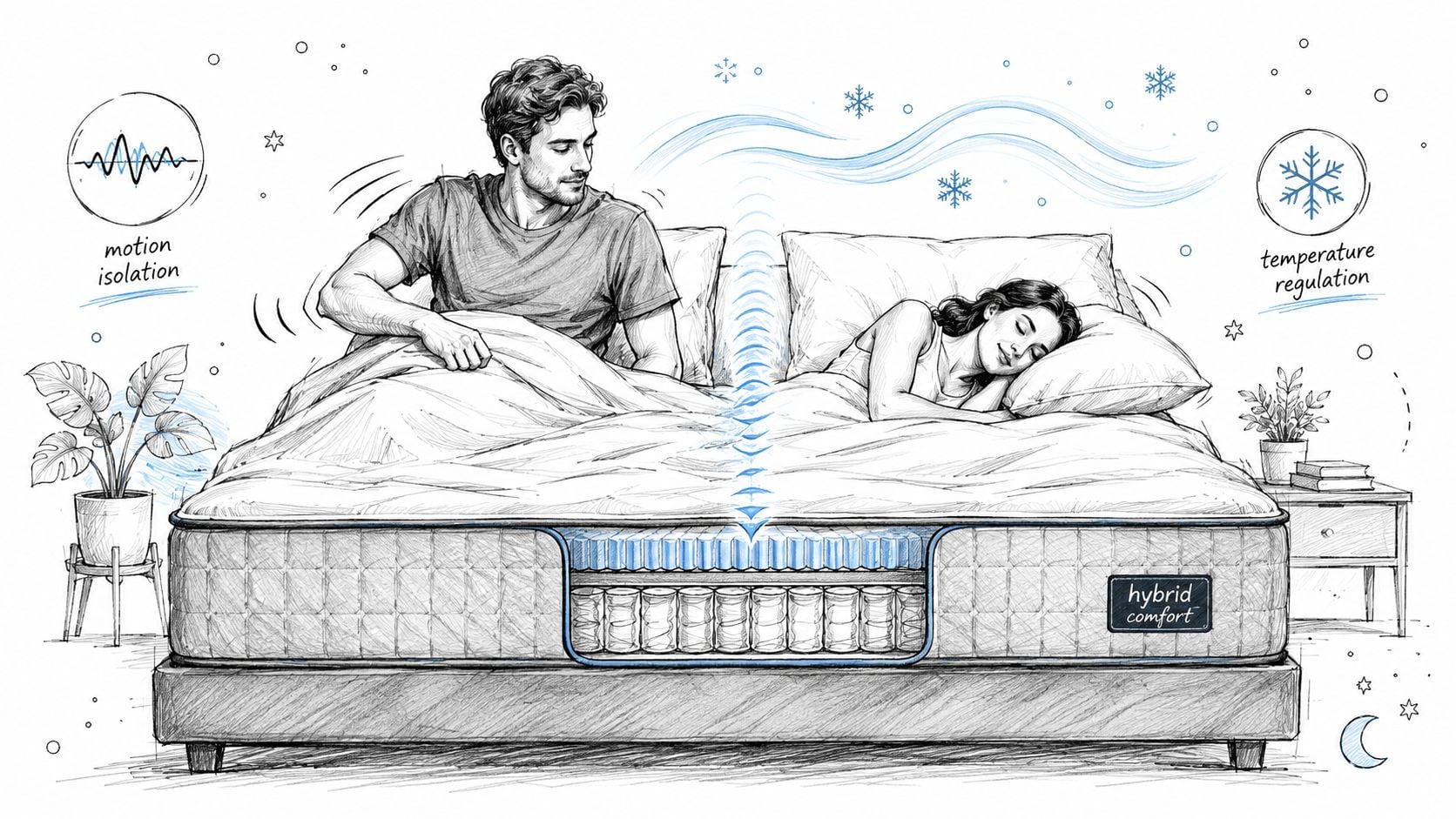
For couples, one of the biggest differences in hybrid mattress vs innerspring is how much movement travels across the surface. According to Sleep Reviews' comparison of sleep quality across mattress types, hybrid mattresses provide superior motion isolation by reducing motion transfer by up to 90% compared to traditional innerspring coils, a critical factor for co-sleepers with restless partners.
That's a practical benefit, not a technical one. If one partner changes position, the other is less likely to feel a ripple through the mattress. Families in Central Indiana often notice this most when one sleeper keeps irregular hours or gets up with children during the night.
Shoppers comparing shared-sleep comfort can use Lucas's guide to the best mattress for couples with different preferences.
Cooling and summer comfort
Hot sleeping creates a different kind of confusion. Many shoppers assume innerspring always wins on temperature. Traditional innersprings do have a naturally open structure, and that can help airflow. But the answer isn't quite that simple.
Pocketed-coil hybrids still allow air to move through the support core, and some are designed to address heat more effectively than older foam-heavy models. The key is balance. A shopper who needs pressure relief but also sleeps warm may not need to settle for a basic spring feel just to avoid overheating.
One caution is worth noting here. The comfort layers in hybrids can change surface warmth. In some builds, thicker foam can make the top feel warmer than a thinner, more basic mattress surface. That's one reason two hybrids can feel very different in the showroom.
A couple shopping in summer shouldn't ask only, “Is this cooling?” A better question is, “How does this mattress handle body heat, movement, and pressure at the same time?”
Your Investment Long-Term Durability and Lifespan
The cheapest mattress isn't always the least expensive choice over time. A better way to judge value is to ask how long the mattress is likely to stay comfortable and supportive before replacement becomes necessary.
How lifespan affects value
According to Tip Top Furniture's comparison of hybrid and innerspring durability, hybrid mattresses typically last 7–10 years, significantly outpacing traditional innerspring mattresses that average 5–7 years in lifespan. This durability advantage stems from hybrid construction, which features at least 2 inches of foam comfort layers over pocketed coils.
That difference matters for a practical reason. Mattress replacement is disruptive. It means another shopping trip, another delivery window, another expense, and another round of adjusting to a new sleep surface. If a mattress holds comfort and structure longer, that extra time has real value for a household budget.
Looking past the sticker price
The same source notes that hybrids often come with a higher upfront cost, while innersprings are usually more budget-friendly at purchase. That can make innersprings appealing for guest rooms, temporary setups, or shoppers who want to keep the initial spend lower.
But many value-conscious shoppers in Central Indiana look at the purchase a different way:
- Short-term savings: A lower initial price may make sense for a lightly used room.
- Longer-use households: A primary bedroom usually benefits more from durability.
- Comfort retention: Lasting support matters if the mattress is used every night.
Lucas offers additional guidance for shoppers thinking in long-term terms through its article on how long mattresses last.
The better value isn't always the one with the smallest receipt today. It's the mattress that still feels supportive years later, without forcing an early replacement.
There is one nuance worth keeping in mind. Layered mattresses can have more than one place where wear shows up. A coil unit may still be sound while upper foam layers begin to show impressions. That doesn't make hybrids a poor choice. It just means shoppers should pay attention to overall construction quality, not only the label on the tag.
The 'False Hybrid' Trap and How to Avoid It
This is the part of mattress shopping that frustrates many informed buyers. The word “hybrid” sounds precise, but in practice, it isn't tightly controlled. That creates a gap between what shoppers think they're buying and what may be inside the mattress.

Why the label can mislead shoppers
According to Avocado Green Mattress's explanation of hybrid vs innerspring definitions, the term 'hybrid' is unregulated, allowing manufacturers to label mattresses with only 0.5 inches of foam as hybrids, while true performance hybrids require at least 2 inches of foam over pocketed coils to deliver meaningful pressure relief and motion isolation.
That's a major issue because shoppers often pay more for the word “hybrid” expecting a certain feel and performance. If the mattress barely has any comfort material and uses the wrong coil design, it may behave much more like a basic innerspring.
How to spot a pseudo-hybrid
A shopper doesn't need to memorize technical diagrams to avoid the trap. A few clear questions usually expose the difference.
- Ask about coil type: If the mattress doesn't use pocketed coils, that's a warning sign.
- Ask how much comfort material sits above the coils: A true performance hybrid should have enough depth to cushion pressure points.
- Test for feel, not label: If the mattress feels flat, rigid, and highly reactive across the whole surface, the “hybrid” name may be doing more work than the design.
- Request construction details: A transparent showroom should be able to explain what's inside without vague language.
One more point often helps shoppers stay grounded. A mattress tag is not a comfort guarantee. Materials matter more than category names, and category names matter more when they're backed by honest specifications.
The safest approach is simple. Shop by construction first, by feel second, and by marketing label last.
This is one reason a knowledgeable showroom team matters. A shopper who understands the difference between a real hybrid and a pseudo-hybrid can compare models with more confidence and avoid paying premium pricing for a mattress that won't deliver premium performance.
Shop Smart at Our Furniture Store Near Lafayette IN
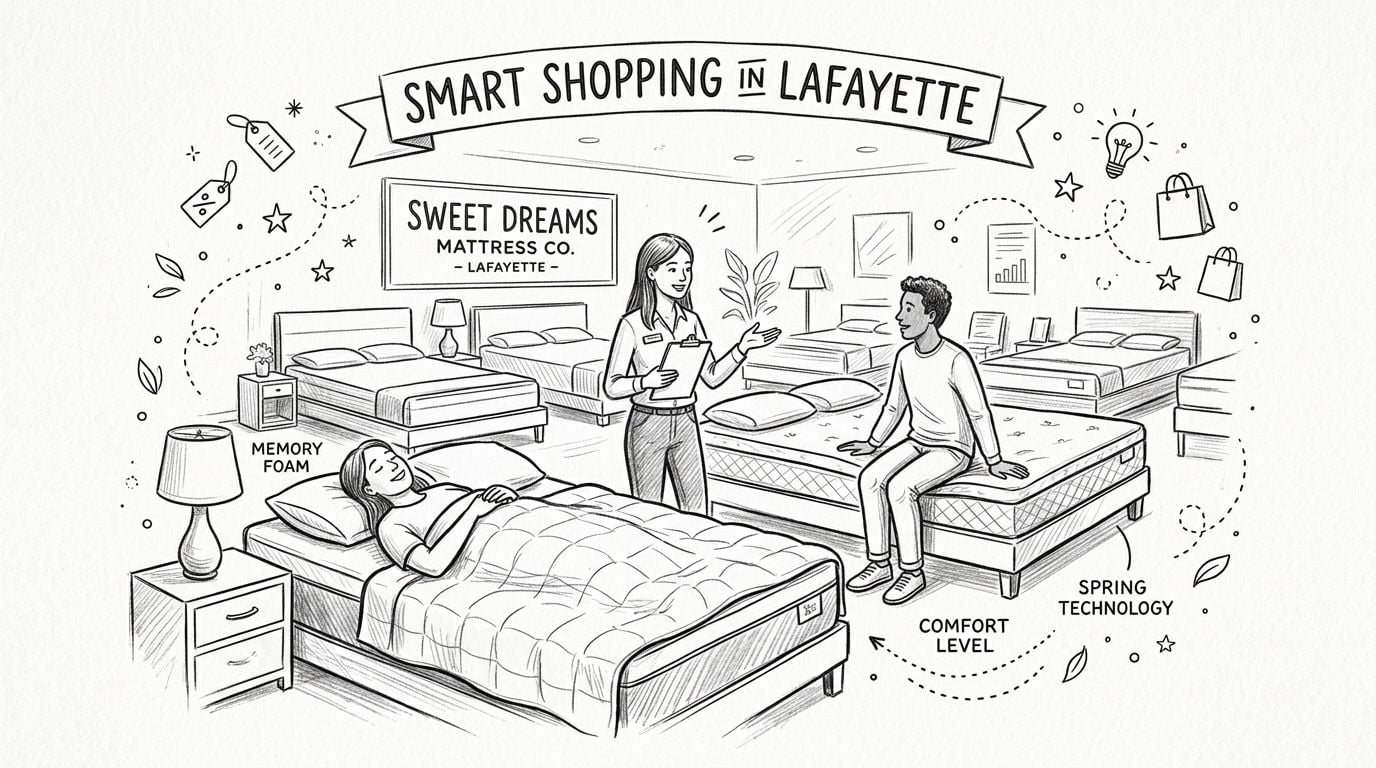
Once the terminology is clear, the showroom visit becomes much easier. A shopper no longer has to guess what “hybrid” or “innerspring” means. The focus shifts to testing the mattress properly and making a decision that fits the home, the budget, and the sleep style.
How to test a mattress in person
A quick sit on the edge isn't enough. Better testing usually looks like this:
- Lie down in the usual sleep position. Side sleepers should spend real time on one shoulder and hip. Back and stomach sleepers should check whether the body feels level.
- Change positions naturally. This helps reveal whether the surface feels easy to move on or too rigid.
- Notice the edge. A shopper who sits on the side of the bed to get dressed or tie shoes should check how stable the perimeter feels.
- Bring the partner if possible. Motion and comfort are easier to judge together than separately.
Why a whole-home stop can make sense
Many Lafayette shoppers aren't only replacing a mattress. They may also be furnishing a bedroom, updating a living room, or planning a move. That's why a store visit can be more efficient when it includes more than one category.
A strong local showroom can help shoppers compare:
- Mattress options: For primary bedrooms, kids' rooms, and guest spaces
- Living room pieces: Sofas, recliners, and sectionals
- Dining and home office furniture: Useful for full-room refreshes
- Outdoor furniture: Helpful for patios and decks during the season
- Clearance selections: Worth checking for outlet savings and room-by-room value
Shoppers who want flexibility can also explore our flexible financing options, browse current clearance furniture savings, and review in-home delivery to the Lafayette area. Those tools matter when a household is balancing mattress needs with a custom order, a bedroom set, or a sectional purchase at the same time.
A good local furniture experience should make the process feel easier, not more confusing. That includes clear explanations, simple financing, dependable delivery, strong customer reviews, and a store team that treats questions seriously instead of rushing the decision.
Visit Lucas Furniture & Mattress, a trusted locally owned furniture store near Lafayette IN serving Central Indiana from the Kokomo showroom and outlet. Shoppers can explore mattresses, sectionals, bedroom sets, dining, home office, outdoor furniture, custom order options, simple financing, and clearance savings with the Low Price Promise and reliable in-home delivery to Lafayette. Visit our showroom near Lafayette today, or browse our full inventory online with guaranteed in-home delivery to the Lafayette area!